


.avif)


.avif)
.avif)
.avif)
.avif)


















.avif)







TOPIC
Global Economy
3
articles
Contrary to optimistic stock market signals, global economic troubles are intensifying, especially in the U.S. and China, with looming challenges in public finance and property markets, per commentary from American Enterprise Institute.
Contrary to optimistic stock market signals, global economic troubles are intensifying, especially in the U.S. and China, with looming challenges in public finance and property markets, per commentary from American Enterprise Institute.
The issue:
The world economy faces significant challenges as the U.S. public finances are on an unsustainable path, with a projected budget deficit above six percent of GDP for years. China is also suffering from a housing bubble collapse, resulting in slower growth and declining property values.
What they recommend:
No recommendations provided in the commentary.
Go deeper:
The potential for a trade war initiated by the incoming Trump administration could severely impact both the U.S. and Chinese economies, further escalating tensions. In Europe, existing economic weaknesses, particularly in Germany and Italy, coupled with political dysfunction, could spark another Eurozone debt crisis. This complex landscape raises questions about the current high stock market valuations, echoing historical instances where markets failed to predict economic turmoil.
This is a brief overview of a blog from American Enterprise Institute. For complete insights, we recommend reading the full blog.

Contrary to optimistic stock market signals, global economic troubles are intensifying, especially in the U.S. and China, with looming challenges in public finance and property markets, per commentary from American Enterprise Institute.

Trump's threatened tariffs could lead to significant economic harm for the U.S., Canada, Mexico, and China. These tariffs, if implemented, threaten to slow economic growth and increase inflation across all involved nations, per commentary from Peterson Institute for International Economics.
Trump's proposed tariffs on Mexico, Canada, and China could harm all involved economies, including the US. These measures aim to tackle illegal immigration and drug flows, according to a commentary by experts at Peterson Institute for International Economics.
The issue:
Trump intends to impose a 25% tariff on Mexico and Canada and a 10% tariff on China to address illegal immigration and fentanyl trafficking. These tariffs threaten to disrupt highly integrated economies, potentially reducing US GDP by $200 billion and significantly slowing growth in all affected countries.
What they recommend:
Experts advise renegotiating the US-Mexico-Canada Agreement (USMCA) to avoid the economic damage from imposing tariffs. They suggest making concessions within the agreement to address US concerns and prevent the need for tariff imposition.
Go deeper:
The analysis utilizes the G-Cubed model to project extensive GDP losses and increased inflation across the US, Mexico, Canada, and China if the tariffs are implemented. Mexico, heavily reliant on US exports, faces catastrophic economic impacts, potentially exacerbating illegal immigration incentives. Historical patterns indicate that Trump may not follow through on his tariff threats, as seen during his previous administration.
This is a brief overview of the commentary by experts at Peterson Institute for International Economics. For complete insights, we recommend reading the full commentary.
Trump's threatened tariffs could lead to significant economic harm for the U.S., Canada, Mexico, and China. These tariffs, if implemented, threaten to slow economic growth and increase inflation across all involved nations, per commentary from Peterson Institute for International Economics.
.avif)
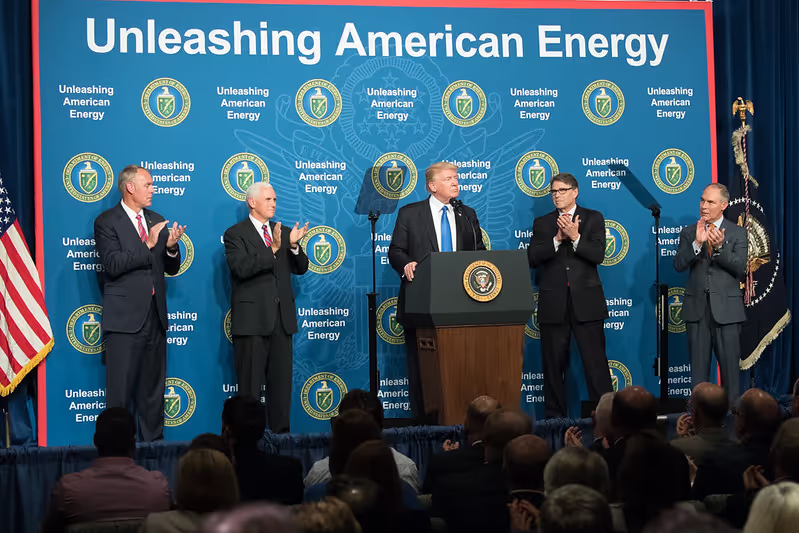
Tariffs on imports from Canada and Mexico could significantly undermine U.S. energy dominance by raising domestic energy prices and disrupting critical supply chains. These actions may drive U.S. trading partners to seek alternatives, diminishing American competitiveness in energy exports, per commentary from Atlantic Council.
Tariffs on imports from Canada and Mexico could significantly undermine U.S. energy dominance by raising domestic energy prices and disrupting critical supply chains. These actions may drive U.S. trading partners to seek alternatives, diminishing American competitiveness in energy exports, per commentary from Atlantic Council.
The issue:
Tariffs on energy imports present a critical challenge for U.S. energy markets, particularly as Canada accounts for about 62% of U.S. crude oil imports, followed by Mexico at approximately 7%. Such tariffs could lead to higher domestic energy costs and retaliatory actions from trading partners.
Go deeper:
With U.S. refineries largely dependent on imported heavy crude, tariffs could spike consumer prices, especially in Midwest states lacking alternative supply options. Additionally, retaliatory tariffs in agricultural products from Mexico could severely impact U.S. natural gas exports, destabilizing domestic prices. The commentary warns that these trade barriers may inadvertently strengthen competitors like China in the energy market.
This is a brief overview of a commentary from Atlantic Council. For complete insights, we recommend reading the full commentary.
Tariffs on imports from Canada and Mexico could significantly undermine U.S. energy dominance by raising domestic energy prices and disrupting critical supply chains. These actions may drive U.S. trading partners to seek alternatives, diminishing American competitiveness in energy exports, per commentary from Atlantic Council.