
Thinktanker Summary
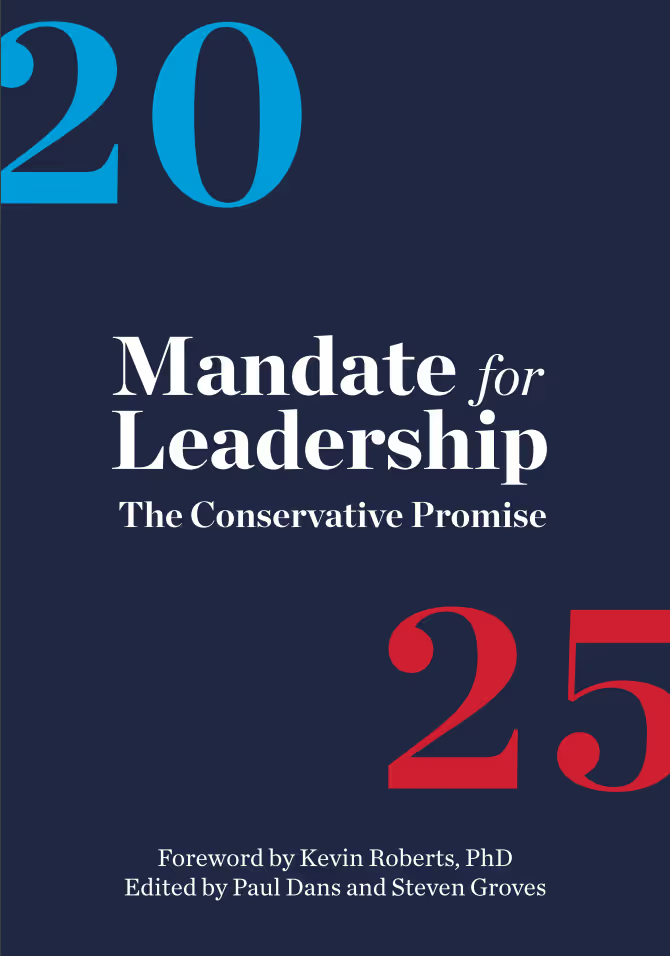
- Brendan Duke at Center for American Progress argues that Project 2025 proposes a tax plan that raises taxes on low- and middle-income families while giving significant tax cuts to the wealthy and corporations.
- The analysis asserts that the introduction of a flat consumption tax and elimination of income taxes would result in higher costs for middle- and low-income households, shifting the tax burden away from wealthy individuals and large corporations.
Overview:
This article was written by Brendan Duke at Center for American Progress.
- The article discusses how Project 2025's tax reform plans would significantly raise taxes on low- and middle-income households while providing substantial tax cuts for the wealthy.
- The proposed tax changes would shift the burden from wealthy individuals and corporations to the middle class and poorer Americans, exacerbating income inequality.
Key Quotes:
- "This is because the two current bottom brackets (10 percent and 12 percent) are lower than the 15 percent tax bracket proposed by Project 2025."
- "The required roughly 45 percent VAT is a lower bound..."
What They Discuss:
- The "intermediate tax reform" proposed by Project 2025 includes consolidating existing tax brackets to two brackets (15 percent and 30 percent), which would result in a $3,000 tax increase for the median family of four and a $950 increase for a typical single-person household.
- The wealthiest 45,000 U.S. households would receive an average tax cut of $1.5–2.4 million due to the plan's restructuring and cuts to taxes on investment income.
- Project 2025 aims to reduce the corporate tax rate from 21 percent to 18 percent, resulting in a $24 billion tax cut for America’s top 100 corporations.
- The long-term plan includes replacing all individual and corporate income taxes with a consumption tax, potentially leading to a 45 percent national sales tax, which would cause a significant rise in prices and inflation.
- The proposed tax changes would disproportionately impact middle-income households, increasing their average tax burden by $5,900, while the top 0.1 percent would see an average tax cut of $2 million.
What They Recommend:
- Brendan Duke recommends a thorough evaluation of Project 2025 to understand its potential impacts on different income groups.
- Policymakers should consider the regressive nature of shifting to a consumption tax and its long-term effects on economic inequality.
- It’s implied that more progressive tax reforms, which include protections and deductions for low- and middle-income families, should be explored instead.
Key Takeaways:
- Project 2025’s tax reform plans would lead to significant tax increases for middle-income households and substantial tax cuts for the wealthiest Americans and corporations.
- The proposed consumption tax, replacing current income taxes, could result in steep price increases and inflation, disproportionately affecting low- and middle-income families.
- These tax reforms could exacerbate economic inequality in the U.S. by shifting the tax burden from the rich to the poorer segments of society.
This is a brief overview of the article by Brendan Duke at Center for American Progress. For complete insights, we recommend reading the full article.
THINK TANK PROFILE
Washington DC
Founded 1916
An influential Washington-based think tank focusing on global security, defense, and economic policy.
Liberal
Leans Right