

.avif)


.avif)
.avif)
.avif)
.avif)
.avif)
















.avif)






TOPIC
2024 U.S. Elections
26
articles


President Trump’s latest tariff plan is under fire from a conservative think tank, which says the math behind it is both flawed and misleading.
President Trump’s latest tariff plan is under fire from a conservative think tank, which says the math behind it is both flawed and misleading.


The U.S. dollar has seen a moderate increase since Donald Trump's election victory, reflecting expectations of fiscal easing and stronger growth. A larger surge in dollar strength may occur if tariffs are imposed on China, potentially leading to significant global financial impacts, per commentary from Brookings.
The U.S. dollar has seen a moderate increase since Donald Trump's election victory, reflecting expectations of fiscal easing and stronger growth. A larger surge in dollar strength may occur if tariffs are imposed on China, potentially leading to significant global financial impacts, per commentary from Brookings.
The issue:
The dollar's rise is influenced by investor expectations of U.S. fiscal policy changes, similar to trends observed after the 2016 election. A potential new phase of dollar strength could emerge with tariffs on China, risking severe depreciation in emerging markets and affecting commodity prices.
What they recommend:
No recommendations provided in the commentary.
Go deeper:
The report highlights a historical precedent from 2018, where U.S. tariffs led to a comparable fall of the yuan against the dollar, affecting global markets negatively. Tariffs could prompt China to buy more U.S. goods, potentially harming countries like Brazil and the EU, which heavily export to China. This dynamic could tighten global financial conditions, increasing risks for the U.S. economy.
This is a brief overview of a commentary from Brookings. For complete insights, we recommend reading the full commentary.
The U.S. dollar has seen a moderate increase since Donald Trump's election victory, reflecting expectations of fiscal easing and stronger growth. A larger surge in dollar strength may occur if tariffs are imposed on China, potentially leading to significant global financial impacts, per commentary from Brookings.
Cutting federal government spending under the Trump administration may harm essential public services, creating significant backlash from citizens. Disruption caused by deep cuts could lead to political repercussions, complicating the government's efficiency goals, per commentary from Brookings.
Cutting federal government spending under the Trump administration may harm essential public services, creating significant backlash from citizens. Disruption caused by deep cuts could lead to political repercussions, complicating the government's efficiency goals, per commentary from Brookings.
The issue:
The federal government’s primary challenge lies in reducing spending without jeopardizing essential services that Americans rely on, such as Social Security and Medicare. Mandatory spending accounts for 66% of the 2022 budget, leaving limited room for cuts in discretionary spending.
What they recommend:
No recommendations provided in the commentary.
Go deeper:
Expert analysis suggests that a drastic reduction in the federal workforce, such as an 80% cut, would severely impair essential services like air traffic control and border security. Historical examples, such as the National Performance Review, highlight the importance of targeted reforms rather than sweeping cuts. Leveraging modern technology and a thorough agency-by-agency review could yield better outcomes without compromising public safety or services.
This is a brief overview of a commentary from Brookings. For complete insights, we recommend reading the full commentary.
Cutting federal government spending under the Trump administration may harm essential public services, creating significant backlash from citizens. Disruption caused by deep cuts could lead to political repercussions, complicating the government's efficiency goals, per commentary from Brookings.
With Donald Trump's potential return to the White House, global partners must adapt to a shift toward an "America First" foreign policy. This approach prioritizes U.S. interests and presents a more unpredictable stance towards international relations, per commentary from Center for Strategic and International Studies.
With Donald Trump's potential return to the White House, global partners must adapt to a shift toward an "America First" foreign policy. This approach prioritizes U.S. interests and presents a more unpredictable stance towards international relations, per commentary from Center for Strategic and International Studies.
The issue:
The core challenge is Trump's transactional view of foreign alliances, where he demands that allies pay their fair share or risk U.S. support. For instance, Trump has stated that nations relying on U.S. defense without adequate financial contributions could face abandonment in crises.
What they recommend:
No recommendations provided in the commentary.
Go deeper:
Trump's policies may create divisions within NATO and affect the dynamics in the Indo-Pacific region, leading to increased tensions among allies. His criteria for evaluating alliances involve trade surpluses and defense spending, categorizing partners into "Safe" and "Danger" zones. Allies not meeting his expectations may face scrutiny and reduced support.
This is a brief overview of a commentary from Center for Strategic and International Studies. For complete insights, we recommend reading the full commentary.
With Donald Trump's potential return to the White House, global partners must adapt to a shift toward an "America First" foreign policy. This approach prioritizes U.S. interests and presents a more unpredictable stance towards international relations, per commentary from Center for Strategic and International Studies.
The world trading system faces significant challenges due to proposed tariffs by the U.S. president, notably a 60% tariff on China. These actions threaten to disrupt global trade and create tensions among member nations, as they debate their responses to this situation, per commentary from Peterson Institute for International Economics.
The world trading system faces significant challenges due to proposed tariffs by the U.S. president, notably a 60% tariff on China. These actions threaten to disrupt global trade and create tensions among member nations, as they debate their responses to this situation, per commentary from Peterson Institute for International Economics.
The issue:
The core challenge is the potential disintegration of the rules-based international trade system, exacerbated by the proposed tariffs. A leadership deficit at the WTO has left member nations unsure about how to address trade imbalances and maintain cooperation.
What they recommend:
No recommendations provided in the commentary.
Go deeper:
The WTO has faced serious institutional problems, including the inability to achieve binding agreements comparable to those established during the Uruguay Round 30 years ago. Without binding dispute resolution mechanisms, there is skepticism about the WTO’s effectiveness in managing future trade conflicts. It is noted that even with a leadership void, there is still hope for a coalition of willing nations to bolster the trading system moving forward.
This is a brief overview of a speech from Peterson Institute for International Economics. For complete insights, we recommend reading the full speech.
The world trading system faces significant challenges due to proposed tariffs by the U.S. president, notably a 60% tariff on China. These actions threaten to disrupt global trade and create tensions among member nations, as they debate their responses to this situation, per commentary from Peterson Institute for International Economics.
Per commentary from Center for American Progress, President-elect Trump faces pressure from corporate lobbyists to prioritize special interests at the expense of public lands. The proposed actions threaten the environmental protections that Trump previously disavowed during his campaign.
Per commentary from Center for American Progress, President-elect Trump faces pressure from corporate lobbyists to prioritize special interests at the expense of public lands. The proposed actions threaten the environmental protections that Trump previously disavowed during his campaign.
The issue:
The Trump administration's management of America's public lands is under scrutiny, as corporate lobbyists propose drastic changes that could benefit private interests. This raises concerns about the long-term impact on healthy ecosystems, local communities, and natural resources.
What they recommend:
No specific recommendations for action on this issue were provided in the report.
Go deeper:
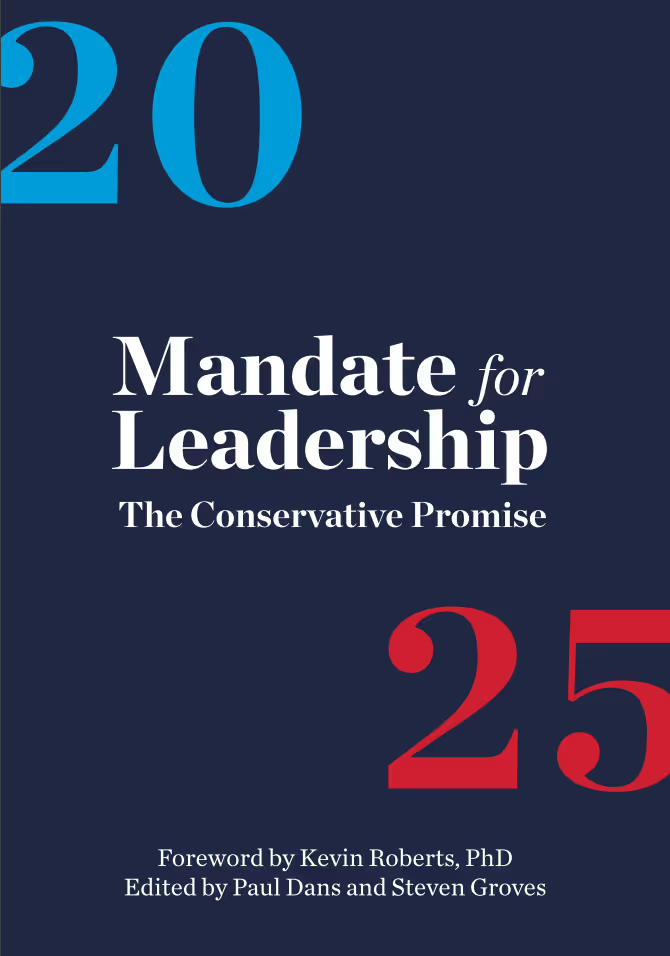
Many of the proposals align with Project 2025, which seeks to overturn critical environmental regulations and increase corporate access to public lands. Historically, public lands have been a vital resource for conservation and recreation, making the potential shift towards privatization a significant concern. The consequences of these actions could set a precedent that undermines environmental protections and public access for generations.
This is a brief overview of a report from Center for American Progress. For complete insights, we recommend reading the full report.
Per commentary from Center for American Progress, President-elect Trump faces pressure from corporate lobbyists to prioritize special interests at the expense of public lands. The proposed actions threaten the environmental protections that Trump previously disavowed during his campaign.
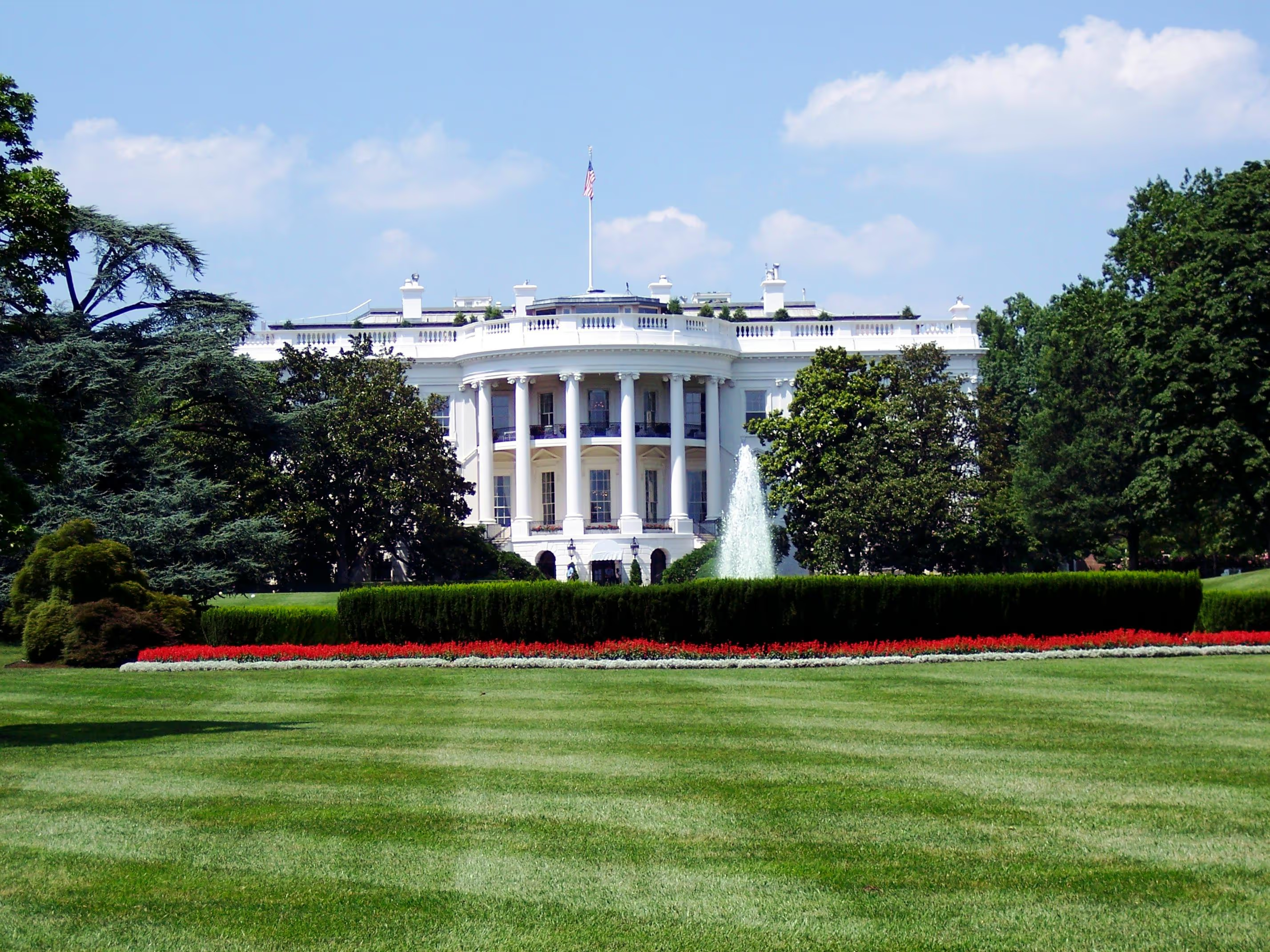
The newly announced Department of Government Efficiency (DOGE), led by Elon Musk and Vivek Ramaswamy, aims to provide strategic recommendations by July 4, 2026, to enhance government efficiency, cut wasteful spending, and leverage technology, including AI, to improve federal agency performance. The American Enterprise Institute (AEI) has preemptively outlined actionable proposals to assist the Trump administration in achieving these objectives.
The Issue:
What They Recommend:
Go Deeper:
The AEI report emphasizes that meaningful fiscal reform is essential to address the country's financial challenges without compromising assistance to vulnerable populations. It suggests that by adjusting key programs and tax policies, the government can enhance economic growth while ensuring fiscal responsibility. The economists behind the proposals advocate for a balanced approach that fosters efficiency and promotes equity.
Conclusion:
This is a brief overview of the article by James Pethokoukis at American Enterprise Institute, published on 2024-11-13. For complete insights, we recommend reading the full article.