
TOPIC

2024 U.S. Elections

26
articles
Count

Feature

Center for Strategic International Studies
The presidential debate accomplished more for Harris than it did for Trump

President Trump’s latest tariff plan is under fire from a conservative think tank, which says the math behind it is both flawed and misleading.

  • Donald Trump focused on separating himself from his party's extreme policies and addressing key voter concerns like the economy and abortion.
Commentary
Leans Left
September 12, 2024
Center for Strategic International Studies

The presidential debate accomplished more for Harris than it did for Trump

President Trump’s latest tariff plan is under fire from a conservative think tank, which says the math behind it is both flawed and misleading.

  • Donald Trump focused on separating himself from his party's extreme policies and addressing key voter concerns like the economy and abortion.
Commentary
Leans Left

More on:

2024 U.S. Elections
Topics
Jan 14, 2024
Trump gained some minority voters, but the GOP is hardly a multiracial coalition
Thinktanker Summary
AI-assisted summary reviewed by Thinktanker. While reasonable care is taken, errors may occur. Refer to the original source text for full accuracy.
  • William H. Frey at Brookings writes that despite claims of a multiracial transformation, Trump's support remains predominantly among white voters, with only modest gains among Latino or Hispanic voters and minimal shifts among Black voters.
  • The analysis asserts that the long-standing racial voting divide persists, with Democrats retaining significant support from Black and Latino or Hispanic voters, questioning any significant transformation of the GOP voter base.

Thinktanker Summary

  • William H. Frey at Brookings writes that despite claims of a multiracial transformation, Trump's support remains predominantly among white voters, with only modest gains among Latino or Hispanic voters and minimal shifts among Black voters.
  • The analysis asserts that the long-standing racial voting divide persists, with Democrats retaining significant support from Black and Latino or Hispanic voters, questioning any significant transformation of the GOP voter base.

Analyses of the 2024 election exit polls suggest that, while President-elect Donald Trump showed a strong performance and garnered some support among minority voters, the Republican Party's base remains predominantly white, and any perceived transformation into a multiracial coalition is likely premature.

The Issue:  

  • Republican-leaning pundits claim Trump's 2024 election success signifies a shift towards a multiracial GOP coalition.
  • Trump's support among white working-class voters, particularly men, continues to be robust, yet his gains among Latino or Hispanic and Black male voters may not reflect a true transformation of the Republican base.
  • The long-standing Democratic preference among Black and Latino or Hispanic voters has largely persisted, with systematic data from elections demonstrating consistent voting patterns over time.
  • Analysis of vote margins indicates Republicans' solid support from white voters across presidential elections since 2000, while both Black and Latino or Hispanic voters show clear Democratic alignment.
  • Variations in minority voting patterns in specific states and demographic groups signify movements that are not comprehensive; they may reflect transient reactions to current socioeconomic conditions, rather than a deep-seated change in partisan alignment.

What They Recommend:  

  • Experts advise caution in interpreting shifts in voting patterns as evidence of an enduring change in the Republican electoral base.
  • Monitoring future elections will be crucial to ascertain if the changes among specific demographic groups are sustainable or short-term fluctuations.
  • Efforts should be directed towards understanding the socioeconomic factors influencing minority voter sentiment and turnout, which may focus on economic conditions and perceptions of party responsiveness.

Go Deeper:  

The analysis utilizes data from Edison Research and AP VoteCast, highlighting demographic compositions of voters for both Trump and Harris in the 2024 election. It underscores the notable racial disparity in voter support and the implications of shifting margins among key demographic groups, particularly emphasizing the importance of context surrounding economic stability and party messaging. The historical trends in electoral outcomes warrant further scrutiny to forecast future voting behaviors accurately.

Conclusion:  

This is a brief overview of the article by William H. Frey at Brookings, published on 2024-11-12. For complete insights, we recommend reading the full article.

Trump gained some minority voters, but the GOP is hardly a multiracial coalition

  • William H. Frey at Brookings writes that despite claims of a multiracial transformation, Trump's support remains predominantly among white voters, with only modest gains among Latino or Hispanic voters and minimal shifts among Black voters.
  • The analysis asserts that the long-standing racial voting divide persists, with Democrats retaining significant support from Black and Latino or Hispanic voters, questioning any significant transformation of the GOP voter base.
Leans Left
Topics
Jan 13, 2024
In Tied Presidential Race, Harris and Trump Have Contrasting Strengths, Weaknesses
Thinktanker Summary
AI-assisted summary reviewed by Thinktanker. While reasonable care is taken, errors may occur. Refer to the original source text for full accuracy.
  • Pew Research Center report shows that the presidential race between Harris and Trump is currently deadlocked, with each candidate receiving 49% support among registered voters. Voters regard Trump as stronger on the economy while Harris is preferred on abortion and personal traits like honesty.
  • The survey asserts that voters are divided on Trump’s actions related to the 2020 election and his age. Additionally, Harris would make history if elected, being the first woman, Asian American, and Black woman president, while Trump would become the oldest person to assume office at 78.

Thinktanker Summary

  • Pew Research Center report shows that the presidential race between Harris and Trump is currently deadlocked, with each candidate receiving 49% support among registered voters. Voters regard Trump as stronger on the economy while Harris is preferred on abortion and personal traits like honesty.
  • The survey asserts that voters are divided on Trump’s actions related to the 2020 election and his age. Additionally, Harris would make history if elected, being the first woman, Asian American, and Black woman president, while Trump would become the oldest person to assume office at 78.

Overview:

This report was published by Pew Research Center. 

  • The presidential race between Vice President Kamala Harris and former President Donald Trump is deadlocked, with 49% of registered voters supporting each candidate.
  • Harris holds considerable advantages in personal traits and issues like abortion, while Trump leads on economic confidence.

Key Quotes:

  • "55% of voters say they are very or somewhat confident in Trump to make good decisions about economic policy, compared with 45% who say that about Harris."
  • "Currently, 61% of voters say the phrase 'mentally sharp' describes Harris very or fairly well, compared with 52% who describe Trump this way."

What They Discuss:

  • The latest national survey highlights the unchanged dynamics of the presidential race and the contrasting strengths and weaknesses of the candidates.
  • Trump leads among White voters (56% to 42%), while Harris garners significant support from Black voters (84% to 13%) and Asian voters (61% to 37%).
  • Economic outlook remains bleak, with only 25% of Americans rating the national economy as excellent or good.
  • The potential historic impact of Harris becoming the first woman, Asian American, and Black woman president, versus Trump potentially becoming the oldest president to take office at 78.
  • Divided opinions on the acceptability of presidential actions, with differences in perspectives on the investigation of political opponents, pardons, and the use of executive orders.

What They Recommend:

  • The article does not specify direct recommendations from the author but implies the importance of understanding voter priorities and candidate strengths in shaping policy and campaign strategies.

Key Takeaways:

  • The race is highly competitive, with both candidates bringing distinctive strengths to the table.
  • Voters have varying degrees of confidence in the candidates' capabilities, influenced by personal traits and issue-specific stances.
  • The economic outlook and demographic preferences play crucial roles in voter support.
  • The potential impacts of the candidates’ demographic characteristics and public perceptions of their actions are significant factors.
  • The presidential actions and the candidates' pasts, including divisive issues like Trump’s role in the 2020 election and fraud charges, heavily influence voter opinions.

This is a brief overview of the report by Pew Research Center. For complete insights, we recommend reading the full article.
In Tied Presidential Race, Harris and Trump Have Contrasting Strengths, Weaknesses

  • Pew Research Center report shows that the presidential race between Harris and Trump is currently deadlocked, with each candidate receiving 49% support among registered voters. Voters regard Trump as stronger on the economy while Harris is preferred on abortion and personal traits like honesty.
  • The survey asserts that voters are divided on Trump’s actions related to the 2020 election and his age. Additionally, Harris would make history if elected, being the first woman, Asian American, and Black woman president, while Trump would become the oldest person to assume office at 78.
Nonpartisan
Topics
Jan 13, 2024
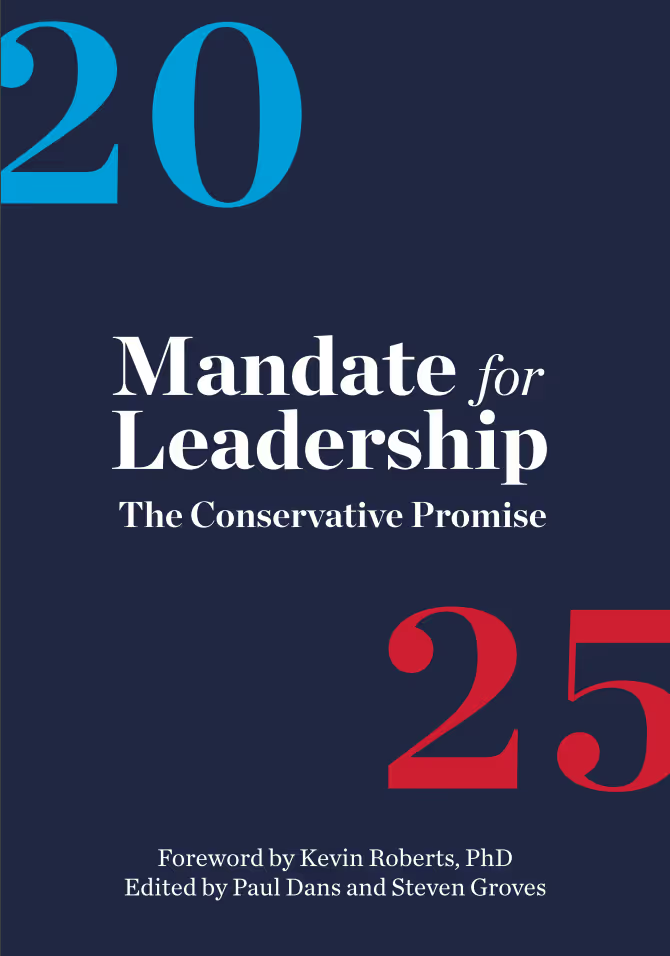
Project 2025’s Tax Plan Would Raise Taxes on the Middle Class and Cut Taxes for the Wealthy
Thinktanker Summary
AI-assisted summary reviewed by Thinktanker. While reasonable care is taken, errors may occur. Refer to the original source text for full accuracy.
  • Brendan Duke at Center for American Progress argues that Project 2025 proposes a tax plan that raises taxes on low- and middle-income families while giving significant tax cuts to the wealthy and corporations.
  • The analysis asserts that the introduction of a flat consumption tax and elimination of income taxes would result in higher costs for middle- and low-income households, shifting the tax burden away from wealthy individuals and large corporations.

Thinktanker Summary

  • Brendan Duke at Center for American Progress argues that Project 2025 proposes a tax plan that raises taxes on low- and middle-income families while giving significant tax cuts to the wealthy and corporations.
  • The analysis asserts that the introduction of a flat consumption tax and elimination of income taxes would result in higher costs for middle- and low-income households, shifting the tax burden away from wealthy individuals and large corporations.

Overview:  

This article was written by Brendan Duke at Center for American Progress.  

  • The article discusses how Project 2025's tax reform plans would significantly raise taxes on low- and middle-income households while providing substantial tax cuts for the wealthy.
  • The proposed tax changes would shift the burden from wealthy individuals and corporations to the middle class and poorer Americans, exacerbating income inequality.

Key Quotes:

  1. "This is because the two current bottom brackets (10 percent and 12 percent) are lower than the 15 percent tax bracket proposed by Project 2025."
  2. "The required roughly 45 percent VAT is a lower bound..."

What They Discuss:

  • The "intermediate tax reform" proposed by Project 2025 includes consolidating existing tax brackets to two brackets (15 percent and 30 percent), which would result in a $3,000 tax increase for the median family of four and a $950 increase for a typical single-person household.
  • The wealthiest 45,000 U.S. households would receive an average tax cut of $1.5–2.4 million due to the plan's restructuring and cuts to taxes on investment income.
  • Project 2025 aims to reduce the corporate tax rate from 21 percent to 18 percent, resulting in a $24 billion tax cut for America’s top 100 corporations.
  • The long-term plan includes replacing all individual and corporate income taxes with a consumption tax, potentially leading to a 45 percent national sales tax, which would cause a significant rise in prices and inflation.
  • The proposed tax changes would disproportionately impact middle-income households, increasing their average tax burden by $5,900, while the top 0.1 percent would see an average tax cut of $2 million.

What They Recommend:

  • Brendan Duke recommends a thorough evaluation of Project 2025 to understand its potential impacts on different income groups.
  • Policymakers should consider the regressive nature of shifting to a consumption tax and its long-term effects on economic inequality.
  • It’s implied that more progressive tax reforms, which include protections and deductions for low- and middle-income families, should be explored instead.

Key Takeaways:

  • Project 2025’s tax reform plans would lead to significant tax increases for middle-income households and substantial tax cuts for the wealthiest Americans and corporations.
  • The proposed consumption tax, replacing current income taxes, could result in steep price increases and inflation, disproportionately affecting low- and middle-income families.
  • These tax reforms could exacerbate economic inequality in the U.S. by shifting the tax burden from the rich to the poorer segments of society.

This is a brief overview of the article by Brendan Duke at Center for American Progress. For complete insights, we recommend reading the full article.

Project 2025’s Tax Plan Would Raise Taxes on the Middle Class and Cut Taxes for the Wealthy

  • Brendan Duke at Center for American Progress argues that Project 2025 proposes a tax plan that raises taxes on low- and middle-income families while giving significant tax cuts to the wealthy and corporations.
  • The analysis asserts that the introduction of a flat consumption tax and elimination of income taxes would result in higher costs for middle- and low-income households, shifting the tax burden away from wealthy individuals and large corporations.
Progressive
Topics
Jan 14, 2024
The presidential debate accomplished more for Harris than it did for Trump
Center for Strategic International Studies
Thinktanker Summary
AI-assisted summary reviewed by Thinktanker. While reasonable care is taken, errors may occur. Refer to the original source text for full accuracy.

President Trump’s latest tariff plan is under fire from a conservative think tank, which says the math behind it is both flawed and misleading.

  • Donald Trump focused on separating himself from his party's extreme policies and addressing key voter concerns like the economy and abortion.

Thinktanker Summary

President Trump’s latest tariff plan is under fire from a conservative think tank, which says the math behind it is both flawed and misleading.

  • Donald Trump focused on separating himself from his party's extreme policies and addressing key voter concerns like the economy and abortion.

Overview: 

This article was written by William A. Galston and Elaine Kamarck at Brookings. 

  • Kamala Harris used the debate to introduce herself to voters, emphasizing her middle-class background and experience as a prosecutor.
  • Donald Trump focused on separating himself from his party's extreme policies and addressing key voter concerns like the economy and abortion.

Key Quotes:

  • “From the very first minutes of the debate, it was clear that she knew she had to define herself and that she did—as a child of the middle class who, in contrast to Trump, was not given $400 million to start a business.”
  • “Trump tried to distance himself from the extremes, arguing that he would approve of abortions for rape and incest and even going so far as to say the Florida six-week ban is too short.”

What They Discuss:

  • Kamala Harris faced three main challenges: introducing herself to unfamiliar voters, explaining her shifting positions on key issues, and proving her capability to serve as president.
  • Harris consistently brought up her prosecutorial background to counter claims of being weak on crime.
  • Trump needed to convey he wasn't obsessed with conspiracy theories and to appeal to swing voters.
  • Trump’s repeated focus on illegal immigration highlighted a core issue for his campaign but may have limited his broader appeal.
  • Abortion emerged as a particularly controversial topic, with Harris attacking restrictive state policies and Trump attempting to moderate his stance.

What They Recommend:

  • Harris should continue defining herself clearly to voters and emphasize her prosecutorial experience.
  • Trump should stick to script on key issues like the economy and avoid deviating into conspiracy theories.
  • Both candidates need to clarify their positions on contentious issues like abortion and immigration to appeal to undecided voters.

Key Takeaways:

  • Kamala Harris' debate performance likely energized her supporters and further introduced her to voters who didn't know her well.
  • Trump's focus on illegal immigration and attempts to moderate his position on abortion had mixed success in broadening his appeal.
  • The debate could boost Harris' campaign, but the final outcome will depend on continued voter engagement and state-specific efforts.

This is a brief overview of the article by William A. Galston and Elaine Kamarck at Brookings. For complete insights, we recommend reading the full article.

Center for Strategic International Studies

The presidential debate accomplished more for Harris than it did for Trump

President Trump’s latest tariff plan is under fire from a conservative think tank, which says the math behind it is both flawed and misleading.

  • Donald Trump focused on separating himself from his party's extreme policies and addressing key voter concerns like the economy and abortion.
Commentary
Leans Left
Topics
Jan 13, 2024
Trump, Harris, and All the Wrong Ways to Do Tax Reform
Thinktanker Summary
AI-assisted summary reviewed by Thinktanker. While reasonable care is taken, errors may occur. Refer to the original source text for full accuracy.
  • Adam N. Michel at Cato Institute argues that tax policy's prominence in the presidential campaign is due to the impending expiration of the 2017 Tax Cuts and Jobs Act and the candidates' proposals for new special-interest tax breaks that complicate and increase the tax code's complexity.
  • The report asserts that while there is bipartisan support for extending most of the expiring tax cuts, proposed targeted benefits for tips, families, homeowners, domestic production, and seniors will further complicate the tax system and pose significant fiscal challenges.

Thinktanker Summary

  • Adam N. Michel at Cato Institute argues that tax policy's prominence in the presidential campaign is due to the impending expiration of the 2017 Tax Cuts and Jobs Act and the candidates' proposals for new special-interest tax breaks that complicate and increase the tax code's complexity.
  • The report asserts that while there is bipartisan support for extending most of the expiring tax cuts, proposed targeted benefits for tips, families, homeowners, domestic production, and seniors will further complicate the tax system and pose significant fiscal challenges.

Overview:  

This article was written by Adam N. Michel at Cato Institute.  

  • Lawmakers will soon confront the expiration of the 2017 Tax Cuts and Jobs Act.  
  • Both presidential candidates propose extensive new tax breaks, complicating efforts to simplify the tax code.

Key Quotes:  

  • "The prominence of tax policy makes sense. In the first year of the next administration, lawmakers will have to address the automatic expiration of almost all of the 2017 Tax Cuts and Jobs Act."  
  • "Despite the rhetoric, the 2017 tax cut was primarily a tax cut for typical Americans. Over three-quarters (77 percent) of the original tax cut went to individuals, with the largest tax reductions going to the lowest-income taxpayers."

What They Discuss:  

  • Trump and Harris propose tax exemptions for tipped income, risking up to $500 billion in lost revenue over ten years.
  • Both candidates support significant increases in child tax credits, potentially decreasing revenue by trillions of dollars.
  • Harris’s $25,000 subsidy for first-time homeowners could cost over $600 billion, mostly benefiting sellers and banks.
  • Proposals for specific industries, like domestic production incentives, may reduce revenues and revive previously inefficient policies.
  • Exempting Social Security income from taxes, as Trump suggests, could increase the budget deficit by $1.6 trillion over a decade.

What They Recommend:  

  • Maintain and extend the successful broad-based tax cuts from 2017.
  • Avoid new complexity and special-interest tax breaks that undermine the simplified tax code.
  • Focus on comprehensive tax reforms that reduce rates and eliminate targeted subsidies and deductions.
  • Prioritize broad tax relief over hyper-targeted subsidies that skew economic incentives and increase overall tax complexity.

Key Takeaways:  

  • Extending the 2017 tax cuts is broadly supported but costly.
  • Both candidates' proposals for tax breaks risk adding complexity and inequality to the tax system.
  • Increased tax breaks for specific groups could exacerbate deficits and economic disparities.
  • Comprehensive reform is needed to maintain lower tax rates and reduce special-interest provisions.

This is a brief overview of the article by Adam N. Michel at Cato Institute. For complete insights, we recommend reading the full article.

Trump, Harris, and All the Wrong Ways to Do Tax Reform

  • Adam N. Michel at Cato Institute argues that tax policy's prominence in the presidential campaign is due to the impending expiration of the 2017 Tax Cuts and Jobs Act and the candidates' proposals for new special-interest tax breaks that complicate and increase the tax code's complexity.
  • The report asserts that while there is bipartisan support for extending most of the expiring tax cuts, proposed targeted benefits for tips, families, homeowners, domestic production, and seniors will further complicate the tax system and pose significant fiscal challenges.
Libertarian
Topics
Jan 14, 2024
Is Kamala Harris leading Donald Trump in the presidential race?
Thinktanker Summary
AI-assisted summary reviewed by Thinktanker. While reasonable care is taken, errors may occur. Refer to the original source text for full accuracy.
  • Experts at Brookings argue that Kamala Harris has regained lost ground for the Democrats, erasing the "enthusiasm gap" and leading in both national and key swing state polls against Donald Trump.
  • They examine the reliability of poll averages, highlighting historical underestimation of Trump’s support and the necessity for Harris to maintain significant momentum to secure victory.

Thinktanker Summary

  • Experts at Brookings argue that Kamala Harris has regained lost ground for the Democrats, erasing the "enthusiasm gap" and leading in both national and key swing state polls against Donald Trump.
  • They examine the reliability of poll averages, highlighting historical underestimation of Trump’s support and the necessity for Harris to maintain significant momentum to secure victory.

Overview:

This article was written by William A. Galston at Brookings.

  • Kamala Harris has gained substantial ground since replacing Joe Biden as the Democratic nominee, closing the enthusiasm gap and outperforming Trump on key personal attributes.
  • Although Harris currently leads in many critical states, the election remains highly volatile, with polling inaccuracies and unpredictable events potentially influencing the final outcome.

Key Quotes:

  • "In six extraordinary weeks since replacing Joe Biden as the Democratic presidential nominee, Kamala Harris has regained all the ground Biden lost between January and July—and more."
  • "We should also be cautious about concluding that Harris now enjoys a clear lead over Trump. In recent elections, not just individual polls but also poll averages have turned out to be misleading."

What They Discuss:

  • Averages of multiple polls are more reliable than individual polls, with RealClearPolitics and FiveThirtyEight offering different methodologies.
  • Harris's lead in crucial "Blue Wall" states could provide her with the 270 electoral votes needed, but this is not guaranteed.
  • Historical inaccuracy of polls, especially in estimating Trump's support, underscores the need for caution.
  • Polling errors have been more pronounced in key swing states compared to other regions.
  • Issues such as inflation may play a more significant role in voter preferences this election cycle, over issues like abortion.

What They Recommend:

  • Be cautious about relying solely on current poll data, as past inaccuracies have shown.
  • Consider multiple sources and types of polling data to get a more comprehensive view of the race.
  • Stay alert for shifts in campaign dynamics, especially after significant events like debates.

Key Takeaways:

  • Harris's early surge in support does not necessarily secure her victory due to the fluid nature of electoral politics.
  • Polling errors, particularly underestimating Trump’s support, have been significant in past elections.
  • Key issues and voter demographics today may not align perfectly with past election cycles.
  • Election outcomes likely depend on a small number of votes in crucial swing states, making the race highly competitive and unpredictable.

This is a brief overview of the article by William A. Galston at Brookings. For complete insights, we recommend reading the full article.


Is Kamala Harris leading Donald Trump in the presidential race?

  • Experts at Brookings argue that Kamala Harris has regained lost ground for the Democrats, erasing the "enthusiasm gap" and leading in both national and key swing state polls against Donald Trump.
  • They examine the reliability of poll averages, highlighting historical underestimation of Trump’s support and the necessity for Harris to maintain significant momentum to secure victory.
Leans Left

Every think tank. One newsletter.

Your new weekly briefing - curated from America’s top think tanks on Substack.

Your Think Tank Sidecar

Save and curate your own Readlists, create your own Dashboards, and more.
Got it