

Feature


President Trump’s latest tariff plan is under fire from a conservative think tank, which says the math behind it is both flawed and misleading.
- Donald Trump focused on separating himself from his party's extreme policies and addressing key voter concerns like the economy and abortion.


The presidential debate accomplished more for Harris than it did for Trump
President Trump’s latest tariff plan is under fire from a conservative think tank, which says the math behind it is both flawed and misleading.
- Donald Trump focused on separating himself from his party's extreme policies and addressing key voter concerns like the economy and abortion.
More on:
- Elaine Kamarck and William A. Galston at Brookings examine that the Republican National Convention highlighted a stark contrast between a verbose Trump and a struggling Biden, leading to widespread speculation about Biden's potential exit and Kamala Harris's possible rise as the Democratic candidate.
- The article argues that while Trump missed an opportunity to solidify his lead with a long-winded, undisciplined speech, Democratic officials and voters are increasingly viewing Biden as a weakened candidate, potentially paving the way for Harris to step in and challenge Trump's controversial policies.
Thinktanker Summary
- Elaine Kamarck and William A. Galston at Brookings examine that the Republican National Convention highlighted a stark contrast between a verbose Trump and a struggling Biden, leading to widespread speculation about Biden's potential exit and Kamala Harris's possible rise as the Democratic candidate.
- The article argues that while Trump missed an opportunity to solidify his lead with a long-winded, undisciplined speech, Democratic officials and voters are increasingly viewing Biden as a weakened candidate, potentially paving the way for Harris to step in and challenge Trump's controversial policies.
Overview:
This article was written by Elaine Kamarck and William A. Galston at Brookings.
- The article provides a detailed account of the final day of the Republican National Convention (RNC), highlighting the split-screen scenario with Joe Biden and Donald Trump.
- It examines the political implications of Biden's potential exit from the presidential race and Trump's extended, unfocused speech.
Key Quotes:
- "The whole political world was trying to figure out whether Biden was about to exit the stage, just as Trump was returning to it."
- "Trump did not finish his speech until after midnight. By then, much of the energy had drained from the crowd at the convention hall."
What They Discuss:
- Reporters at the RNC in Milwaukee were diverted to cover stories about the Democrats, primed by rumors of Biden's potential exit.
- Democratic figures, including Barack Obama and Nancy Pelosi, have reportedly urged Biden to leave the race, leading Biden to feel "betrayed by his former friends."
- Nearly two-thirds of Democratic voters now want Biden to step down, reflecting growing concerns about his age and capabilities.
- 20 to 30 members of Congress publicly or privately suggested that Biden should consider stepping down.
- Trump's 92-minute speech, the longest since 1972, meandered through various topics, largely repeating grievances and failing to maintain structure.
What They Recommend:
- The authors imply that Democrats need to quickly solidify their candidate to effectively counter Trump's campaign.
- They suggest Vice President Kamala Harris as the likely successor if Biden exits, noting the importance of an energetic and vigorous candidate.
- Democrats should prepare for a potential upheaval in the campaign to improve their chances of victory.
Key Takeaways:
- The RNC showcased a polarized image of the presidential race, with Trump dominating the screen and Biden's potential withdrawal overshadowing proceedings.
- Biden's frailty and growing discontent among Democratic voters and officials may push him to exit the race, likely paving the way for Kamala Harris.
- Trump's long, disorganized speech failed to capitalize on his recent gains, leaving the door open for a strong Democratic challenger.
This is a brief overview of the article by Elaine Kamarck and William A. Galston at Brookings. For complete insights, we recommend reading the full article.
Trump misses a golden opportunity in his acceptance speech
- Elaine Kamarck and William A. Galston at Brookings examine that the Republican National Convention highlighted a stark contrast between a verbose Trump and a struggling Biden, leading to widespread speculation about Biden's potential exit and Kamala Harris's possible rise as the Democratic candidate.
- The article argues that while Trump missed an opportunity to solidify his lead with a long-winded, undisciplined speech, Democratic officials and voters are increasingly viewing Biden as a weakened candidate, potentially paving the way for Harris to step in and challenge Trump's controversial policies.
- Elaine Kamarck at Brookings writes that Joe Biden's endorsement of Kamala Harris for the Democratic Party's nomination is due to her extensive presidential-level vetting, practical time constraints, and her robust political experience.
- The article asserts that Harris' widespread delegate support, substantial financial backing, and the urgent need for party unity and focus on the general election are key reasons for the swift consolidation around her candidacy.
Thinktanker Summary
- Elaine Kamarck at Brookings writes that Joe Biden's endorsement of Kamala Harris for the Democratic Party's nomination is due to her extensive presidential-level vetting, practical time constraints, and her robust political experience.
- The article asserts that Harris' widespread delegate support, substantial financial backing, and the urgent need for party unity and focus on the general election are key reasons for the swift consolidation around her candidacy.
Overview:
This article was written by Elaine Kamarck at Brookings.
- Joe Biden dropped out of the presidential race and endorsed Kamala Harris, who has swiftly consolidated support within the Democratic Party.
- Several factors, including immediate vetting, logistical time constraints, and her qualifications, contributed to the rapid consolidation around Harris's candidacy.
Key Quotes:
- "In order to become vice president in the first place, Harris passed the vetting test, and four years in the White House was plenty of time for any other skeletons in her closet to be outed."
- "Kamala has been in the White House for nearly four full years, she has led delegations overseas, she has listened to classified briefings, she has negotiated with Congress."
What They Discuss:
- The party decided quickly to support Harris due to the lack of time and the extensive vetting she has already undergone as Vice President.
- While proposals for a mini-primary to replace Biden were floated, logistical challenges made this impractical.
- Other potential candidates showed no substantial initiative to run against Harris, such as rallying delegate support.
- Harris’s deep involvement in significant political activities and readiness to assume presidential duties made her the most suitable candidate.
- A swift transition to Harris helps the party focus on the general election, avoiding prolonged uncertainty and disorganization.
What They Recommend:
- Follow existing convention rules to officially nominate Harris, bypassing the need for elaborate new procedures.
- Leverage the already pledged delegate support to formalize the nomination quickly and efficiently.
- Maintain momentum into the general election campaign to capitalize on the current unity and fundraising success.
Key Takeaways:
- Kamala Harris is recognized as the best-prepared candidate to replace Biden, owing to her experience and rapid endorsement from delegates.
- Time constraints and logistical challenges prevented a more drawn-out selection process.
- Unifying behind Harris helps the Democratic Party avoid further chaos and positions it strongly against the Republicans in the upcoming general election.
This is a brief overview of the article by Elaine Kamarck at Brookings. For complete insights, we recommend reading the full article.
Why is Kamala Harris wrapping up the Democratic nomination so quickly?
- Elaine Kamarck at Brookings writes that Joe Biden's endorsement of Kamala Harris for the Democratic Party's nomination is due to her extensive presidential-level vetting, practical time constraints, and her robust political experience.
- The article asserts that Harris' widespread delegate support, substantial financial backing, and the urgent need for party unity and focus on the general election are key reasons for the swift consolidation around her candidacy.

- William H. Frey at Brookings argues that Vice President Kamala Harris's nomination as the Democratic presidential candidate has invigorated the race, with a particular impact on female voters who have historically supported Democratic candidates.
- The analysis reviews that women's votes were crucial in recent elections, highlighting how post-Roe v. Wade changes and Harris’s advocacy on women's issues could lead to a significant voting surge, potentially favoring her in the 2024 election.

Thinktanker Summary
- William H. Frey at Brookings argues that Vice President Kamala Harris's nomination as the Democratic presidential candidate has invigorated the race, with a particular impact on female voters who have historically supported Democratic candidates.
- The analysis reviews that women's votes were crucial in recent elections, highlighting how post-Roe v. Wade changes and Harris’s advocacy on women's issues could lead to a significant voting surge, potentially favoring her in the 2024 election.
Overview:
This article was written by William H. Frey at Brookings.
- Vice President Kamala Harris's nomination as the Democratic presidential candidate has generated significant enthusiasm, particularly among women voters.
- The impact of the women’s vote, especially considering recent historical contexts such as the rejection of the predicted "red wave" in the 2022 midterm elections, will be pivotal in determining the outcome of the 2024 election.
Key Quotes:
- "Now, just weeks after most polls had President Joe Biden trailing his Republican rival Donald Trump, the emergence of Vice President Harris as the Democratic candidate has already injected enthusiasm among many Democrats, especially women."
- "Women’s health, abortion, and reproductive freedom—issues Harris has championed—will once again be leading issues for this election."
What They Discuss:
- Gender differences in presidential voting preferences demonstrate that women have consistently voted more for Democrats than for Republicans since 1984.
- In the 2020 election, women registered positive Democratic-Republican (D-R) margins in key battleground states, contributing significantly to Democratic successes.
- Women have higher voter turnout rates than men, and they have comprised more than half of all voters in recent elections, with a notable 9.7 million more female than male voters in 2020.
- The female electorate is becoming more diverse and highly educated, with increases in Democratic-favorable groups such as white college graduates and minorities and a decline in Republican-favorable groups like white non-college graduates.
- Polls indicated that Harris's candidacy led to a substantial increase in D-R margins among women, signaling a potential increase in Democratic support and turnout.
What They Recommend:
- Emphasize issues critical to women voters, such as women’s health, abortion rights, paid parental leave, and child care, which are likely to garner significant support for Harris.
- Capitalize on the enthusiasm and increased turnout among women voters to boost Democratic performance in the upcoming election.
- Strategically focus on key demographic shifts, particularly the increase in college-educated and minority women, to maximize voter outreach and support.
Key Takeaways:
- Women have historically supported Democratic candidates more than Republican ones, a trend likely to continue with Harris's nomination.
- Higher voter turnout rates among women and shifting demographics favor Democrats, providing a potential advantage in the election.
- Harris’s focus on women's issues and the newfound enthusiasm among female voters could be game-changing factors for the 2024 election.
This is a brief overview of the article by William H. Frey at Brookings. For complete insights, we recommend reading the full article.

Kamala Harris’s chances in November could hinge on a women’s voting surge
- William H. Frey at Brookings argues that Vice President Kamala Harris's nomination as the Democratic presidential candidate has invigorated the race, with a particular impact on female voters who have historically supported Democratic candidates.
- The analysis reviews that women's votes were crucial in recent elections, highlighting how post-Roe v. Wade changes and Harris’s advocacy on women's issues could lead to a significant voting surge, potentially favoring her in the 2024 election.

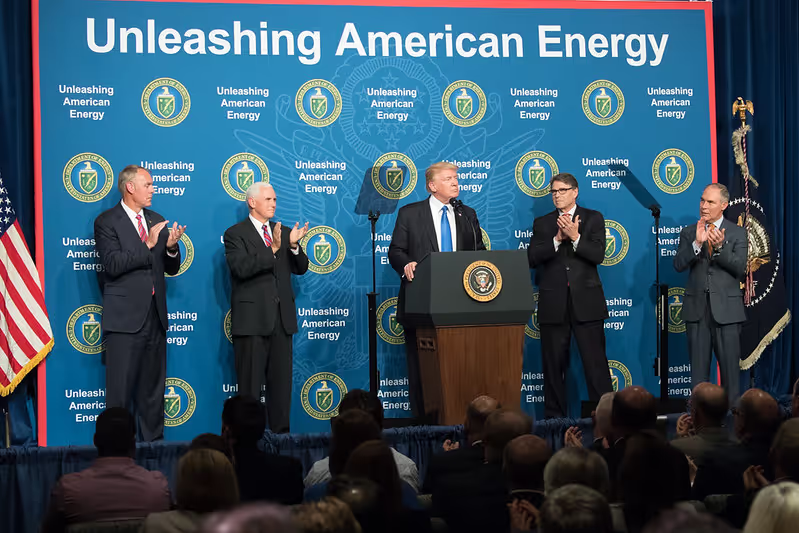
- Samantha Gross and Louison Sall at Brookings argue that Donald Trump advocates for a shift in U.S. energy policy, focusing on fossil fuels, reducing regulations, and opposing renewable energy initiatives to lower energy costs and achieve "energy dominance."
- The article asserts that Trump's ability to implement his energy agenda depends on Congress and the courts, with recent Supreme Court decisions potentially aiding his deregulatory efforts in a second term.

Thinktanker Summary
- Samantha Gross and Louison Sall at Brookings argue that Donald Trump advocates for a shift in U.S. energy policy, focusing on fossil fuels, reducing regulations, and opposing renewable energy initiatives to lower energy costs and achieve "energy dominance."
- The article asserts that Trump's ability to implement his energy agenda depends on Congress and the courts, with recent Supreme Court decisions potentially aiding his deregulatory efforts in a second term.
Overview:
This article was written by Samantha Gross and Louison Sall at Brookings.
- A second Trump administration would emphasize fossil fuel dominance and deregulation while rolling back renewable energy initiatives.
- Success in achieving these goals would depend largely on congressional support and judicial interpretations of regulatory laws.
Key Quotes:
- “Trump claims that aggressive drilling policies could reduce energy costs by 50%.”
- "A second Trump administration would likely succeed in changing key regulations, which the executive branch can accomplish on its own."
What They Discuss:
- Trump aims to increase domestic fossil fuel production, refilling the strategic petroleum reserve, and removing delays on federal drilling permits and leases.
- Despite Trump's criticism of Biden’s renewable energy policies, renewable energies like wind and solar have been proven to be cost-effective in many cases.
- Trump's statements on U.S. energy resource sizes are often exaggerated; the U.S. ranks between ninth and 11th for oil reserves and fourth or fifth for natural gas reserves.
- Biden-era climate and energy laws such as the Infrastructure Investment and Jobs Act (IIJA) and the Inflation Reduction Act (IRA) would be difficult to repeal without significant congressional support.
- Supreme Court decisions like West Virginia v. EPA and the end of Chevron deference could aid a Trump administration in rolling back regulations.
What They Recommend:
- The authors recommend looking critically at the feasibility of Trump's energy policy goals, especially his claims about reducing energy costs through increased drilling.
- They suggest understanding the role of existing laws like the IIJA and IRA that may limit the extent to which future administrations can undo current policies.
- They highlight the importance of acknowledging market realities, such as the global pricing of oil, which might undermine the purported benefits of aggressive drilling policies.
Key Takeaways:
- Achieving Trump's extensive energy policy changes requires more than executive orders; congressional support and judicial interpretations are crucial.
- A rightward shift in federal courts and more experienced administration staff could make regulatory rollbacks more likely under a potential second Trump administration.
- Renewable energy initiatives face strong opposition from Trump, but existing investments and policies under Biden may provide resilience against complete rollbacks.
- Supreme Court rulings on administrative law could lead to significant changes in how regulations are interpreted and enforced.
This is a brief overview of the article by Samantha Gross and Louison Sall at Brookings. For complete insights, we recommend reading the full article.

Trump has big plans for climate and energy policy, but can he implement them?
- Samantha Gross and Louison Sall at Brookings argue that Donald Trump advocates for a shift in U.S. energy policy, focusing on fossil fuels, reducing regulations, and opposing renewable energy initiatives to lower energy costs and achieve "energy dominance."
- The article asserts that Trump's ability to implement his energy agenda depends on Congress and the courts, with recent Supreme Court decisions potentially aiding his deregulatory efforts in a second term.
- Elaine Kamarck at Brookings writes that in selecting Senator J.D. Vance as his running mate, Donald Trump aimed to solidify his hard-right agenda, emphasizing Vance's alignment with Trump's core messages and MAGA base.
- The article examines how Trump's choice of Vance follows the "reinforcing model" of vice-presidential selection, where the VP candidate strengthens the presidential candidate's message and governance, rather than providing a traditional ideological or geographic balance.
Thinktanker Summary
- Elaine Kamarck at Brookings writes that in selecting Senator J.D. Vance as his running mate, Donald Trump aimed to solidify his hard-right agenda, emphasizing Vance's alignment with Trump's core messages and MAGA base.
- The article examines how Trump's choice of Vance follows the "reinforcing model" of vice-presidential selection, where the VP candidate strengthens the presidential candidate's message and governance, rather than providing a traditional ideological or geographic balance.
Overview:
This article was written by Elaine Kamarck at Brookings.
- Donald Trump's selection of Senator J.D. Vance as his running mate emphasizes the reinforcing model over the traditional balancing model for vice-presidential picks.
- The reinforcing model has evolved the role of vice presidents into more influential and integral parts of the administration, in contrast to the historically ceremonial and sidelined roles.
Key Quotes:
- "What Trump did in choosing Vance was to choose a younger, more handsome, and more articulate version of himself—he was reinforcing his message."
- "Trump has made an effective choice in Senator Vance. Vance will not only reinforce Trump’s core messages, but also he will be trustworthy as a vice president."
What They Discuss:
- Vice-presidential selections historically balanced geographic and ideological differences, such as John F. Kennedy choosing Lyndon B. Johnson.
- The modern reinforcing model prioritizes message consistency, as seen with Bill Clinton's selection of Al Gore.
- Trump's selection of J.D. Vance aligns with his strategy to maintain and amplify his core messages.
- The reinforcing model became popular due to its advantages in both campaigning and governance, reducing intra-administration conflicts.
- Vance, a steadfast supporter of Trump, echoes core Trump base sentiments on issues like the 2020 election and Capitol attack prisoners, ensuring alignment with Trump's policies.
What They Recommend:
- The article suggests that future presidential candidates should consider the reinforcing model for vice-presidential selections to ensure cohesive administration policies and effective governance.
- It implies that aligning vice-presidents with the presidential agenda could prevent internal conflicts, thus better serving the electoral and governance needs.
Key Takeaways:
- The reinforcing model has proven effective in recent decades by ensuring vice presidents align closely with the president’s agenda.
- J.D. Vance's alignment with Trump’s positions strengthens Trump's political messaging, particularly significant given Trump's age.
- The shift from balancing to reinforcing vice-presidential picks marks a significant change in political strategy and governance.
This is a brief overview of the article by Elaine Kamarck at Brookings. For complete insights, we recommend reading the full article.
Trump chose Vance to reinforce his message
- Elaine Kamarck at Brookings writes that in selecting Senator J.D. Vance as his running mate, Donald Trump aimed to solidify his hard-right agenda, emphasizing Vance's alignment with Trump's core messages and MAGA base.
- The article examines how Trump's choice of Vance follows the "reinforcing model" of vice-presidential selection, where the VP candidate strengthens the presidential candidate's message and governance, rather than providing a traditional ideological or geographic balance.
- Elaine Kamarck at Brookings argues that President Biden's poor debate performance against Trump has raised doubts about his ability to lead, prompting questions about the delegates' role in deciding nominations.
- The article examines the history of delegate roles in U.S. party conventions, noting that although modern delegates are typically bound by primary results, under certain circumstances, they may exercise more independent decision-making.
Thinktanker Summary
- Elaine Kamarck at Brookings argues that President Biden's poor debate performance against Trump has raised doubts about his ability to lead, prompting questions about the delegates' role in deciding nominations.
- The article examines the history of delegate roles in U.S. party conventions, noting that although modern delegates are typically bound by primary results, under certain circumstances, they may exercise more independent decision-making.
Overview:
This article was written by Elaine Kamarck at Brookings.
- Delegates in modern conventions are often seen as symbolic, yet historical and current contexts reveal their potential power.
- Rule changes and debates over delegate binding and conscience clauses have shaped presidential nominations.
Key Quotes:
- “Because the victor at most modern conventions has been a foregone conclusion, the notion of delegates as the final decision-makers in a long nomination process has been lost—but, under certain circumstances, perhaps this one, they may still have the final word.”
- “Delegates elected to the national convention pledged to a presidential candidate shall in all good conscience reflect the sentiments of those who elected them.”
What They Discuss:
- Between 1831 and 1972, U.S. presidential candidates were nominated by conventions composed of elected officials and party leaders, with primaries playing a minimal, non-binding role.
- The 1968 Democratic convention, amidst anti-Vietnam War protests, led to reforms that required delegates to reflect voter preferences and transitioned towards primaries.
- The Democratic "robot rule" (Rule 11(H)) in 1980 mandated that delegates vote for the candidate they were elected to support. Senator Kennedy's challenge to this rule demonstrated the difficulties of altering delegate commitments.
- In 2016, Republican delegates faced a similar "robot rule" (Rule 16) controversy, aiming to introduce a conscience clause to vote against Trump, which ultimately failed.
- Currently, the Democratic rule (Rule 13(J)) requires delegates to act "in all good conscience," a clause open to interpretation, which might become crucial if doubts about President Biden grow.
What They Recommend:
- Recognize the potential for delegate roles to shift under unusual circumstances, reflecting broader party concerns.
- Monitor the application and interpretation of the "in all good conscience" clause in future conventions, especially given potential challenges to candidacies.
Key Takeaways:
- Historical shifts have transformed the role of delegates from decision-makers to more symbolic participants.
- Despite reforms aimed at binding delegates to voter preferences, rules allowing for delegate discretion under specific conditions remain significant.
- Present circumstances, such as doubts about a candidate's viability, can amplify the importance of these rules and the role of delegates.
This is a brief overview of the article by Elaine Kamarck at Brookings. For complete insights, we recommend reading the full article.
Are convention delegates bound to their presidential candidate?
- Elaine Kamarck at Brookings argues that President Biden's poor debate performance against Trump has raised doubts about his ability to lead, prompting questions about the delegates' role in deciding nominations.
- The article examines the history of delegate roles in U.S. party conventions, noting that although modern delegates are typically bound by primary results, under certain circumstances, they may exercise more independent decision-making.


.avif)

.avif)
.avif)
.avif)
.avif)
.avif)


.avif)