

.avif)


.avif)
.avif)
.avif)
.avif)
.avif)

















.avif)


Search Insights
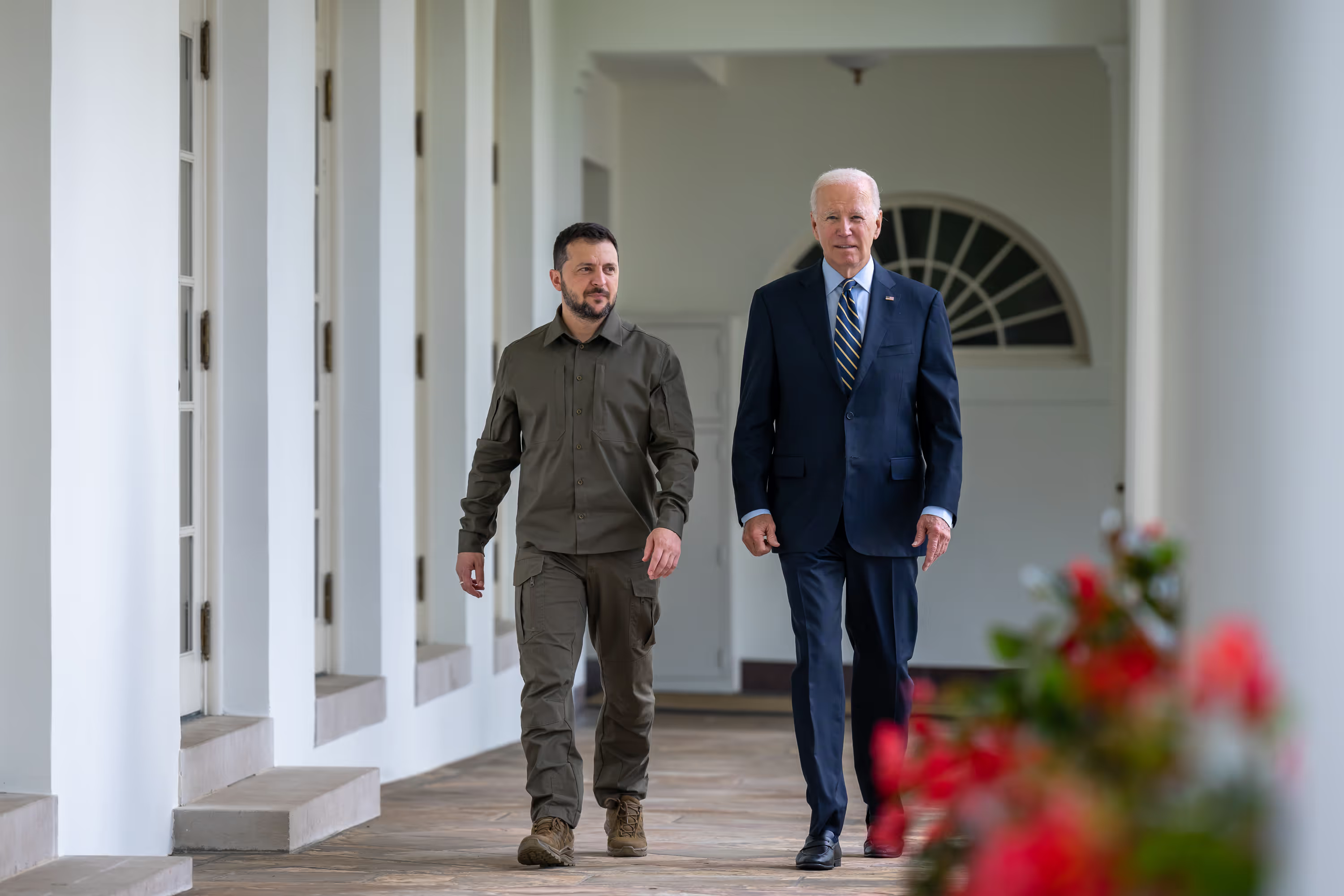
- The Biden administration's latest request for $61 billion for Ukraine would bring the total U.S. support since 2022 to nearly $200 billion.
- The authors question the feasibility of a Ukrainian victory and the U.S.'s ability to sustain financial support given its fiscal challenges.|
Overview:
This commentary piece by Justin Logan and Dan Caldwell at the Cato Institute critiques President Biden's approach to supporting Ukraine, arguing that the United States has overextended its resources. They assert that the Biden administration's request for additional funding for Ukraine is unsustainable given the U.S.'s fiscal position and the uncertain prospects of a Ukrainian victory.
Key Points:
- The Biden administration's latest request for $61 billion for Ukraine would bring the total U.S. support since 2022 to nearly $200 billion.
- The authors question the feasibility of a Ukrainian victory and the U.S.'s ability to sustain financial support given its fiscal challenges.|
Key Quotes:
- "The Biden administration continues to publicly advance the delusion that Ukraine can achieve a total and decisive victory against Russia."
- "Interest on the debt is now roughly $1 trillion per year, the national debt itself is at almost $34 trillion, and the budget deficit each year is some $1.5 trillion and expected to jump to almost $3 trillion by 2033."
What They Discuss:
- The impact of U.S. support for Ukraine on the country's ammunition stockpiles and its ability to support other allies.
- The challenges in achieving a meaningful Ukrainian breakthrough against Russia in the near term.
- The risks of escalating the conflict in Ukraine and the high rates of munition expenditure.
- The dire U.S. fiscal position, including a growing national debt and budget deficit, which makes continued support for Ukraine unsustainable.
What They Recommend:
- Congress should reject the latest funding request for Ukraine due to the lack of a clear plan for victory and the U.S.'s precarious fiscal position.
- The U.S. should reconsider its approach to the conflict in Ukraine, focusing on diplomatic solutions rather than continued military support.
Key Takeaways:
- The commentary highlights the fiscal and strategic challenges of the U.S.'s continued support for Ukraine.
- It emphasizes the need for a reassessment of U.S. foreign policy priorities and fiscal responsibilities.
- The authors argue for a more cautious approach to international conflicts, considering the U.S.'s domestic fiscal challenges.
This is a brief overview of the commentary from the Cato Institute. For complete insights, we recommend reading the full article.

Biden Has Massively Overdrawn America’s Account with Blank Checks to Ukraine
- The Biden administration's latest request for $61 billion for Ukraine would bring the total U.S. support since 2022 to nearly $200 billion.
- The authors question the feasibility of a Ukrainian victory and the U.S.'s ability to sustain financial support given its fiscal challenges.|
Ukraine-Russia War

- The report argues that both the U.S. and China, as status quo powers, share an interest in a stable global security environment and an open global economy.
- It suggests that diplomacy should focus on framing an inclusive global system, focusing on actions that reduce zero-sum constraints.
Overview:
This report by Jake Werner from the Quincy Institute for Responsible Statecraft discusses "Common Good Diplomacy" as a framework for stable U.S.-China relations.
- The report argues that both the U.S. and China, as status quo powers, share an interest in a stable global security environment and an open global economy.
- It suggests that diplomacy should focus on framing an inclusive global system, focusing on actions that reduce zero-sum constraints.
Key Quotes:
- "Rather than seeking to counter every Chinese initiative, U.S. leaders should carefully distinguish between beneficial and damaging outcomes, affirming and building on China’s constructive proposals and managing differences through negotiation rather than polemics and confrontation."
- "Working with China to revitalize the international order would not only prevent such a conflict, it would also establish the conditions for healthy forms of both competition and cooperation in the U.S.–China relationship."
What They Discuss:
- The report examines the complexities of the U.S.-China relationship, highlighting the potential for cooperation in areas like climate change, development in the Global South, and reforming international institutions.
- It emphasizes the need for the U.S. to carefully navigate its approach to China, distinguishing between actions that are beneficial or damaging to global stability.
- The concept of "Common Good Diplomacy" is proposed as a means to manage differences and build on constructive proposals from both sides.
- The report critiques the current U.S. approach of countering every Chinese initiative, advocating for a more nuanced strategy.
- It also addresses the challenges and opportunities in areas like global authority and security, the global economy, and climate change.
What They Recommend:
- Adopting a diplomatic approach that focuses on building an inclusive global system and reducing zero-sum constraints.
- Engaging in cooperative efforts with China in areas like climate change, global economic guidelines, and international order reform.
- Differentiating between Chinese actions that exacerbate tensions and those that contribute to global stability.
- Pursuing a balanced approach that allows for competition within a rules-based order, avoiding destructive conflict.
Key Takeaways:
- The report advocates for a strategic approach to U.S.-China relations that balances competition with cooperation.
- It highlights the importance of recognizing shared interests in a stable global order and the potential for mutually beneficial reforms.
- The concept of "Common Good Diplomacy" is presented as a framework for stable and constructive U.S.-China relations.
This is a brief overview of Jake Werner's report from the Quincy Institute for Responsible Statecraft. For complete insights, we recommend reading the full report.
Common Good Diplomacy: A Framework for Stable U.S.–China Relations
- The report argues that both the U.S. and China, as status quo powers, share an interest in a stable global security environment and an open global economy.
- It suggests that diplomacy should focus on framing an inclusive global system, focusing on actions that reduce zero-sum constraints.
U.S.-China Relations

- Generative AI tools could enhance disinformation, recruitment, and intelligence efforts by producing convincing fake content, as well as cybercrimes like extortion and cyber-espionage.
- Predictive AI could be used to optimize weaponry and personnel deployment, reducing tactical advantages of state actors.
Overview:
The article from Valerie Wirtschafter at Brookings explores the potential implications of the AI boom, particularly generative AI, for nonstate armed actors in 2024. It discusses how these actors might exploit AI for criminal activities, including disinformation campaigns, recruitment, extortion, and intelligence gathering. The article also considers the challenges policymakers and law enforcement face in mitigating these malicious uses.
Key Points:
- Generative AI can lower the technical threshold for actions like cyber espionage and cyberattacks, which were not previously major capabilities of nonstate armed actors.
- Policymakers should focus on the harms of different AI systems or models, rather than just their size, as an indicator of risk. Auditing processes are also important to assess the risks and benefits of open-sourcing a model.
- International consensus on common standards is crucial, especially with nations whose governance norms may differ from democratic partners like the United States.
- AI can be leveraged by law enforcement and military personnel to detect potential harms, but success depends on effective utilization of these technologies.
- Open collaboration in cyberspace has been critical in identifying and thwarting cyberattacks, but open-sourcing AI models poses risks of adaptation for malicious use.
Implications for Nonstate Armed Actors:
- Generative AI tools could enhance disinformation, recruitment, and intelligence efforts by producing convincing fake content.
- Predictive AI could be used to optimize weaponry and personnel deployment, reducing tactical advantages of state actors.
- Generative AI could facilitate cybercrimes like extortion and cyber-espionage by making spearfishing campaigns more sophisticated and difficult to detect.
Policy Recommendations:
- National legislation should focus on the specific harms of AI systems and include auditing processes.
- International cooperation is needed to establish shared standards for AI governance.
- Investments in AI tools for law enforcement should be balanced with respect for human rights and maintaining human control over decision-making processes.
This is a brief overview of the Valerie Wirtschafter's article from Brookings. For complete insights, we recommend reading the full article.
The implications of the AI boom for nonstate armed actors
- Generative AI tools could enhance disinformation, recruitment, and intelligence efforts by producing convincing fake content, as well as cybercrimes like extortion and cyber-espionage.
- Predictive AI could be used to optimize weaponry and personnel deployment, reducing tactical advantages of state actors.
Artificial Intelligence

- Brookings expert Jeffrey Feltman discuss the escalating violence by extremist Israeli settlers against Palestinian civilians in the West Bank and the implications for the Israeli-Palestinian conflict.
- He argues that these Israeli settlers should be considered nonstate armed actors (NSAA) and suggests that the U.S. should take stronger actions against them, similar to measures used against Palestinian terrorism.
Overview:
The article from Brookings expert Jeffrey Feltman discusses the escalating violence by extremist Israeli settlers against Palestinian civilians in the West Bank and the implications for the Israeli-Palestinian conflict. It argues that these settlers should be considered nonstate armed actors (NSAA) and suggests that the U.S. should take stronger actions against them, similar to measures used against Palestinian terrorism.
Key Points:
- The article highlights the increase in violence by extremist Israeli settlers in the West Bank, particularly after the October 7 terrorist attack by Hamas.
- It notes that the U.S. has announced visa restrictions against Israelis and Palestinians undermining peace in the West Bank, but argues that more action is needed.
- The article suggests that the U.S. should treat extremist Israeli settlers as NSAA and employ mechanisms like freezing financial accounts and imposing sanctions.
- It proposes widening the target net to include American citizens involved in group attacks on Palestinian civilians and seizing assets of U.S.-based groups funding extremist settler groups.
- The article also recommends building coalitions with like-minded countries to coordinate multinational measures against extremist settler violence.
What They Discuss:
- Extremist Israeli settlers aim to drive Palestinians out of the West Bank, particularly from Area C, which is under full Israeli civilian and military control.
- The Israeli government, particularly under the current Netanyahu administration, has been accused of endorsing the goals of these settlers and failing to prosecute them for attacks on Palestinians.
- The article argues that the actions of these settlers constitute ethnic cleansing and pose a risk of igniting a third Palestinian intifada.
What They Recommend:
- The U.S. should expand its mechanisms used against Palestinian terrorism to include actions against extremist Israeli settler groups.
- Measures could include freezing financial accounts, imposing sanctions, and seizing assets of groups funding the violence.
- The U.S. should collaborate with international partners to build coalitions against settler violence and hold Israeli government officials accountable if they aid and abet such violence.
This is a brief overview of the article from Brookings on extremist Israeli settlers as nonstate armed actors. For complete insights, we recommend reading the full article.
Extremist Israeli settlers are nonstate armed actors
- Brookings expert Jeffrey Feltman discuss the escalating violence by extremist Israeli settlers against Palestinian civilians in the West Bank and the implications for the Israeli-Palestinian conflict.
- He argues that these Israeli settlers should be considered nonstate armed actors (NSAA) and suggests that the U.S. should take stronger actions against them, similar to measures used against Palestinian terrorism.
War in Israel-Gaza

- The emergency arms sale to Israel undermines effective oversight of arms transfers and contradicts the Biden administration’s policies on civilian protection and human rights.
- Congress should preserve oversight over weapons transfers and consider amendments requiring reporting on compliance with U.S. and international law and protection of civilians.
Overview:
The article by Allison McManus, Laura Kilbury, and Robert Benson at the Center for American Progress critiques the U.S. Secretary of State Antony Blinken's decision to use emergency authority for the immediate sale of nearly 14,000 120-millimeter tank munition cartridges to Israel. This decision bypassed the standard 15-day period of congressional review and occurred amid concerns over Israel's failure to protect civilians in a military campaign that has claimed over 18,000 lives.
Key Points:
- The emergency arms sale to Israel undermines effective oversight of arms transfers and contradicts the Biden administration’s policies on civilian protection and human rights.
- Previous uses of emergency authority, such as for Ukraine in 2022 and for Saudi Arabia, the UAE, and Jordan in 2019, were conducted under different circumstances and with varying degrees of support and controversy.
Relevant Policies and Concerns:
- The U.S. Department of Defense's Civilian Harm Mitigation and Response Action Plan (CHMR-AP) and the U.S. State Department's Civilian Harm Incident Response Guidance aim to prevent U.S. complicity in civilian harm.
- The Conventional Arms Transfer (CAT) policy requires considering the risk of human rights violations before approving arms transfers.
- Israel's military offensive in Gaza has raised concerns about civilian harm, with reports suggesting that American-made weapons have been implicated in civilian casualties.
Policy Recommendations:
- The administration should adhere to its policies, reviewing arms transfers prior to approval and investigating any reported incidents involving U.S. weapons.
- Congress should preserve oversight over weapons transfers and consider amendments requiring reporting on compliance with U.S. and international law and protection of civilians.
Conclusion:
- The high civilian death toll in Gaza warrants more scrutiny for arms transfers to Israel, and policymakers should ensure compliance with civilian harm mitigation policies.
This is a brief overview of the article from the Center for American Progress. For complete insights, we recommend reading the full article.
Emergency Arms Sale to Israel Undermines Accountability
- The emergency arms sale to Israel undermines effective oversight of arms transfers and contradicts the Biden administration’s policies on civilian protection and human rights.
- Congress should preserve oversight over weapons transfers and consider amendments requiring reporting on compliance with U.S. and international law and protection of civilians.
War in Israel-Gaza
- AEI scholar Samuel J. Abrams argues that while Gay's resignation is a step forward, it is insufficient in addressing the broader issues within Harvard and other collegiate institutions regarding DEI policies.
- Abrams criticizes Harvard's DEI bureaucracy, accusing it of promoting hatred toward Jews and suppressing free speech.
Overview:
The article from the American Enterprise Institute (AEI) by Samuel J. Abrams discusses the resignation of Claudine Gay from the Harvard presidency, criticizing the institution's approach to diversity, equity, and inclusion (DEI) and its impact on academic standards and freedom of speech. The article argues that while Gay's resignation is a step forward, it is insufficient in addressing the broader issues within Harvard and other collegiate institutions regarding DEI policies.
Key Points:
- Claudine Gay's resignation is seen as a response to her failure to condemn antisemitism and meet academic standards, but the article argues that it is merely symbolic and does not address the root problems at Harvard.
- The article criticizes Harvard's DEI bureaucracy, accusing it of promoting hatred toward Jews and suppressing free speech.
- It suggests that DEI policies are deeply embedded in many schools and are divisive, citing examples from Johns Hopkins University.
- The article acknowledges some progress against DEI policies in states like Utah but insists that more needs to be done to dismantle these offices in educational institutions.
- The author expresses concern that Harvard's current climate remains antithetical to its mission of finding and promoting truth, even after Gay's departure.
What They Discuss:
- Claudine Gay faced criticism for her handling of issues related to antisemitism and academic standards during her tenure at Harvard.
- The article views DEI initiatives as harmful to academic freedom and standards, promoting a divisive and reductive approach to identity and privilege.
What They Recommend:
- The article calls for the dismantling of DEI offices in colleges and universities, arguing that they promote racist and anti-inclusive ideas.
- It suggests that institutions should focus on their core missions of truth and exceptional scholarship, free from the influence of DEI bureaucracy.
Critique:
- The article presents a critical view of DEI initiatives, suggesting that they have a negative impact on academic standards and freedom of speech.
- It advocates for a return to traditional academic values and standards, free from what it perceives as the ideological influence of DEI policies.
This is a brief overview of Samuel J. Abrams' article from the American Enterprise Institute on Claudine Gay's resignation and the broader implications for DEI policies in higher education. For complete insights, we recommend reading the full article.
Claudine Gay Is Just the Start
- AEI scholar Samuel J. Abrams argues that while Gay's resignation is a step forward, it is insufficient in addressing the broader issues within Harvard and other collegiate institutions regarding DEI policies.
- Abrams criticizes Harvard's DEI bureaucracy, accusing it of promoting hatred toward Jews and suppressing free speech.
Education

- This report discusses the challenges in estimating the Chinese defense budget and draws parallels with the difficulties faced during the Cold War in assessing the Soviet defense budget.
- The report emphasizes the importance of accurate, data-informed estimates of the Chinese defense budget for assessing the U.S. defense budget and suggests that lessons from the Cold War can inform current analysis of China's military spending.
Overview:
This report by Wilson Beaver at The Heritage Foundation discusses the challenges in estimating the Chinese defense budget and draws parallels with the difficulties faced during the Cold War in assessing the Soviet defense budget. The report emphasizes the importance of accurate, data-informed estimates of the Chinese defense budget for assessing the U.S. defense budget and suggests that lessons from the Cold War can inform current analysis of China's military spending.
Key Quotes:
- "Accurate, data-informed estimates of the size and composition of the Chinese defense budget are critical to the assessment of the U.S. defense budget."
- "If policymakers want a data-informed official estimate of the true size of the Chinese defense budget, the U.S. government must re-establish the economic analysis offices at the Department of Defense and in the Intelligence Community that did this work on the Soviet defense budget during the Cold War."
What They Discuss:
- The report examines the ongoing attempts to estimate China's defense budget and compares it with the U.S. defense budget, highlighting the similarities with Cold War-era debates over the Soviet defense budget.
- It critiques the reliance on Soviet self-reporting and purchasing power parity (PPP) calculations in estimating Soviet expenditures, noting similar challenges with China.
- The report argues for the importance of understanding the nuances in defense budget estimates and their impact on U.S. defense spending decisions.
- It advocates for the U.S. government to publish its defense analysis estimates to inform public debate and suggests re-establishing economic analysis offices for more accurate assessments.
- The report details the methodologies used during the Cold War for estimating Soviet defense spending and suggests applying similar approaches to China.
What They Recommend:
- The U.S. government should re-establish specialized economic analysis offices to provide more accurate estimates of the Chinese defense budget.
- Policymakers should consider lessons from the Cold War in analyzing China's defense expenditures, including the use of PPP and direct costing methods.
- The U.S. should publish its defense budget analysis to inform public debate and policy decisions.
Key Takeaways:
- Estimating the Chinese defense budget is complex and requires sophisticated economic analysis, similar to the challenges faced during the Cold War with the Soviet Union.
- Accurate estimates are crucial for understanding the U.S. defense budget in the context of strategic competition with China.
- Lessons from the Cold War can provide valuable insights into developing more effective methods for analyzing China's military spending.
This is a brief overview of Wilson Beaver's report from The Heritage Foundation. For complete insights, we recommend reading the full report.
Cold War Lessons for Estimating the Chinese Defense Budget
- This report discusses the challenges in estimating the Chinese defense budget and draws parallels with the difficulties faced during the Cold War in assessing the Soviet defense budget.
- The report emphasizes the importance of accurate, data-informed estimates of the Chinese defense budget for assessing the U.S. defense budget and suggests that lessons from the Cold War can inform current analysis of China's military spending.
U.S.-China Relations

- Brookings expert Samantha Gross writes that reducing oil production in the U.S. will not significantly impact global oil production, as other producers can easily fill the gap.
- Changing the transportation system from gasoline and diesel to electricity is key to reducing oil demand and greenhouse gas emissions.
Overview:
This article by Brookings expert Samantha Gross argues that reducing U.S. oil demand, rather than production, is the most effective strategy for addressing climate change.
- It emphasizes that focusing on reducing oil production in the U.S. will not significantly impact global oil production, as other producers can easily fill the gap.
- The article suggests that changing the transportation system from gasoline and diesel to electricity is key to reducing oil demand and greenhouse gas emissions.
Key Quotes:
- "Without these changes in our transport system, canceling specific projects or limiting U.S. oil production will only move emissions elsewhere, rather than reducing them."
- "The United States is not the world’s marginal producer of oil, meaning that eliminating a project in the United States will not meaningfully reduce global oil production."
What They Discuss:
- The U.S. is a leading oil producer, but reducing domestic production won't significantly lower global emissions due to the fungibility of oil.
- The focus should be on reducing oil demand, particularly in transportation, which accounts for a significant portion of U.S. oil use.
- Electric vehicles are a key part of the solution, but broader changes in transportation infrastructure and urban design are also necessary.
- The article critiques the approach of targeting specific oil production projects, arguing it's ineffective in reducing overall emissions.
- It advocates for a combination of strict regulation of domestic oil production and policies to reduce oil demand.
What They Recommend:
- Implement stringent fuel economy standards and promote electric vehicle adoption.
- Redesign cities and lifestyles to make efficient transport modes more viable.
- Strictly regulate U.S. oil production, focusing on minimizing greenhouse gas emissions.
- Develop and demonstrate new technologies to facilitate the transition away from oil dependency.
Key Takeaways:
- The article argues that reducing oil demand is a more effective climate strategy than targeting production.
- It highlights the need for systemic changes in energy use, particularly in transportation.
- The recommendations focus on a combination of regulatory measures and technological innovation to achieve significant reductions in oil demand and emissions.
This is a brief overview of the work from Brookings Institution. For complete insights, we recommend reading the full article.
Reducing US oil demand, not production, is the way forward for the climate
- Brookings expert Samantha Gross writes that reducing oil production in the U.S. will not significantly impact global oil production, as other producers can easily fill the gap.
- Changing the transportation system from gasoline and diesel to electricity is key to reducing oil demand and greenhouse gas emissions.
Climate Change

- The Arab public's response to the Israel-Hamas conflict is increasingly characterized by a preference for nonviolent, pro-peace approaches.
- There is a significant shift in the Arab world towards rejecting violence and extremist ideologies, as evidenced by public opinion surveys.
Overview:
- Authored by Amr Hamzawy, the article focuses on the Arab public's response to the conflict between Israel and Hamas, highlighting the peaceful nature of protests across the region.
- The Arab public's response to the conflict is characterized by peaceful demonstrations advocating for Palestinian rights.
- There is a growing trend in the Arab world to renounce violence as a means of pursuing political objectives.
Key Quotes:
- "The peaceful nature of this wave of Arab mass mobilization reflects a growing trend to renounce violence as a means of pursuing political objectives."
- "The Arab street has watched as the civilian population in Gaza falls victim to Israeli attacks and is left without international protection or aid amid a humanitarian catastrophe."
What They Discuss:
- The widespread peaceful protests in Arab cities in support of Palestinians in Gaza, emphasizing basic human rights amid the Israeli military assault.
- The initial Arab public response to Hamas's actions, which set a secular and moderate tone, condemning violence and calling for the protection of life on both sides.
- The focus of Arab commentators and influencers on the occupation and siege of Palestinian territories, and the struggles of Palestinians in different regions.
- The rejection of narratives that dehumanize Israeli civilians, maintaining a nonviolent and humanist response.
- The role of mass mobilizations in Arab countries in highlighting the plight of Palestinians and criticizing Western double standards and complicity in the conflict.
Key Takeaways:
- The Arab public's response to the Israel-Hamas conflict is increasingly characterized by a preference for nonviolent, pro-peace approaches.
- There is a significant shift in the Arab world towards rejecting violence and extremist ideologies, as evidenced by public opinion surveys.
- The current trend in the Arab public space could potentially contribute to a revival of the peace process between Israelis and Palestinians, with broad Arab support.
This is a brief overview of Amr Hamzawy's work from the Carnegie Endowment for International Peace. For complete insights, we recommend reading the full article.
Pay Attention to the Arab Public Response to the Israel-Hamas War
- The Arab public's response to the Israel-Hamas conflict is increasingly characterized by a preference for nonviolent, pro-peace approaches.
- There is a significant shift in the Arab world towards rejecting violence and extremist ideologies, as evidenced by public opinion surveys.
War in Israel-Gaza
- CSIS Global Health Policy experts write that the Biden administration must reset its strategy to manage Israel's conduct in the conflict, which has caused an "apocalyptic" humanitarian crisis and global reputational damage.
- Gaza's entire health system has been destroyed, with UN agencies and NGOs struggling to provide minimum medical aid to Gazan refugees.
Overview:
This article was written by CSIS experts Leonard Rubenstein and J. Stephen Morrison, focusing on the dire humanitarian situation in Gaza amid ongoing conflict.
- The article highlights the massive scale of human suffering and infrastructure damage in Gaza due to the conflict between Israel and Hamas.
- It emphasizes the urgent need for international intervention to mitigate the humanitarian crisis and address the deteriorating health and living conditions in Gaza.
Key Quotes:
- "Israel’s assaults have damaged or destroyed 70 percent of Gaza’s housing and nearly half of its infrastructure."
- "Almost two million people have been displaced to areas that remain acutely unsafe."
What They Discuss:
- The article details the catastrophic impact of the conflict on Gaza's civilian population, with over 23,000 deaths, most being women and children.
- It discusses the severe damage to Gaza’s infrastructure, with 70% of housing and nearly half of all infrastructure destroyed.
- The authors note the decimation of Gaza's healthcare system, with only a third of hospitals partially functioning and widespread infectious diseases.
- They highlight the challenges faced by international aid agencies in delivering essential services due to operational barriers and insecurity.
- The article points out the failure of international diplomatic efforts, particularly by the UN Security Council, in effectively addressing the crisis.
What They Recommend:
- The authors urge the Biden administration to reset its strategy, focusing on stabilizing and protecting the Gazan population.
- They recommend concrete proof of IDF compliance with international humanitarian law and the implementation of deconfliction mechanisms.
- The article suggests quadrupling the flow of essential supplies like food, fuel, and medicines to Gaza.
- It calls for expanded U.S. technical support to strengthen Palestine's health services and laboratory capabilities.
- The authors propose engaging Arab countries to press Hamas for a cessation of fighting and the expedited release of hostages.
Key Takeaways:
- The conflict in Gaza has resulted in an unprecedented humanitarian crisis, with extensive loss of life and destruction of infrastructure.
- There is an urgent need for international intervention to alleviate the suffering and stabilize the situation.
- The article advocates for a more assertive and concrete approach by the U.S. and international community in addressing the crisis.
This is a brief overview of Leonard Rubenstein and J. Stephen Morrison's work from the Center for Strategic and International Studies. For complete insights, we recommend reading the full article.
Gaza’s Human Crisis Demands a Rethink
- CSIS Global Health Policy experts write that the Biden administration must reset its strategy to manage Israel's conduct in the conflict, which has caused an "apocalyptic" humanitarian crisis and global reputational damage.
- Gaza's entire health system has been destroyed, with UN agencies and NGOs struggling to provide minimum medical aid to Gazan refugees.