


.avif)


.avif)
.avif)
.avif)
















.avif)






Search Insights
Trump's foreign policy aims to reassert America's strength on the global stage while demanding accountability from allies and adversaries alike. By prioritizing an America-first agenda, Trump seeks to reshape international relations in favor of U.S. interests, per commentary from Heritage Foundation.
Trump's foreign policy aims to reassert America's strength on the global stage while demanding accountability from allies and adversaries alike. By prioritizing an America-first agenda, Trump seeks to reshape international relations in favor of U.S. interests, per commentary from Heritage Foundation.
The issue:
The current foreign policy landscape is challenged by America's perceived lack of presence and strength, following the Biden administration's approach. Many Americans feel a strong urge for a foreign policy that not only protects but also elevates U.S. interests and allies.
What they recommend:
Trump's administration emphasizes an assertive foreign policy that involves ending financial support for countries that do not contribute to their own defense. He advocates for significant shifts in NATO funding and a focus on bolstering American energy independence.
Go deeper:
Trump's strategy includes restoring deterrence against global adversaries like Russia, Iran, and China, which he sees as weakened by their own miscalculations. Additionally, major investments from allied nations, such as the anticipated $600 billion from Saudi Arabia, are designed to invigorate the U.S. economy and create mutual partnerships. Overall, Trump's vision reflects a departure from fiscal internationalism to a distinctly self-interested approach to global affairs.
This is a brief overview of a commentary from Heritage Foundation. For complete insights, we recommend reading the full commentary.

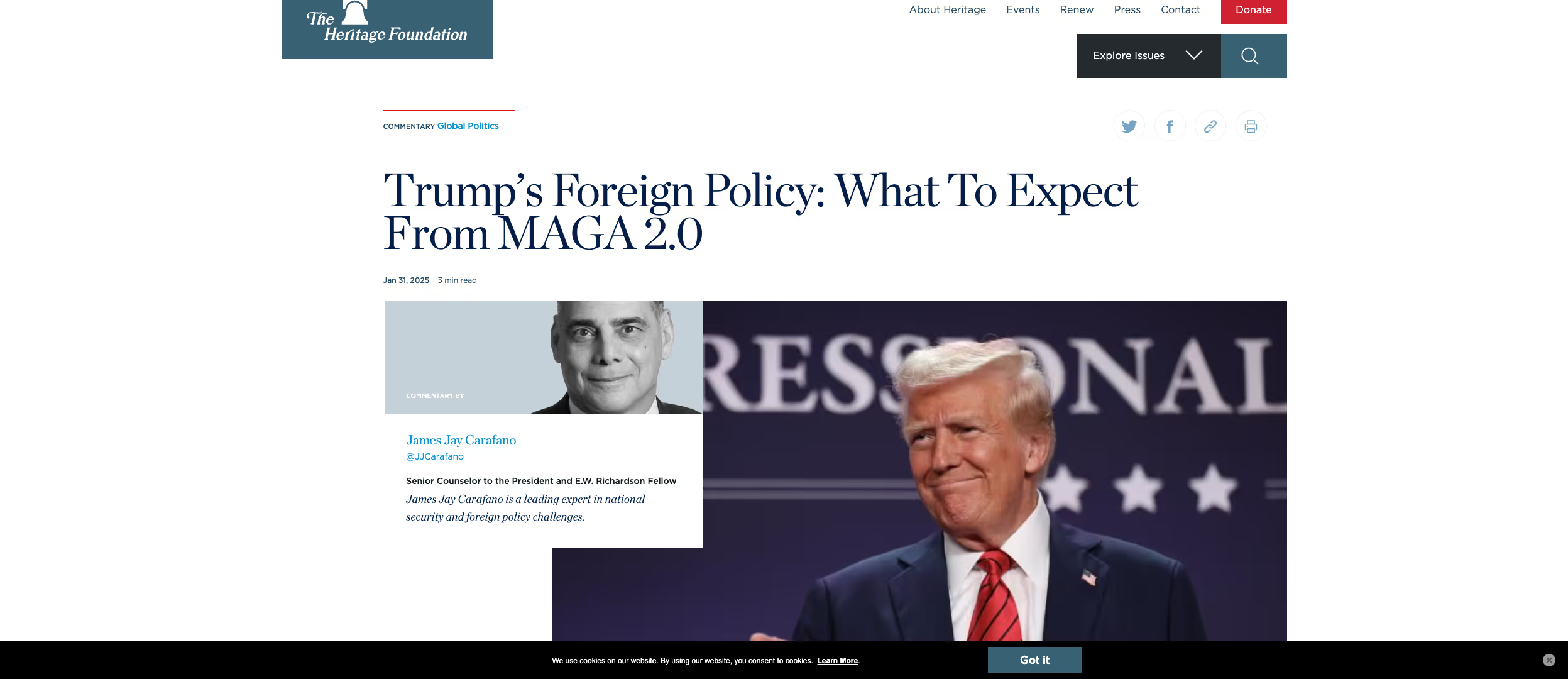
Trump’s Foreign Policy: What To Expect From MAGA 2.0
Trump's foreign policy aims to reassert America's strength on the global stage while demanding accountability from allies and adversaries alike. By prioritizing an America-first agenda, Trump seeks to reshape international relations in favor of U.S. interests, per commentary from Heritage Foundation.
International Affairs
.avif)
President Trump's questioning of the birthright citizenship clause is based on a historical interpretation of the 14th Amendment. This perspective suggests that citizenship was never intended for all individuals born in the U.S. without consideration of parental status, per commentary from Heritage Foundation.
President Trump's questioning of the birthright citizenship clause is based on a historical interpretation of the 14th Amendment. This perspective suggests that citizenship was never intended for all individuals born in the U.S. without consideration of parental status, per commentary from Heritage Foundation.
The issue:
The core challenge revolves around the interpretation of the 14th Amendment, which states that only those born "subject to the jurisdiction" of the U.S. are citizens. Historical context indicates that the amendment was designed to eliminate race-based citizenship barriers rather than to guarantee citizenship for all born in the U.S.
Go deeper:
Legislative history underscores that children born to non-citizens owe allegiance to their parents' home countries, thereby precluding automatic U.S. citizenship. Iconic court cases like Elk v. Wilkins (1884) reinforce the view that the Supreme Court has historically limited the scope of birthright citizenship. The president's order seeks to realign federal policy to adhere to this original intent of the 14th Amendment.
This is a brief overview of a commentary from Heritage Foundation. For complete insights, we recommend reading the full commentary.
The Birthright Citizenship Clause Too Many Forget, but Trump Is Right To Question
President Trump's questioning of the birthright citizenship clause is based on a historical interpretation of the 14th Amendment. This perspective suggests that citizenship was never intended for all individuals born in the U.S. without consideration of parental status, per commentary from Heritage Foundation.
U.S. Politics
.avif)
The exponential growth of artificial intelligence (AI) systems is driving unprecedented demands for power that could overwhelm existing infrastructure. If not addressed, U.S. companies may have to relocate AI operations overseas, jeopardizing national competitiveness and security, per commentary from RAND Corporation.
The exponential growth of artificial intelligence (AI) systems is driving unprecedented demands for power that could overwhelm existing infrastructure. If not addressed, U.S. companies may have to relocate AI operations overseas, jeopardizing national competitiveness and security, per commentary from RAND Corporation.
The issue:
AI systems are generating immense power requirements, potentially reaching 68 gigawatts (GW) by 2027, which exceeds the total global capacity of only 88 GW in 2022. For instance, a single AI training run could demand up to 1 GW by 2028, leading to significant infrastructure challenges.
What they recommend:
Experts recommend modeling future power supply against growing data center demand while exploring efficiency improvements in AI hardware to lessen power needs. They also suggest examining permitting bottlenecks and evaluating new power sources capable of supporting AI workloads.
Go deeper:
Recent findings indicate that U.S. data centers face extensive permitting delays, with some projects taking four to seven years for grid connections in critical regions. As U.S. companies seek better power availability abroad, this could enhance the compute capabilities of other nations, presenting economic and military advantages. Without swift action, the U.S. may lag in the global AI race amidst tightening power constraints.
This is a brief overview of a report from RAND Corporation. For complete insights, we recommend reading the full report.
AI's Power Requirements Under Exponential Growth
The exponential growth of artificial intelligence (AI) systems is driving unprecedented demands for power that could overwhelm existing infrastructure. If not addressed, U.S. companies may have to relocate AI operations overseas, jeopardizing national competitiveness and security, per commentary from RAND Corporation.
Artificial Intelligence
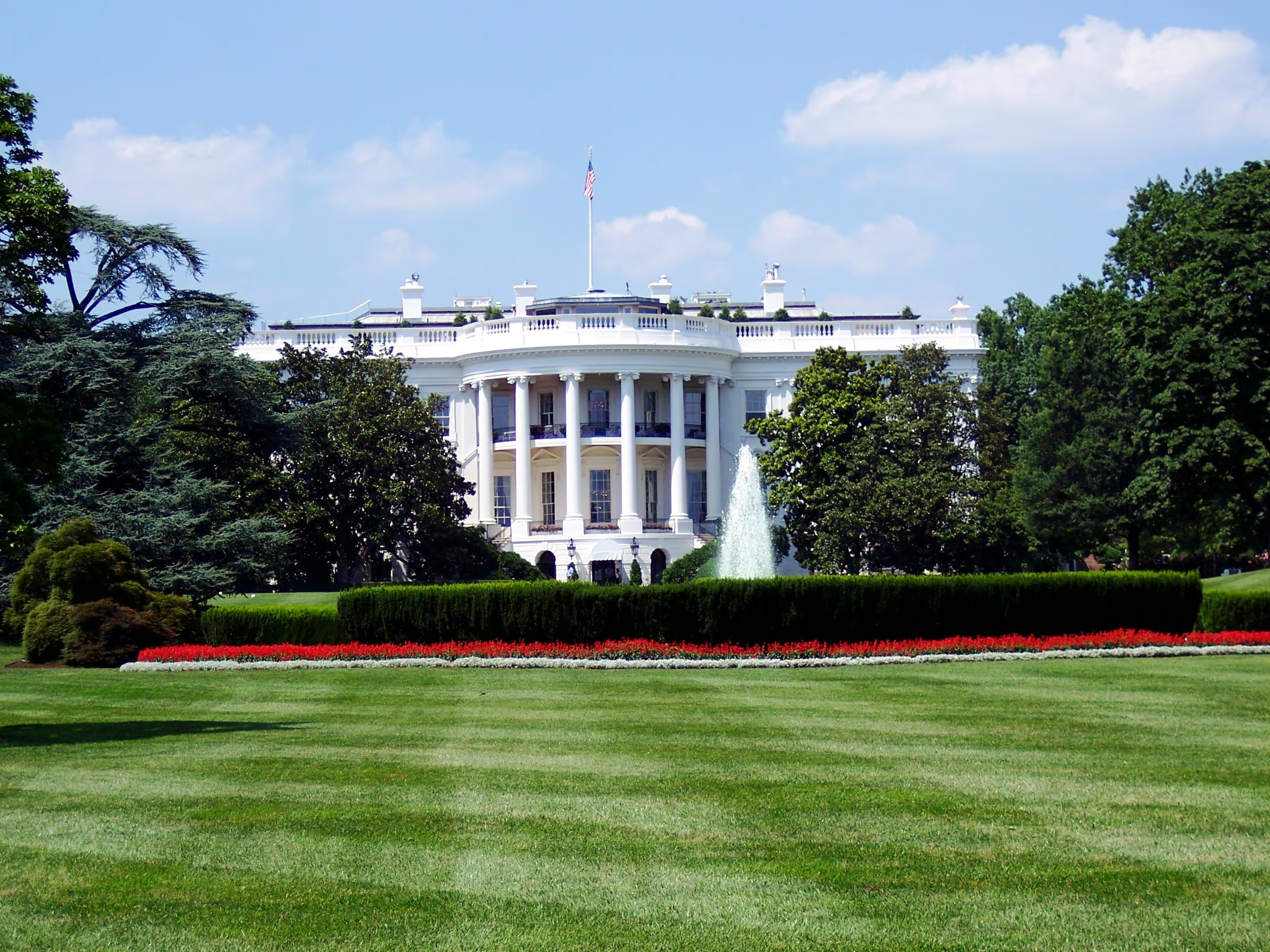
- James Pethokoukis at American Enterprise Institute writes that the newly announced Department of Government Efficiency (DOGE), led by Elon Musk and Vivek Ramaswamy, will act as an external consulting group to the Trump White House, aiming to provide recommendations to streamline government operations by July 4, 2026.
- The commentary argues that Washington policymakers should examine actionable proposals for improving healthcare, Social Security, and tax reform. These policies emphasize market incentives, fiscal responsibility, and economic growth, as discussed in the AEI report "A Balanced Plan for Fiscal Stability and Economic Growth."
The newly announced Department of Government Efficiency (DOGE), led by Elon Musk and Vivek Ramaswamy, aims to provide strategic recommendations by July 4, 2026, to enhance government efficiency, cut wasteful spending, and leverage technology, including AI, to improve federal agency performance. The American Enterprise Institute (AEI) has preemptively outlined actionable proposals to assist the Trump administration in achieving these objectives.
The Issue:
- Government bureaucracy is often criticized for inefficiency and excessive spending.
- The federal budget continues to face significant challenges, requiring reforms to ensure fiscal stability.
- Policymakers need urgent, effective solutions to streamline operations and allocate resources better.
- Areas identified for reform include healthcare, Social Security, and taxation, where inefficiencies are prevalent.
What They Recommend:
- Healthcare: Transition Medicare to a premium support model with competitive plans; reform Medicaid with per-capita allotments; replace tax benefits for employer insurance with refundable credits.
- Social Security: Implement a means-tested benefit structure; introduce matched contributions to retirement accounts; allow temporary borrowing to maintain solvency during reforms.
- Taxes: Reform the tax code to promote growth and maintain revenue neutrality; lower individual tax rates while broadening the base; replace the standard deduction with a credit and reduce corporate rates.
Go Deeper:
The AEI report emphasizes that meaningful fiscal reform is essential to address the country's financial challenges without compromising assistance to vulnerable populations. It suggests that by adjusting key programs and tax policies, the government can enhance economic growth while ensuring fiscal responsibility. The economists behind the proposals advocate for a balanced approach that fosters efficiency and promotes equity.
Conclusion:
This is a brief overview of the article by James Pethokoukis at American Enterprise Institute, published on 2024-11-13. For complete insights, we recommend reading the full article.
“Government Efficiency,” You Say? AEI Scholars Have Ideas
- James Pethokoukis at American Enterprise Institute writes that the newly announced Department of Government Efficiency (DOGE), led by Elon Musk and Vivek Ramaswamy, will act as an external consulting group to the Trump White House, aiming to provide recommendations to streamline government operations by July 4, 2026.
- The commentary argues that Washington policymakers should examine actionable proposals for improving healthcare, Social Security, and tax reform. These policies emphasize market incentives, fiscal responsibility, and economic growth, as discussed in the AEI report "A Balanced Plan for Fiscal Stability and Economic Growth."
2024 U.S. Elections

- William H. Frey at Brookings writes that despite claims of a multiracial transformation, Trump's support remains predominantly among white voters, with only modest gains among Latino or Hispanic voters and minimal shifts among Black voters.
- The analysis asserts that the long-standing racial voting divide persists, with Democrats retaining significant support from Black and Latino or Hispanic voters, questioning any significant transformation of the GOP voter base.
Analyses of the 2024 election exit polls suggest that, while President-elect Donald Trump showed a strong performance and garnered some support among minority voters, the Republican Party's base remains predominantly white, and any perceived transformation into a multiracial coalition is likely premature.
The Issue:
- Republican-leaning pundits claim Trump's 2024 election success signifies a shift towards a multiracial GOP coalition.
- Trump's support among white working-class voters, particularly men, continues to be robust, yet his gains among Latino or Hispanic and Black male voters may not reflect a true transformation of the Republican base.
- The long-standing Democratic preference among Black and Latino or Hispanic voters has largely persisted, with systematic data from elections demonstrating consistent voting patterns over time.
- Analysis of vote margins indicates Republicans' solid support from white voters across presidential elections since 2000, while both Black and Latino or Hispanic voters show clear Democratic alignment.
- Variations in minority voting patterns in specific states and demographic groups signify movements that are not comprehensive; they may reflect transient reactions to current socioeconomic conditions, rather than a deep-seated change in partisan alignment.
What They Recommend:
- Experts advise caution in interpreting shifts in voting patterns as evidence of an enduring change in the Republican electoral base.
- Monitoring future elections will be crucial to ascertain if the changes among specific demographic groups are sustainable or short-term fluctuations.
- Efforts should be directed towards understanding the socioeconomic factors influencing minority voter sentiment and turnout, which may focus on economic conditions and perceptions of party responsiveness.
Go Deeper:
The analysis utilizes data from Edison Research and AP VoteCast, highlighting demographic compositions of voters for both Trump and Harris in the 2024 election. It underscores the notable racial disparity in voter support and the implications of shifting margins among key demographic groups, particularly emphasizing the importance of context surrounding economic stability and party messaging. The historical trends in electoral outcomes warrant further scrutiny to forecast future voting behaviors accurately.
Conclusion:
This is a brief overview of the article by William H. Frey at Brookings, published on 2024-11-12. For complete insights, we recommend reading the full article.
Trump gained some minority voters, but the GOP is hardly a multiracial coalition
- William H. Frey at Brookings writes that despite claims of a multiracial transformation, Trump's support remains predominantly among white voters, with only modest gains among Latino or Hispanic voters and minimal shifts among Black voters.
- The analysis asserts that the long-standing racial voting divide persists, with Democrats retaining significant support from Black and Latino or Hispanic voters, questioning any significant transformation of the GOP voter base.
2024 U.S. Elections
- Christopher S. Chivvis and Jennifer Kavanagh at Carnegie Endowment for International Peace discuss the potential for AI to both enhance and complicate decision-making within the U.S. National Security Council, highlighting challenges like information overload and misperceptions.
- The article asserts that advanced AI could combat groupthink by offering diverse perspectives but also risks intensifying it due to overconfidence in AI systems, and emphasizes the need for training and AI governance to ensure effective use and stability in crises.
Overview:
This article was written by Christopher S. Chivvis and Jennifer Kavanagh at Carnegie Endowment for International Peace.
- AI systems can both accelerate and complicate decision-making in national security scenarios.
- Overconfidence in AI recommendations could lead to groupthink and potentially dangerous misperceptions.
Key Quotes:
- "AI-enabled systems can help accelerate the speed of commanders’ decisions and improve the quality and accuracy of those decisions."
- "In reality, AI systems are only as good as the data they are trained on, and even the best AI have biases, make errors, and malfunction in unexpected ways."
What They Discuss:
- The proliferation of AI in national security could slow decision-making because AI systems produce additional data that need to be evaluated.
- AI’s potential to create uncertainty in crisis situations involves deepfake videos and potentially misleading information.
- AI might challenge existing groupthink in decision-making settings by offering out-of-the-box ideas but could also entrench it if decision-makers over-rely on AI recommendations.
- The development of AI tools by well-funded agencies could disturb the balance of influence among key governmental bodies like the Department of Defense and Intelligence Community.
- Misjudging adversary actions influenced by AI systems could escalate crises due to the risk of miscalculation.
What They Recommend:
- Implement thorough training for policymakers on AI systems to understand their limits and capabilities.
- Establish an AI governance regime similar to arms control to manage and reduce risks of AI deployment in military contexts.
- Foster international cooperation, especially between the U.S. and China, on AI safety and governance measures.
Key Takeaways:
- AI has the dual potential to both streamline and complicate crisis decision-making processes.
- Training and prior experience with AI tools are crucial for their effective and safe use.
- Establishing clear norms and agreements on AI use is important for reducing the risk of misperceptions and unintended escalations.
- Policymakers must be wary of AI’s potential to sway groupthink and maintain a balanced approach incorporating human judgement.
This is a brief overview of the article by Christopher S. Chivvis and Jennifer Kavanagh at Carnegie Endowment for International Peace. For complete insights, we recommend reading the full article.
How AI Might Affect Decisionmaking in a National Security Crisis
- Christopher S. Chivvis and Jennifer Kavanagh at Carnegie Endowment for International Peace discuss the potential for AI to both enhance and complicate decision-making within the U.S. National Security Council, highlighting challenges like information overload and misperceptions.
- The article asserts that advanced AI could combat groupthink by offering diverse perspectives but also risks intensifying it due to overconfidence in AI systems, and emphasizes the need for training and AI governance to ensure effective use and stability in crises.
Artificial Intelligence

- Pew Research Center report shows that the presidential race between Harris and Trump is currently deadlocked, with each candidate receiving 49% support among registered voters. Voters regard Trump as stronger on the economy while Harris is preferred on abortion and personal traits like honesty.
- The survey asserts that voters are divided on Trump’s actions related to the 2020 election and his age. Additionally, Harris would make history if elected, being the first woman, Asian American, and Black woman president, while Trump would become the oldest person to assume office at 78.
Overview:
This report was published by Pew Research Center.
- The presidential race between Vice President Kamala Harris and former President Donald Trump is deadlocked, with 49% of registered voters supporting each candidate.
- Harris holds considerable advantages in personal traits and issues like abortion, while Trump leads on economic confidence.
Key Quotes:
- "55% of voters say they are very or somewhat confident in Trump to make good decisions about economic policy, compared with 45% who say that about Harris."
- "Currently, 61% of voters say the phrase 'mentally sharp' describes Harris very or fairly well, compared with 52% who describe Trump this way."
What They Discuss:
- The latest national survey highlights the unchanged dynamics of the presidential race and the contrasting strengths and weaknesses of the candidates.
- Trump leads among White voters (56% to 42%), while Harris garners significant support from Black voters (84% to 13%) and Asian voters (61% to 37%).
- Economic outlook remains bleak, with only 25% of Americans rating the national economy as excellent or good.
- The potential historic impact of Harris becoming the first woman, Asian American, and Black woman president, versus Trump potentially becoming the oldest president to take office at 78.
- Divided opinions on the acceptability of presidential actions, with differences in perspectives on the investigation of political opponents, pardons, and the use of executive orders.
What They Recommend:
- The article does not specify direct recommendations from the author but implies the importance of understanding voter priorities and candidate strengths in shaping policy and campaign strategies.
Key Takeaways:
- The race is highly competitive, with both candidates bringing distinctive strengths to the table.
- Voters have varying degrees of confidence in the candidates' capabilities, influenced by personal traits and issue-specific stances.
- The economic outlook and demographic preferences play crucial roles in voter support.
- The potential impacts of the candidates’ demographic characteristics and public perceptions of their actions are significant factors.
- The presidential actions and the candidates' pasts, including divisive issues like Trump’s role in the 2020 election and fraud charges, heavily influence voter opinions.
This is a brief overview of the report by Pew Research Center. For complete insights, we recommend reading the full article.
In Tied Presidential Race, Harris and Trump Have Contrasting Strengths, Weaknesses
- Pew Research Center report shows that the presidential race between Harris and Trump is currently deadlocked, with each candidate receiving 49% support among registered voters. Voters regard Trump as stronger on the economy while Harris is preferred on abortion and personal traits like honesty.
- The survey asserts that voters are divided on Trump’s actions related to the 2020 election and his age. Additionally, Harris would make history if elected, being the first woman, Asian American, and Black woman president, while Trump would become the oldest person to assume office at 78.
2024 U.S. Elections
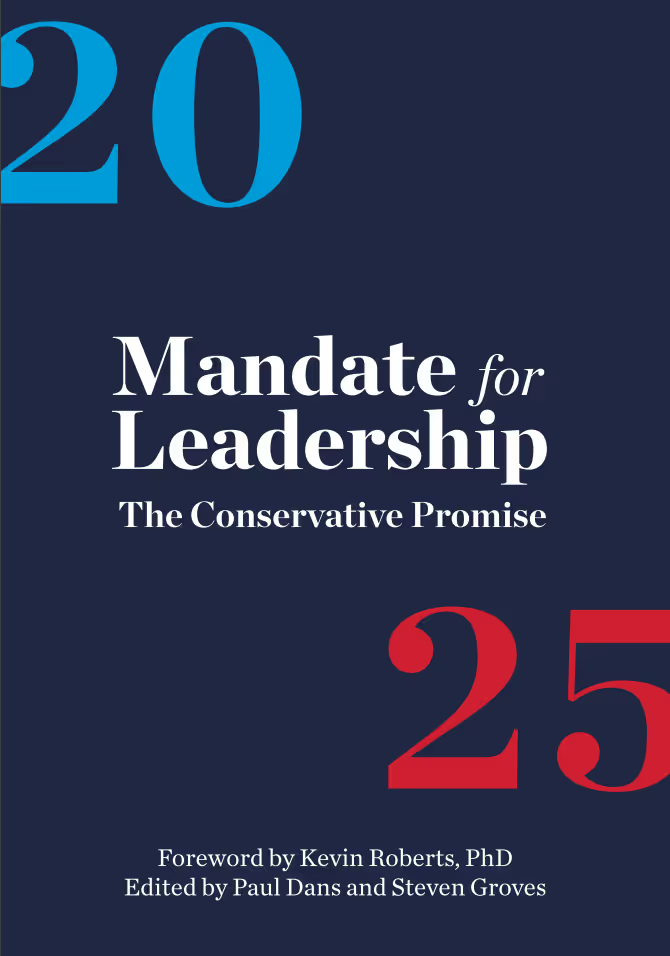
- Brendan Duke at Center for American Progress argues that Project 2025 proposes a tax plan that raises taxes on low- and middle-income families while giving significant tax cuts to the wealthy and corporations.
- The analysis asserts that the introduction of a flat consumption tax and elimination of income taxes would result in higher costs for middle- and low-income households, shifting the tax burden away from wealthy individuals and large corporations.
Overview:
This article was written by Brendan Duke at Center for American Progress.
- The article discusses how Project 2025's tax reform plans would significantly raise taxes on low- and middle-income households while providing substantial tax cuts for the wealthy.
- The proposed tax changes would shift the burden from wealthy individuals and corporations to the middle class and poorer Americans, exacerbating income inequality.
Key Quotes:
- "This is because the two current bottom brackets (10 percent and 12 percent) are lower than the 15 percent tax bracket proposed by Project 2025."
- "The required roughly 45 percent VAT is a lower bound..."
What They Discuss:
- The "intermediate tax reform" proposed by Project 2025 includes consolidating existing tax brackets to two brackets (15 percent and 30 percent), which would result in a $3,000 tax increase for the median family of four and a $950 increase for a typical single-person household.
- The wealthiest 45,000 U.S. households would receive an average tax cut of $1.5–2.4 million due to the plan's restructuring and cuts to taxes on investment income.
- Project 2025 aims to reduce the corporate tax rate from 21 percent to 18 percent, resulting in a $24 billion tax cut for America’s top 100 corporations.
- The long-term plan includes replacing all individual and corporate income taxes with a consumption tax, potentially leading to a 45 percent national sales tax, which would cause a significant rise in prices and inflation.
- The proposed tax changes would disproportionately impact middle-income households, increasing their average tax burden by $5,900, while the top 0.1 percent would see an average tax cut of $2 million.
What They Recommend:
- Brendan Duke recommends a thorough evaluation of Project 2025 to understand its potential impacts on different income groups.
- Policymakers should consider the regressive nature of shifting to a consumption tax and its long-term effects on economic inequality.
- It’s implied that more progressive tax reforms, which include protections and deductions for low- and middle-income families, should be explored instead.
Key Takeaways:
- Project 2025’s tax reform plans would lead to significant tax increases for middle-income households and substantial tax cuts for the wealthiest Americans and corporations.
- The proposed consumption tax, replacing current income taxes, could result in steep price increases and inflation, disproportionately affecting low- and middle-income families.
- These tax reforms could exacerbate economic inequality in the U.S. by shifting the tax burden from the rich to the poorer segments of society.
This is a brief overview of the article by Brendan Duke at Center for American Progress. For complete insights, we recommend reading the full article.
Project 2025’s Tax Plan Would Raise Taxes on the Middle Class and Cut Taxes for the Wealthy
- Brendan Duke at Center for American Progress argues that Project 2025 proposes a tax plan that raises taxes on low- and middle-income families while giving significant tax cuts to the wealthy and corporations.
- The analysis asserts that the introduction of a flat consumption tax and elimination of income taxes would result in higher costs for middle- and low-income households, shifting the tax burden away from wealthy individuals and large corporations.
2024 U.S. Elections

President Trump’s latest tariff plan is under fire from a conservative think tank, which says the math behind it is both flawed and misleading.
- Donald Trump focused on separating himself from his party's extreme policies and addressing key voter concerns like the economy and abortion.
Overview:
This article was written by William A. Galston and Elaine Kamarck at Brookings.
- Kamala Harris used the debate to introduce herself to voters, emphasizing her middle-class background and experience as a prosecutor.
- Donald Trump focused on separating himself from his party's extreme policies and addressing key voter concerns like the economy and abortion.
Key Quotes:
- “From the very first minutes of the debate, it was clear that she knew she had to define herself and that she did—as a child of the middle class who, in contrast to Trump, was not given $400 million to start a business.”
- “Trump tried to distance himself from the extremes, arguing that he would approve of abortions for rape and incest and even going so far as to say the Florida six-week ban is too short.”
What They Discuss:
- Kamala Harris faced three main challenges: introducing herself to unfamiliar voters, explaining her shifting positions on key issues, and proving her capability to serve as president.
- Harris consistently brought up her prosecutorial background to counter claims of being weak on crime.
- Trump needed to convey he wasn't obsessed with conspiracy theories and to appeal to swing voters.
- Trump’s repeated focus on illegal immigration highlighted a core issue for his campaign but may have limited his broader appeal.
- Abortion emerged as a particularly controversial topic, with Harris attacking restrictive state policies and Trump attempting to moderate his stance.
What They Recommend:
- Harris should continue defining herself clearly to voters and emphasize her prosecutorial experience.
- Trump should stick to script on key issues like the economy and avoid deviating into conspiracy theories.
- Both candidates need to clarify their positions on contentious issues like abortion and immigration to appeal to undecided voters.
Key Takeaways:
- Kamala Harris' debate performance likely energized her supporters and further introduced her to voters who didn't know her well.
- Trump's focus on illegal immigration and attempts to moderate his position on abortion had mixed success in broadening his appeal.
- The debate could boost Harris' campaign, but the final outcome will depend on continued voter engagement and state-specific efforts.
This is a brief overview of the article by William A. Galston and Elaine Kamarck at Brookings. For complete insights, we recommend reading the full article.

The presidential debate accomplished more for Harris than it did for Trump
President Trump’s latest tariff plan is under fire from a conservative think tank, which says the math behind it is both flawed and misleading.
- Donald Trump focused on separating himself from his party's extreme policies and addressing key voter concerns like the economy and abortion.
2024 U.S. Elections
- Bryan Burack at Heritage Foundation writes that the Trump administration's significant foreign policy legacy was its strategic response to China's economic warfare against the U.S., emphasizing the importance of maintaining these measures for deterrence.
- The article asserts that the Biden administration has adopted a less assertive approach, reviving engagement policies with China due to concerns that aggressive economic protections might provoke conflict, which has led to counterproductive security tradeoffs.
Overview:
This article was written by Bryan Burack at the Heritage Foundation.
- The Trump administration's significant foreign policy legacy is its proactive response to China's economic strategies against the United States.
- The Biden administration, although continuing some of Trump's economic and tech policies toward China, has softened its overall approach due to concerns about perceived provocations.
Key Quotes:
- "The Trump administration’s most important foreign policy legacy is its much-needed response to China’s economic warfare against the United States."
- "The Biden administration has watered down its overall approach due to fears that aggressively protecting the U.S. economy may be too provocative."
What They Discuss:
- The contrasting approaches of the Trump and Biden administrations regarding U.S. economic policies towards China, with the former adopting a more antagonistic stance and the latter emphasizing engagement.
- Even while continuing some policies, the Biden administration has taken actions to reassure China, which some view as weakening the U.S. position.
- Concerns from both political spectrums that rigorous economic measures could provoke China into conflict if enforced without a strong military position.
- Arguments against the belief that the U.S. is "strangling" China's economy, pointing out that both nations remain heavily interdependent economically.
- The inevitability of decoupling in critical economic sectors as pushed by the Chinese government itself, which has been preparing to become more self-reliant.
What They Recommend:
- Maintain and continue the economic and technological measures initiated by the Trump administration to reduce dependencies on China.
- Strengthen America’s defense industrial base and address supply chain vulnerabilities to ensure credible military deterrence.
- Acknowledge and prepare for the inevitability of some form of economic decoupling from China, acting from a position of strength.
Key Takeaways:
- The U.S. should continue efforts to reduce reliance on China to maintain national security and economic stability.
- Assertive economic policies are essential to deter Chinese aggression effectively.
- The current U.S.-China relationship dynamic is not akin to the pre-WWII U.S.-Japan scenario in terms of economic measures.
- Decoupling in sensitive sectors is perceived as inevitable and is being actively pursued by China's own policy goals.
- Ensuring America's economic security will make the country more resilient and better positioned to counter China's growing influence.
This is a brief overview of the article by Bryan Burack at Heritage Foundation. For complete insights, we recommend reading the full article.
Bring Back Trump’s China Policy
- Bryan Burack at Heritage Foundation writes that the Trump administration's significant foreign policy legacy was its strategic response to China's economic warfare against the U.S., emphasizing the importance of maintaining these measures for deterrence.
- The article asserts that the Biden administration has adopted a less assertive approach, reviving engagement policies with China due to concerns that aggressive economic protections might provoke conflict, which has led to counterproductive security tradeoffs.