

.avif)


.avif)
.avif)
.avif)
.avif)
.avif)














.avif)





Search Insights
- Brookings experts are watching the EU's capability to fund Ukraine, NATO's strategy for integrating Ukraine, and the possibility of either Russia or Ukraine breaking through stalemate on the battlefied.
- They are also watching Western defense industry's ability to match Russia's, the international community's potential appropriation of Russian assets for Ukraine's rebuilding, and the influence of the 2024 U.S. presidential election.
Overview:
This article from Brookings experts Michael E. O’Hanlon, Constanze Stelzenmüller, and David Wessel examines the ongoing war between Ukraine and Russia as it heads into 2024, highlighting potential military and political turning points. It discusses the current stalemate on the battlefield, the vacillation of Ukraine’s allies, and internal political tensions in Kyiv, all of which could impact Ukraine's ability to defend itself against Russia.
Key Points:
- The battlefield situation is largely stalemated, with the main action shifting to Ukraine’s skies. Russia has bombarded Ukraine’s cities and infrastructure, while Ukraine has managed to damage and drive the Russian Navy from its base in Crimea.
- European countries, supplying more than 50% of Western aid for Ukraine, are struggling to maintain their support. Hungary's opposition to EU membership talks with Ukraine and the Slovak government's opposition to support for Ukraine highlight these challenges.
- In the United States, President Biden is facing difficulties in gaining Congressional approval for his supplemental request of $61 billion for Ukraine.
- Internal political tensions in Ukraine are rising, with criticism of President Zelenskyy and his government becoming more evident.
What They're Watching in 2024:
- The ability of the EU to provide additional funding to Ukraine and NATO's approach to anchoring Ukraine in Western security institutions.
- Whether either side in the conflict can break out of the military stalemates of 2023.
- The capacity of Western defense industrial bases and political will to keep up with that of Russia.
- The potential seizure of Russian assets by the international community to fund Ukraine’s reconstruction.
- The impact of the U.S. presidential race of 2024 on the situation in Ukraine.
Key Takeaways:
- The article underscores the complexity of the Ukraine-Russia conflict and the challenges faced by Ukraine and its Western allies.
- It highlights the importance of continued support from Western nations for Ukraine's defense and the potential consequences of a lack of support.
- The article suggests that the winter of 2023-24 could be a critical period for the conflict, both militarily and politically.
This is a brief overview of the article from Brookings. For complete insights, we recommend reading the full article.

What to watch in Ukraine in 2024
- Brookings experts are watching the EU's capability to fund Ukraine, NATO's strategy for integrating Ukraine, and the possibility of either Russia or Ukraine breaking through stalemate on the battlefied.
- They are also watching Western defense industry's ability to match Russia's, the international community's potential appropriation of Russian assets for Ukraine's rebuilding, and the influence of the 2024 U.S. presidential election.
Ukraine-Russia War

- Trump's win in Iowa was expected, and he secured over 50% of the vote, performing well across various voter groups.
- The race for second place was also as predicted, with Ron DeSantis and Nikki Haley finishing second and third, respectively.
Overview:
- The article by Elaine Kamarck analyzes the results of the Republican Iowa caucus, focusing on Donald Trump's victory and its implications for the upcoming nomination race.
- Trump's win in Iowa was expected, and he secured over 50% of the vote, performing well across various voter groups.
- The race for second place was also as predicted, with Ron DeSantis and Nikki Haley finishing second and third, respectively.
Key Quotes:
- "Trump won Iowa with just over 50% of the vote. He didn’t exceed expectations but neither did he fall below them."
- "The next two months are likely to settle the question once and for all: Will Trump wrap up the Republican nomination early and start the battle against Joe Biden by mid-March or will he face a fight from someone (most likely Haley) all the way to the convention?"
What They Discuss:
- The dynamics of the Republican nomination process as a sequence of state races, each influenced by the previous one.
- The potential impact of the Iowa results on upcoming primaries, especially in New Hampshire and South Carolina.
- The strategic positions of Nikki Haley and Ron DeSantis in the race and their potential to challenge Trump.
- The unique aspects of different state electorates and how they might affect the candidates' performances.
- The importance of delegate accumulation in the nomination process, leading up to "Super Tuesday."
What They Recommend:
- The article does not explicitly recommend any specific actions but provides an analysis of the current political landscape and potential strategies for the candidates.
Key Takeaways:
- Trump's victory in Iowa sets the stage for the next primaries, with his performance likely influencing the strategies of other candidates.
- The race for the Republican nomination is still open, with potential challenges from Haley and DeSantis.
- The upcoming primaries in New Hampshire, South Carolina, and "Super Tuesday" states will be crucial in determining the Republican nominee.
This is a brief overview of Elaine Kamarck's work from Brookings. For complete insights, we recommend reading the full article.
Trump wins Iowa — no surprises there. What happens next?
- Trump's win in Iowa was expected, and he secured over 50% of the vote, performing well across various voter groups.
- The race for second place was also as predicted, with Ron DeSantis and Nikki Haley finishing second and third, respectively.
2024 U.S. Elections

- AEI expert Hal Brands writes that the war in Ukraine is a critical test of democratic resilience against authoritarian forces.
- The outcome of this conflict could either reinforce or erode the current global order, depending on the sustained commitment of democratic nations.
Overview:
- This op-ed from American Enterprise Institute scholar Hal Brands examines the ongoing conflict in Ukraine, particularly focusing on the global implications and the evolving dynamics of the war.
- The initial Western response to Russia's invasion appeared strong, but the long-term effectiveness of these measures is now uncertain.
- The war's outcome could significantly influence global power dynamics, especially regarding democratic resilience against authoritarian expansion.
Key Quotes:
- "In the hopeful early months of the war — characterized by Ukrainian resilience, Russian incompetence and Western unity — it often seemed that the conflict was revealing the strength of the free world and the debility of its enemies."
- "If the US and its allies can find the fortitude and commitment to see Ukraine through to an acceptable outcome... the conflict might still have mostly constructive consequences."
What They Discuss:
- The initial success of Western strategies against Russia's invasion, including sanctions and military support to Ukraine.
- The resilience of the Russian economy despite sanctions, with trade rerouting to Asia and strengthened ties with China.
- The potential for Russia to emerge as a more formidable, illiberal power post-war.
- Challenges within the democratic community, including political dysfunction in the US and "Ukraine fatigue" in the West.
- The uncertain future of the conflict and its implications for global order, particularly if democratic nations fail to maintain support for Ukraine.
What They Recommend:
- The article suggests the need for sustained Western commitment and support to ensure Ukraine's economic viability and military defense.
- It emphasizes the importance of increasing the costs for Russia's aggression to maintain global order.
Key Takeaways:
- The war in Ukraine is a critical test of democratic resilience against authoritarian forces.
- The outcome of this conflict could either reinforce or erode the current global order, depending on the sustained commitment of democratic nations.
- The situation remains fluid, and the long-term implications are still uncertain.
This is a brief overview of the work from the American Enterprise Institute. For complete insights, we recommend reading the full article.
Ukraine’s Desperate Hour: The World Needs a Russian Defeat
- AEI expert Hal Brands writes that the war in Ukraine is a critical test of democratic resilience against authoritarian forces.
- The outcome of this conflict could either reinforce or erode the current global order, depending on the sustained commitment of democratic nations.
Ukraine-Russia War

- AI has the potential to improve election administration but requires vigilant monitoring for risks such as phishing attacks, misinformation, and potential bias in voter rolls.
- Policymakers, advocates, and citizens need to stay informed about technological advancements to harness AI's positive potential.
Overview:
This article was written by Norman Eisen, Nicol Turner Lee, Colby Galliher, and Jonathan Katz and discusses the impact of artificial intelligence (AI) on U.S. democracy.
- This article explores the potential of AI technologies to transform democratic governance while also highlighting the risks it poses to election integrity.
- It emphasizes the need for policymakers, advocates, and citizens to stay informed about technological advancements to harness AI's positive potential.
Key Quotes:
- "AI could revamp election administration processes to make them more efficient, reliable, and secure."
- "AI is already altering the way candidates conduct their campaigns and can democratize the public comment process.
What They Discuss:
- AI's role in improving election administration by identifying anomalies in voter lists and reducing the time for reporting election results.
- The risks associated with AI, including phishing attacks on election officials and the potential for disseminating misinformation.
- AI's impact on election campaigns, including the use of generative AI for persuasive communication.
- Concerns about AI-fueled programs fabricating public comments and endorsements.
- The importance of safeguarding democracy against anti-democratic actors and autocrats.
What They Recommend:
- Monitor AI's role in election administration carefully to prevent fraud or disenfranchisement.
- Address the risks associated with AI, such as phishing attacks and misinformation dissemination.
- Leverage AI to democratize the public comment process and enhance citizen engagement.
- Develop strategies to distinguish AI-generated content from genuine public input.
- Emphasize the role of policymakers, advocates, and civil society in guiding AI regulation.
Key Takeaways:
- AI has the potential to improve election administration but requires vigilant monitoring.
- Risks include phishing attacks, misinformation, and potential bias in voter rolls.
- AI is changing election campaigns and public engagement.
- Safeguarding democracy against AI-related threats is essential.
- Policymakers, advocates, and civil society play a crucial role in shaping AI regulation.
Disclaimer: This is a brief overview of Norman Eisen, Nicol Turner Lee, Colby Galliher, and Jonathan Katz's work from The Brookings Institution. For complete insights, we recommend reading the full article.
AI can strengthen U.S. democracy—and weaken it
- AI has the potential to improve election administration but requires vigilant monitoring for risks such as phishing attacks, misinformation, and potential bias in voter rolls.
- Policymakers, advocates, and citizens need to stay informed about technological advancements to harness AI's positive potential.
Artificial Intelligence

- Samuel J. Abrams at the American Enterprise Institute discusses the issue of free speech on college campuses, arguing the real issue lies with college administrators and diversity, equity, and inclusion offices, which contribute to a culture of censorship and fear.
- Abrams argues students widely support the First Amendment and open debate, even if some ideas may be uncomfortable.
Overview:
This article by Samuel J. Abrams at the American Enterprise Institute (AEI) discusses the issue of free speech on college campuses, arguing that students are not the primary problem when it comes to restrictions on speech.
- Abrams emphasizes that the real issue lies with college administrators and diversity, equity, and inclusion offices, which contribute to a culture of censorship and fear.
- The article highlights that most students value free speech and are open to diverse viewpoints.
Key Quotes:
- "It is the college administrators and diversity, equity, and inclusion offices that hinder the classical liberal education experience."
- "About 61 percent of students often feel intimidated to share their ideas, opinions, or beliefs in class because they are different than those of their professors."
What They Discuss:
- The decline of viewpoint diversity and open debate in colleges, leading to ideological monoculture.
- The misconception that student mobs are the main cause of speech limitations, while the role of college administrators is more significant.
- Data from the Buckley Institute showing that a majority of students value free speech but feel pressured to self-censor.
- The support among students for the First Amendment and open debate, even if some ideas may be uncomfortable.
- The need to educate students on the value of free speech and diverse opinions for a better education and future leadership.
What They Recommend:
- Supporting students' desire to learn and question, rather than focusing on a minority that seeks to limit liberal education.
- Promoting the fact that most students understand the importance of listening to different opinions for a liberal education.
- Encouraging students to be key players in pushing back against the impulse to silence debate.
- Backing students in their learning and not blaming them for the problems of expression on campus.
Key Takeaways:
- The article challenges the narrative that students are the main impediment to free speech on campuses.
- It highlights the need to address the role of college administrators in creating a restrictive environment.
- The article underscores the importance of fostering an educational culture that values open debate and diverse viewpoints.
This is a brief overview of Samuel J. Abrams' article from the American Enterprise Institute. For complete insights, we recommend reading the full article.
Students Are Not the Biggest Problem When It Comes to Speech
- Samuel J. Abrams at the American Enterprise Institute discusses the issue of free speech on college campuses, arguing the real issue lies with college administrators and diversity, equity, and inclusion offices, which contribute to a culture of censorship and fear.
- Abrams argues students widely support the First Amendment and open debate, even if some ideas may be uncomfortable.
Education

- The U.S. is increasing its production of artillery rounds, with plans to produce more than 80,000 rounds per month next year and potentially 100,000 shells per month by 2025.
- Supporting Ukraine is pushing the American defense industrial base to produce high quantities of weapons in a short amount of time across various states.
Overview:
This report by Rebeccah L. Heinrichs at the Hudson Institute analyzes how the United States' support for Ukraine is driving an increase in weapons production. The need to deliver weapons to vulnerable allies like Ukraine has prompted Congress to purchase weapons more quickly and responsibly, which is expected to improve the U.S. military's ability to deter major power wars.
Key Points:
- The U.S. is increasing its production of artillery rounds, with plans to produce more than 80,000 rounds per month next year and potentially 100,000 shells per month by 2025.
- Supporting Ukraine is pushing the American defense industrial base to produce high quantities of weapons in a short amount of time across various states.
Highlights of Increased Production:
- In Camden, Arkansas, Lockheed Martin is preparing to boost production of the High Mobility Artillery Rocket System (HIMARS) from 48 to 96 units per year.
- In Lima, Ohio, General Dynamics is refurbishing and upgrading Abrams tanks, with the capacity to double its production to meet orders.
- In Troy, Alabama, the facility producing Javelin anti-tank guided missiles plans to increase production from 2,100 units per year to 3,960 by 2026.
- In Tucson, Arizona, production of Stinger shoulder-fire anti-aircraft missiles is expected to increase to 60 a month by 2025.
- In Middletown, Iowa, the Iowa Army Ammunition Plant is slated to receive $1.2 billion in upgrades and plans to expand its workforce.
- In Scranton, Pennsylvania, General Dynamics facilities are producing steel bodies for 155mm artillery shells, with a goal to produce 100,000 shells per month by 2025.
What They Discuss:
- The article highlights the significant ramp-up in U.S. weapons production in response to the war in Ukraine.
- It details the specific increases in production capacity for various weapon systems across different states.
- The article underscores the strategic importance of this increased production for U.S. defense capabilities and support for allies.
Key Takeaways:
- The U.S. defense industrial base is undergoing a significant expansion to meet the demands of supporting Ukraine and other allies.
- This increase in weapons production is seen as crucial for enhancing the U.S. military's deterrence capabilities.
- The article illustrates the broad impact of the conflict in Ukraine on U.S. defense manufacturing and strategic planning.
This is a brief overview of the report from the Hudson Institute. For complete insights, we recommend reading the full report.
Helping Ukraine Is Forcing the United States to Produce More Weapons
- The U.S. is increasing its production of artillery rounds, with plans to produce more than 80,000 rounds per month next year and potentially 100,000 shells per month by 2025.
- Supporting Ukraine is pushing the American defense industrial base to produce high quantities of weapons in a short amount of time across various states.
Ukraine-Russia War

AEI experts explore the potential political impact of President Biden's support for Israel on his electoral prospects in Michigan, particularly among Muslim and Arab American voters.
The shift in Arab American support away from Biden in Michigan is important, but it is unlikely to be the sole deciding factor in Michigan's electoral outcome.
Overview:
This article by Karlyn Bowman, Nate Moore, and Ruy Teixeira at the American Enterprise Institute explores the potential political impact of President Biden's support for Israel on his electoral prospects in Michigan, particularly among Muslim and Arab American voters.
- It discusses the "Abandon Biden" movement, initiated by some Muslim community leaders in response to Biden's stance on Israel, aiming to persuade Muslim and Arab Americans to vote for a third-party candidate.
- The article analyzes the significance of the Arab American vote in Michigan, a key battleground state, and weighs the potential electoral consequences for Biden.
Key Quotes:
- "An October survey found just 17.4 percent of Arab Americans would vote for Joe Biden in a general election matchup with Donald Trump—a more than 40-point decline from 2020."
- "The Biden administration should not sacrifice its principled foreign policy for small, short-term electoral gains."
What They Discuss:
- The article highlights the decline in President Biden's approval rating among Arab Americans and the potential impact of this shift on the 2024 election.
- It examines the electoral dynamics in Michigan, noting that while the Arab American vote is significant, it may not be sufficient alone to determine the election outcome.
- The piece considers other factors that could influence Biden's campaign in Michigan, including the enthusiasm of Black and Hispanic voters.
- It discusses the historical voting patterns of Arab Americans in Michigan and the potential for these voters to lean towards the GOP due to social conservatism, regardless of Biden's foreign policy.
- The article also addresses the potential risk of alienating Jewish voters if the Democratic stance against Israel becomes too hardline.
What They Recommend:
- Cataneo suggests that the Biden administration should maintain its foreign policy principles rather than making concessions for electoral gains.
- The article implies that the Biden campaign should focus on larger demographic groups and core Democratic constituencies, as these will have a more significant impact on the election outcome.
Key Takeaways:
- The shift in Arab American support away from Biden in Michigan reflects broader political and social trends that transcend foreign policy issues.
- While the Arab American vote is important, it is unlikely to be the sole deciding factor in Michigan's electoral outcome.
- The Biden administration faces a complex balancing act in maintaining its foreign policy stance while addressing the concerns of diverse voter groups.
This is a brief overview of Karlyn Bowman, Nate Moore, and Ruy Teixeira's work from American Enterprise Institute. For complete insights, we recommend reading the full article.

Will Support for Israel Cost Biden Michigan?
AEI experts explore the potential political impact of President Biden's support for Israel on his electoral prospects in Michigan, particularly among Muslim and Arab American voters.
The shift in Arab American support away from Biden in Michigan is important, but it is unlikely to be the sole deciding factor in Michigan's electoral outcome.
2024 U.S. Elections

- Maggie Jo Buchanan points out that the average tenure of Supreme Court justices has significantly increased, leading to a lack of regularity in vacancies and a more politically charged confirmation process.
- Implementing an 18-year nonrenewable term limit for Supreme Court justices could help better reflect the broader public and reduce the politicization of the court.
Overview:
This article, written by Maggie Jo Buchanan, addresses the need for implementing term limits for U.S. Supreme Court Justices to reflect modern societal changes.
- Buchanan points out that the average tenure of Supreme Court justices has significantly increased, leading to a lack of regularity in vacancies and a more politically charged confirmation process.
- The article suggests that term limits could help the Supreme Court better reflect the broader public and reduce the politicization of the court.
Key Quotes:
- "The average justice’s term is now longer than it has been at any other point in U.S. history."
- "Regular appointments, however, would hopefully make the confirmation process less political."
What They Discuss:
- The average age of Supreme Court justices has remained static, but their terms have lengthened due to increased life expectancy.
- Longer terms have led to justices having more power and influence over American life, more so than other branches of government.
- The political nature of the confirmation process has intensified, with Senate leaders and presidents incentivized to secure ideologically aligned justices.
- Proposals for term limits, such as an 18-year nonrenewable limit, are gaining momentum and support from various legal academics and justices.
- Term limits could ensure more regular turnover, making the court more reflective of the public and less influenced by political agendas.
What They Recommend:
- Implement an 18-year nonrenewable term limit for Supreme Court justices.
- Ensure a more regular appointment process to reflect the broader public and reduce political tensions.
- Allow justices to continue working in a senior status after their term ends, maintaining their contributions to the judiciary.
- Consider statutory limits for term limits, either retrospectively or prospectively.
Key Takeaways:
- The article emphasizes the need for Supreme Court term limits to address the challenges posed by longer tenures and increased politicization.
- It argues that term limits would bring a healthier turnover and alignment with public sentiment, enhancing the court's legitimacy.
- The recommendations aim to balance the need for experienced justices with the benefits of regular new appointments.
This is a brief overview of Maggie Jo Buchanan's work from the Center for American Progress. For complete insights, we recommend reading the full article.
The Need for Supreme Court Term Limits
- Maggie Jo Buchanan points out that the average tenure of Supreme Court justices has significantly increased, leading to a lack of regularity in vacancies and a more politically charged confirmation process.
- Implementing an 18-year nonrenewable term limit for Supreme Court justices could help better reflect the broader public and reduce the politicization of the court.
U.S. Government & Politics
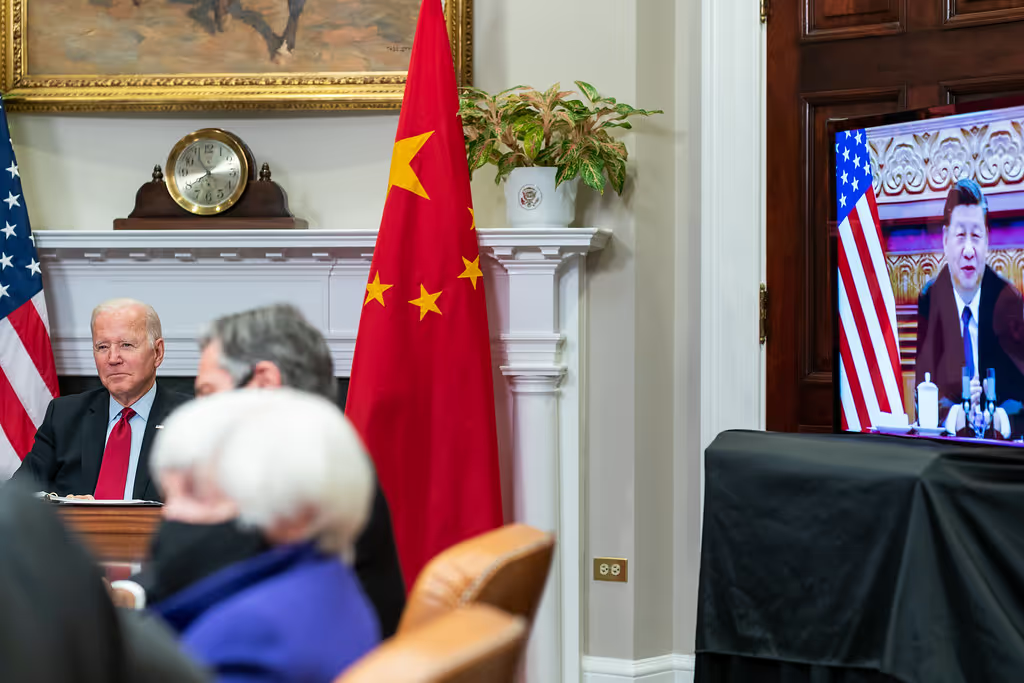
- Brookings experts debate the applicability of the Cold War analogy to the current U.S.-China relationship, considering the economic, political, and military dimensions.
- While the U.S. and China are in a state of competition, it differs fundamentally from the U.S.-Soviet Cold War, particularly due to economic interdependence. China's rise and its political model present unique challenges, but it does not seek to overthrow democratic regimes or force its political model on others.
Overview:
This article, featuring contributions from Patricia M. Kim, Matthew Turpin, Joseph S. Nye Jr., Jessica Chen Weiss, Eun A Jo, Ryan Hass, and Emilie Kimball, explores the question of whether the U.S. should pursue a new Cold War with China.
- The authors debate the applicability of the Cold War analogy to the current U.S.-China relationship, considering the economic, political, and military dimensions.
- They discuss the complexities of the U.S.-China relationship, including economic interdependence and differing political systems.
Key Quotes:
- "China does not pose an existential threat to the U.S. homeland or way of life." - Patricia M. Kim
- "The United States and China are deeply suspicious of and hostile to the worldview of the other." - Matthew Turpin
What They Discuss:
- The U.S. and China are in a state of competition, but it differs fundamentally from the U.S.-Soviet Cold War, particularly due to economic interdependence.
- China's rise and its political model present unique challenges, but it does not seek to overthrow democratic regimes or force its political model on others.
- The U.S. needs a nuanced strategy to address China's military ambitions, economic practices, and diplomatic influence.
- The debate considers whether the U.S. should engage in containment strategies or seek a more cooperative approach.
- The authors emphasize the importance of understanding China's perspective and the potential consequences of U.S. policies.
What They Recommend:
- A multidimensional approach to U.S.-China relations, balancing competition with cooperation where possible.
- Strengthening alliances and international institutions to shape China's external behavior.
- Avoiding total economic decoupling, which would be costly and counterproductive.
- Developing strategies that consider the long-term implications of U.S. actions on the global order.
Key Takeaways:
- The U.S.-China relationship is complex and requires a careful, strategic approach that differs from past Cold War tactics.
- Economic interdependence and global challenges like climate change necessitate some level of cooperation.
- The U.S. should focus on shaping China's behavior through alliances, international institutions, and domestic strength.
This is a brief overview of the aforementioned work from the Brookings Institution. For complete insights, we recommend reading the full article.
Should the US pursue a new Cold War with China?
- Brookings experts debate the applicability of the Cold War analogy to the current U.S.-China relationship, considering the economic, political, and military dimensions.
- While the U.S. and China are in a state of competition, it differs fundamentally from the U.S.-Soviet Cold War, particularly due to economic interdependence. China's rise and its political model present unique challenges, but it does not seek to overthrow democratic regimes or force its political model on others.
U.S.-China Relations

- The U.S. should prioritize negotiating a humanitarian ceasefire in the Israel-Hamas conflict and ensure robust humanitarian aid to Gaza, while supporting Israel's defense needs without contributing to collective punishment against Palestinians.
- It's important for the U.S. to enforce policies on civilian protection and human rights in the conflict, and to lead diplomatic efforts for a political solution that fosters lasting peace between Israelis and Palestinians.
Overview:
This article by Patrick Gaspard and Allison McManus at the Center for American Progress discusses the Israel-Hamas conflict and outlines five actions that Washington should prioritize in response to the situation. The article emphasizes the United States' obligation to support Israel's defense, while also advocating for a balanced approach that considers the humanitarian impact on Palestinians
Key Points:
- The article calls for an immediate humanitarian ceasefire to address the catastrophic consequences for Palestinians in Gaza and to develop a long-term strategy to combat Hamas.
- It highlights the need for the United States to support Israel’s defense needs, particularly in light of Hamas' terror attack on Israeli civilians.
Key Quotes:
- "The United States has an unshakeable obligation to Israel. But being tethered to Israel is not the same as granting absolute proxy to a discredited Netanyahu to conduct wide-scale warfare."
- "The United States must support Israel’s efforts to defend its citizens against these attacks by providing critical funding to maintain the country’s Iron Dome system and deliver other defense assets."
What They Discuss:
- The need for a negotiated ceasefire to allow for humanitarian aid and a clearer long-term strategy.
- Support for Israel's defense needs while ensuring that U.S. assistance does not contribute to collective punishment against Palestinians.
- The importance of protecting humanitarian assistance to the people of Gaza and funding long-term efforts to rebuild the region.
- The necessity for compliance with U.S. policies on civilian protection and human rights in the use of American weapons.
- The role of U.S. diplomacy in advancing a political solution and the need for new leadership in Israel and Palestine.
What They Recommend:
- Urging an immediate humanitarian ceasefire to alleviate the situation in Gaza.
- Supporting Israel's defense needs while making clear that collective punishment against Palestinians is counterproductive.
- Protecting and funding robust humanitarian assistance programs for Gaza.
- Ensuring that arms transfers to Israel adhere to U.S. laws and policies on civilian protection and human rights.
- Centering U.S. diplomacy to advance a political solution that can deliver lasting peace for Israelis and Palestinians.
Key Takeaways:
- The article underscores the complexity of the Israel-Hamas conflict and the need for a balanced U.S. response.
- It highlights the importance of addressing both the defense needs of Israel and the humanitarian crisis in Gaza.
- The recommendations focus on diplomatic efforts, humanitarian aid, and a strategic approach to military support.
This is a brief overview of the article from the Center for American Progress. For complete insights, we recommend reading the full article.
Israel-Hamas Conflict: 5 Actions Washington Should Prioritize Now
- The U.S. should prioritize negotiating a humanitarian ceasefire in the Israel-Hamas conflict and ensure robust humanitarian aid to Gaza, while supporting Israel's defense needs without contributing to collective punishment against Palestinians.
- It's important for the U.S. to enforce policies on civilian protection and human rights in the conflict, and to lead diplomatic efforts for a political solution that fosters lasting peace between Israelis and Palestinians.