.avif)
.avif)
.avif)
.avif)
.avif)

















.avif)






Search Insights

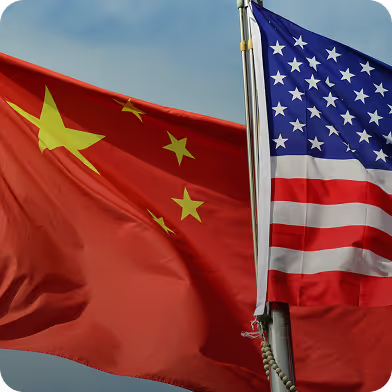
New export restrictions imposed by China on rare earth elements have significant implications for U.S. sourcing of these critical materials, particularly for defense technologies. The restrictions require licenses for exports, potentially disrupting supply chains and impacting U.S. firms, especially in the defense sector, per commentary from Center for Strategic and International Studies.
New export restrictions imposed by China on rare earth elements have significant implications for U.S. sourcing of these critical materials, particularly for defense technologies. The restrictions require licenses for exports, potentially disrupting supply chains and impacting U.S. firms, especially in the defense sector, per commentary from Center for Strategic and International Studies.
The issue:
China has imposed new export restrictions on seven rare earth elements (REEs) essential for industries like defense and energy. This move could halt exports as a licensing system is established, leading to significant supply disruptions for U.S. firms, particularly in defense.
Go deeper:
China accounts for 99 percent of global heavy REE processing, creating a near-monopoly that the U.S. struggles to counter. While the Department of Defense aims to develop a complete REE supply chain by 2027, current U.S. production capabilities remain underdeveloped, leaving it vulnerable. The need for international partnerships is critical to secure alternative sources and reduce reliance on China.
This is a brief overview of an article from Center for Strategic and International Studies. For complete insights, we recommend reading the full an article.

The Consequences of China’s New Rare Earths Export Restrictions
New export restrictions imposed by China on rare earth elements have significant implications for U.S. sourcing of these critical materials, particularly for defense technologies. The restrictions require licenses for exports, potentially disrupting supply chains and impacting U.S. firms, especially in the defense sector, per commentary from Center for Strategic and International Studies.
U.S.-China Relations
.avif)
President Trump’s latest tariff plan is under fire from a conservative think tank, which says the math behind it is both flawed and misleading. The American Enterprise Institute (AEI) warns that the formula used by the White House drastically overstates the trade barriers imposed by foreign countries — and risks harming the U.S. economy.
President Trump’s latest tariff plan is under fire from a conservative think tank, which says the math behind it is both flawed and misleading. The American Enterprise Institute (AEI) warns that the formula used by the White House drastically overstates the trade barriers imposed by foreign countries — and risks harming the U.S. economy.
The issue:
The Trump administration’s “reciprocal” tariff formula calculates foreign tariffs based on the U.S. trade deficit — not on actual policy. AEI says this leads to exaggerated numbers, because the formula mistakenly uses retail price data instead of import price data. That misstep inflates estimated foreign tariffs by 400%, resulting in U.S. tariffs as high as 50% — even in cases where trade barriers are low or non-existent.
What they recommend:
AEI calls for a correction to the formula. Doing so would reduce most tariffs to the 10% minimum floor, ease global trade tensions, and lower the risk of recession — all without abandoning the administration’s stated goals.
Go deeper:
AEI emphasizes that trade deficits are shaped by many factors, including international capital flows and supply chains, not just tariffs. And even if the formula had merit (which AEI disputes), it was applied incorrectly. Fixing this basic error could offer quick relief to U.S. businesses and consumers while restoring credibility to trade policy.
This is a brief overview of a post from the American Enterprise Institute. For complete insights, we recommend reading the full article.

President Trump’s Tariff Formula Makes No Economic Sense. It’s Also Based on an Error.
President Trump’s latest tariff plan is under fire from a conservative think tank, which says the math behind it is both flawed and misleading. The American Enterprise Institute (AEI) warns that the formula used by the White House drastically overstates the trade barriers imposed by foreign countries — and risks harming the U.S. economy.
U.S. Economy
The Democratic Party is currently facing significant challenges in regaining favor after recent electoral losses, as only 33 percent of Americans view the party positively. The party's struggle to adapt and connect with voters indicates a pressing need for strategic changes to compete effectively in future elections, per commentary from American Enterprise Institute.
The Democratic Party is currently facing significant challenges in regaining favor after recent electoral losses, as only 33 percent of Americans view the party positively. The party's struggle to adapt and connect with voters indicates a pressing need for strategic changes to compete effectively in future elections, per commentary from American Enterprise Institute.
The issue:
The Democratic Party is leaderless and more unpopular than ever, with only 33 percent of Americans holding a favorable view of it. This represents the party's lowest rating since 1992, as Republicans continue to outregister Democrats in crucial swing states.
What they recommend:
No recommendations provided in the commentary.
Go deeper:
The Democratic Party must recognize that dismissing popular aspects of Trump's policies will hinder their recovery. Experts suggest that acknowledging voters’ priorities, such as border security and energy abundance, can help Democrats regain ground lost in recent elections. The need for moderation on contentious issues, including immigration and DEI, can create opportunities for compromise and connection with a broader electorate.
This is a brief overview of an op-ed from American Enterprise Institute. For complete insights, we recommend reading the full an op-ed.

Trump 2.0: A Survival Guide for Democrats
The Democratic Party is currently facing significant challenges in regaining favor after recent electoral losses, as only 33 percent of Americans view the party positively. The party's struggle to adapt and connect with voters indicates a pressing need for strategic changes to compete effectively in future elections, per commentary from American Enterprise Institute.
Artificial Intelligence

The federal government's effort to downsize may lead to increased privatization and automation. This shift raises concerns about the accessibility and fairness of services for Americans reliant on government support, per commentary from Brookings.
The federal government's effort to downsize may lead to increased privatization and automation. This shift raises concerns about the accessibility and fairness of services for Americans reliant on government support, per commentary from Brookings.
The issue:
The core challenge involves significant federal workforce reductions that may accelerate the outsourcing and automation of government functions. Many essential services could become less accessible, particularly to marginalized groups, as over 20 million households lost broadband access this year.
What they recommend:
No recommendations provided in the commentary.
Go deeper:
As AI technologies integrate into government services, concerns about bias and data privacy heighten, particularly as previous initiatives for responsible AI use were rescinded. A Stanford University study highlighted that the IRS's AI systems disproportionately targeted Black taxpayers, indicating potential systemic inequities in future implementations. Addressing the digital divide is critical, as disconnected populations risk being left behind as services shift online.
This is a brief overview of a commentary from Brookings. For complete insights, we recommend reading the full commentary.

How federal layoffs set the stage for greater privatization and automation of the US government
The federal government's effort to downsize may lead to increased privatization and automation. This shift raises concerns about the accessibility and fairness of services for Americans reliant on government support, per commentary from Brookings.
U.S. Government & Politics
In exploring how military deployment could shape domestic governance, recent discussions highlight potential risks under the Trump administration. The report indicates that such actions, unless carefully monitored, could undermine constitutional safeguards and public safety, per commentary from Center for American Progress.
In exploring how military deployment could shape domestic governance, recent discussions highlight potential risks under the Trump administration. The report indicates that such actions, unless carefully monitored, could undermine constitutional safeguards and public safety, per commentary from Center for American Progress.
The issue:
The deployment of the military for law enforcement poses significant challenges to civil liberties and public safety. Historical patterns and modern proposals suggest an ambiguous legal framework that could enable extensive military use against civilians.
What they recommend:
No recommendations provided in the commentary.
Go deeper:
The report underscores that past military actions in civilian areas, like the response to the Rodney King riots, reveal the dangers of using combat-trained troops for domestic issues. The military’s different training and rules of engagement can escalate situations rather than de-escalate them, risking civilian lives. Concern also exists regarding how current military leadership may approach domestic deployment, particularly under politically charged circumstances.
This is a brief overview of a report from Center for American Progress. For complete insights, we recommend reading the full report.
Domestic Deployment of the Military: The Past, Present, and Potential Future
In exploring how military deployment could shape domestic governance, recent discussions highlight potential risks under the Trump administration. The report indicates that such actions, unless carefully monitored, could undermine constitutional safeguards and public safety, per commentary from Center for American Progress.
U.S. Military & Defense
Inflation has severely impacted the financial stability of American seniors, requiring many to work an average of six additional years to secure their retirement plans, largely due to mismanagement in Washington.
Inflation has severely impacted the financial stability of American seniors, requiring many to work an average of six additional years to secure their retirement plans, largely due to mismanagement in Washington.
The issue:
- Seniors’ retirement accounts have suffered significant losses, with many unrecognized due to a stock market rally.
- The S&P 500 rose 45% from Q1 2021 to Q3 2023, but half of that gain stemmed from inflation, not an increase in actual value.
- Inflation-adjusted returns were only 22%, exposing seniors who typically invest in safer, fixed income assets to major losses.
- Bond returns have experienced the worst performance in over a century, exacerbating the financial strain on retirees.
- A 20% rise in prices means the purchasing power of savings has drastically declined, forcing many seniors to reconsider their retirement strategies.
- For a planned retirement net worth of $1 million, an additional $200,000 is now necessary to maintain previous living standards.
- Many seniors mistakenly equate increasing dollar amounts in accounts with fixed value, overlooking inflation's impact.
- Pension plans are also under pressure, facing insolvency as inflation outpaces benefit projections.
What they recommend:
- Experts suggest increasing awareness about the real impact of inflation on retirement savings and encourage strategic financial planning to account for purchasing power decreases.
- There is a need for reform in economic policy to stabilize and better manage federal spending, mitigating inflationary effects.
- Improved financial education can help seniors understand the dynamics of their investments and the potential need for adjustments in their retirement plans.
Go deeper:
The study reveals that while average 401(k) balances show nominal gains, inflation has effectively reduced these balances’ real value. Moreover, pension funds, despite a nominal increase of $2.3 trillion, saw their inflation-adjusted value decrease by $2.5 trillion, indicating a systemic crisis in retirement funding exacerbated by rising inflation and interest rates.
Conclusion:
This is a brief overview of the article by EJ Antoni at Heritage Foundation, published on 2024-11-08. For complete insights, we recommend reading the full article.
Seniors Are Getting Crushed by Washington’s Recklessness
Inflation has severely impacted the financial stability of American seniors, requiring many to work an average of six additional years to secure their retirement plans, largely due to mismanagement in Washington.
U.S. Economy
The U.S. dollar has seen a moderate increase since Donald Trump's election victory, reflecting expectations of fiscal easing and stronger growth. A larger surge in dollar strength may occur if tariffs are imposed on China, potentially leading to significant global financial impacts, per commentary from Brookings.
The U.S. dollar has seen a moderate increase since Donald Trump's election victory, reflecting expectations of fiscal easing and stronger growth. A larger surge in dollar strength may occur if tariffs are imposed on China, potentially leading to significant global financial impacts, per commentary from Brookings.
The issue:
The dollar's rise is influenced by investor expectations of U.S. fiscal policy changes, similar to trends observed after the 2016 election. A potential new phase of dollar strength could emerge with tariffs on China, risking severe depreciation in emerging markets and affecting commodity prices.
What they recommend:
No recommendations provided in the commentary.
Go deeper:
The report highlights a historical precedent from 2018, where U.S. tariffs led to a comparable fall of the yuan against the dollar, affecting global markets negatively. Tariffs could prompt China to buy more U.S. goods, potentially harming countries like Brazil and the EU, which heavily export to China. This dynamic could tighten global financial conditions, increasing risks for the U.S. economy.
This is a brief overview of a commentary from Brookings. For complete insights, we recommend reading the full commentary.
The dollar and global markets after the US election
The U.S. dollar has seen a moderate increase since Donald Trump's election victory, reflecting expectations of fiscal easing and stronger growth. A larger surge in dollar strength may occur if tariffs are imposed on China, potentially leading to significant global financial impacts, per commentary from Brookings.
2024 U.S. Elections
Contrary to optimistic stock market signals, global economic troubles are intensifying, especially in the U.S. and China, with looming challenges in public finance and property markets, per commentary from American Enterprise Institute.
Contrary to optimistic stock market signals, global economic troubles are intensifying, especially in the U.S. and China, with looming challenges in public finance and property markets, per commentary from American Enterprise Institute.
The issue:
The world economy faces significant challenges as the U.S. public finances are on an unsustainable path, with a projected budget deficit above six percent of GDP for years. China is also suffering from a housing bubble collapse, resulting in slower growth and declining property values.
What they recommend:
No recommendations provided in the commentary.
Go deeper:
The potential for a trade war initiated by the incoming Trump administration could severely impact both the U.S. and Chinese economies, further escalating tensions. In Europe, existing economic weaknesses, particularly in Germany and Italy, coupled with political dysfunction, could spark another Eurozone debt crisis. This complex landscape raises questions about the current high stock market valuations, echoing historical instances where markets failed to predict economic turmoil.
This is a brief overview of a blog from American Enterprise Institute. For complete insights, we recommend reading the full blog.
A Troubled World Economy
Contrary to optimistic stock market signals, global economic troubles are intensifying, especially in the U.S. and China, with looming challenges in public finance and property markets, per commentary from American Enterprise Institute.
Global Economy
Cutting federal government spending under the Trump administration may harm essential public services, creating significant backlash from citizens. Disruption caused by deep cuts could lead to political repercussions, complicating the government's efficiency goals, per commentary from Brookings.
Cutting federal government spending under the Trump administration may harm essential public services, creating significant backlash from citizens. Disruption caused by deep cuts could lead to political repercussions, complicating the government's efficiency goals, per commentary from Brookings.
The issue:
The federal government’s primary challenge lies in reducing spending without jeopardizing essential services that Americans rely on, such as Social Security and Medicare. Mandatory spending accounts for 66% of the 2022 budget, leaving limited room for cuts in discretionary spending.
What they recommend:
No recommendations provided in the commentary.
Go deeper:
Expert analysis suggests that a drastic reduction in the federal workforce, such as an 80% cut, would severely impair essential services like air traffic control and border security. Historical examples, such as the National Performance Review, highlight the importance of targeted reforms rather than sweeping cuts. Leveraging modern technology and a thorough agency-by-agency review could yield better outcomes without compromising public safety or services.
This is a brief overview of a commentary from Brookings. For complete insights, we recommend reading the full commentary.
Cut the government with a scalpel, not an axe
Cutting federal government spending under the Trump administration may harm essential public services, creating significant backlash from citizens. Disruption caused by deep cuts could lead to political repercussions, complicating the government's efficiency goals, per commentary from Brookings.
2024 U.S. Elections
With Donald Trump's potential return to the White House, global partners must adapt to a shift toward an "America First" foreign policy. This approach prioritizes U.S. interests and presents a more unpredictable stance towards international relations, per commentary from Center for Strategic and International Studies.
With Donald Trump's potential return to the White House, global partners must adapt to a shift toward an "America First" foreign policy. This approach prioritizes U.S. interests and presents a more unpredictable stance towards international relations, per commentary from Center for Strategic and International Studies.
The issue:
The core challenge is Trump's transactional view of foreign alliances, where he demands that allies pay their fair share or risk U.S. support. For instance, Trump has stated that nations relying on U.S. defense without adequate financial contributions could face abandonment in crises.
What they recommend:
No recommendations provided in the commentary.
Go deeper:
Trump's policies may create divisions within NATO and affect the dynamics in the Indo-Pacific region, leading to increased tensions among allies. His criteria for evaluating alliances involve trade surpluses and defense spending, categorizing partners into "Safe" and "Danger" zones. Allies not meeting his expectations may face scrutiny and reduced support.
This is a brief overview of a commentary from Center for Strategic and International Studies. For complete insights, we recommend reading the full commentary.
How Trump Sees Allies and Partners
With Donald Trump's potential return to the White House, global partners must adapt to a shift toward an "America First" foreign policy. This approach prioritizes U.S. interests and presents a more unpredictable stance towards international relations, per commentary from Center for Strategic and International Studies.