


.avif)


.avif)
.avif)
.avif)
.avif)
.avif)


















.avif)






Search Insights

- Adam N. Michel at Cato Institute argues that tax policy's prominence in the presidential campaign is due to the impending expiration of the 2017 Tax Cuts and Jobs Act and the candidates' proposals for new special-interest tax breaks that complicate and increase the tax code's complexity.
- The report asserts that while there is bipartisan support for extending most of the expiring tax cuts, proposed targeted benefits for tips, families, homeowners, domestic production, and seniors will further complicate the tax system and pose significant fiscal challenges.
Overview:
This article was written by Adam N. Michel at Cato Institute.
- Lawmakers will soon confront the expiration of the 2017 Tax Cuts and Jobs Act.
- Both presidential candidates propose extensive new tax breaks, complicating efforts to simplify the tax code.
Key Quotes:
- "The prominence of tax policy makes sense. In the first year of the next administration, lawmakers will have to address the automatic expiration of almost all of the 2017 Tax Cuts and Jobs Act."
- "Despite the rhetoric, the 2017 tax cut was primarily a tax cut for typical Americans. Over three-quarters (77 percent) of the original tax cut went to individuals, with the largest tax reductions going to the lowest-income taxpayers."
What They Discuss:
- Trump and Harris propose tax exemptions for tipped income, risking up to $500 billion in lost revenue over ten years.
- Both candidates support significant increases in child tax credits, potentially decreasing revenue by trillions of dollars.
- Harris’s $25,000 subsidy for first-time homeowners could cost over $600 billion, mostly benefiting sellers and banks.
- Proposals for specific industries, like domestic production incentives, may reduce revenues and revive previously inefficient policies.
- Exempting Social Security income from taxes, as Trump suggests, could increase the budget deficit by $1.6 trillion over a decade.
What They Recommend:
- Maintain and extend the successful broad-based tax cuts from 2017.
- Avoid new complexity and special-interest tax breaks that undermine the simplified tax code.
- Focus on comprehensive tax reforms that reduce rates and eliminate targeted subsidies and deductions.
- Prioritize broad tax relief over hyper-targeted subsidies that skew economic incentives and increase overall tax complexity.
Key Takeaways:
- Extending the 2017 tax cuts is broadly supported but costly.
- Both candidates' proposals for tax breaks risk adding complexity and inequality to the tax system.
- Increased tax breaks for specific groups could exacerbate deficits and economic disparities.
- Comprehensive reform is needed to maintain lower tax rates and reduce special-interest provisions.
This is a brief overview of the article by Adam N. Michel at Cato Institute. For complete insights, we recommend reading the full article.

Trump, Harris, and All the Wrong Ways to Do Tax Reform
- Adam N. Michel at Cato Institute argues that tax policy's prominence in the presidential campaign is due to the impending expiration of the 2017 Tax Cuts and Jobs Act and the candidates' proposals for new special-interest tax breaks that complicate and increase the tax code's complexity.
- The report asserts that while there is bipartisan support for extending most of the expiring tax cuts, proposed targeted benefits for tips, families, homeowners, domestic production, and seniors will further complicate the tax system and pose significant fiscal challenges.
2024 U.S. Elections

- Urban Institute experts write that the Biden administration's rent stabilization proposal aims to cap annual rent increases at 5% for units owned by large landlords, conditioned on maintaining existing tax breaks, aiming to stabilize housing and protect tenants from eviction or displacement.
- The experts argue that while the proposal could make more units affordable for low-income residents, it may also reduce the overall supply of rental units as landlords might convert properties or avoid entering the market, potentially driving up rents for uncontrolled units.
Overview:
This article was written by Christina Stacy, Gabe Samuels, and Donovan Harvey at Urban Institute.
- Rent stabilization can protect tenants but may also reduce the overall supply of rental units, thus creating a trade-off between immediate tenant protections and long-term housing availability.
- Effective policy design and enforcement are crucial for ensuring that rent stabilization benefits those most in need while preventing unintended consequences such as reduced housing supply and increased costs for non-controlled units.
Key Quotes:
- "The success of this policy hinges on its design and implementation. Our new research shows that while rent stabilization increases the number of units affordable to residents with extremely low incomes, on average, it also reduces the overall supply of rental units."
- "Proactive enforcement can reduce the burden on tenants to know their rights and report violations. But although proactive enforcement is better for vulnerable tenants, it can be very expensive."
What They Discuss:
- The proposal limits annual rent increases to 5 percent for existing units owned by landlords with more than 50 units, leveraging depreciation tax breaks as an incentive for compliance.
- Research indicates a trade-off: rent stabilization can make more units affordable for low-income residents while also potentially decreasing the overall supply of rental units.
- Exemptions and application scope: The proposal exempts new construction and substantial renovations from rent caps, focusing on corporate landlords but not smaller landlords.
- Adaptation of local models: Similar to California’s Tenant Protection Act, rent caps are often tied to inflation indexes plus an additional percentage, capped to protect tenants during high inflation years.
- Enforcement challenges: Ensuring landlords comply with rent stabilization laws may require proactive enforcement measures, such as data collection and monitoring, which can be resource-intensive.
What They Recommend:
- Federal policymakers should determine whether to allow for vacancy decontrol or enact vacancy control to prevent rent increases between tenants.
- Implement just cause eviction protections alongside rent stabilization to reduce tenant displacement.
- Develop a comprehensive tracking and monitoring system to effectively enforce rent stabilization laws and ensure compliance.
- To prevent pre-implementation rent hikes, consider extending the stabilization period and setting base rents at prior years' levels.
- Policymakers should not exempt smaller landlords from rent stabilization regulations to ensure tenant protections are uniformly applied.
Key Takeaways:
- Rent stabilization policies can provide immediate tenant protections but require careful design to avoid reducing the long-term supply of rental units.
- Determining the scope of application and exemptions is crucial to balancing landlord incentives and tenant protections.
- Effective enforcement is key to ensuring compliance and protecting tenants, but it requires significant resources and investment.
- Properly crafted rent stabilization policies must consider potential loopholes landlords might exploit and aim to close these gaps through comprehensive protections and monitoring.
Disclaimer:
This is a brief overview of the article by Christina Stacy, Gabe Samuels, and Donovan Harvey at Urban Institute. For complete insights, we recommend reading the full article.
Breaking Down the Biden Administration’s National Rent Stabilization Proposal
- Urban Institute experts write that the Biden administration's rent stabilization proposal aims to cap annual rent increases at 5% for units owned by large landlords, conditioned on maintaining existing tax breaks, aiming to stabilize housing and protect tenants from eviction or displacement.
- The experts argue that while the proposal could make more units affordable for low-income residents, it may also reduce the overall supply of rental units as landlords might convert properties or avoid entering the market, potentially driving up rents for uncontrolled units.
U.S. Economy

- Experts at Brookings argue that Kamala Harris has regained lost ground for the Democrats, erasing the "enthusiasm gap" and leading in both national and key swing state polls against Donald Trump.
- They examine the reliability of poll averages, highlighting historical underestimation of Trump’s support and the necessity for Harris to maintain significant momentum to secure victory.
Overview:
This article was written by William A. Galston at Brookings.
- Kamala Harris has gained substantial ground since replacing Joe Biden as the Democratic nominee, closing the enthusiasm gap and outperforming Trump on key personal attributes.
- Although Harris currently leads in many critical states, the election remains highly volatile, with polling inaccuracies and unpredictable events potentially influencing the final outcome.
Key Quotes:
- "In six extraordinary weeks since replacing Joe Biden as the Democratic presidential nominee, Kamala Harris has regained all the ground Biden lost between January and July—and more."
- "We should also be cautious about concluding that Harris now enjoys a clear lead over Trump. In recent elections, not just individual polls but also poll averages have turned out to be misleading."
What They Discuss:
- Averages of multiple polls are more reliable than individual polls, with RealClearPolitics and FiveThirtyEight offering different methodologies.
- Harris's lead in crucial "Blue Wall" states could provide her with the 270 electoral votes needed, but this is not guaranteed.
- Historical inaccuracy of polls, especially in estimating Trump's support, underscores the need for caution.
- Polling errors have been more pronounced in key swing states compared to other regions.
- Issues such as inflation may play a more significant role in voter preferences this election cycle, over issues like abortion.
What They Recommend:
- Be cautious about relying solely on current poll data, as past inaccuracies have shown.
- Consider multiple sources and types of polling data to get a more comprehensive view of the race.
- Stay alert for shifts in campaign dynamics, especially after significant events like debates.
Key Takeaways:
- Harris's early surge in support does not necessarily secure her victory due to the fluid nature of electoral politics.
- Polling errors, particularly underestimating Trump’s support, have been significant in past elections.
- Key issues and voter demographics today may not align perfectly with past election cycles.
- Election outcomes likely depend on a small number of votes in crucial swing states, making the race highly competitive and unpredictable.
This is a brief overview of the article by William A. Galston at Brookings. For complete insights, we recommend reading the full article.
Is Kamala Harris leading Donald Trump in the presidential race?
- Experts at Brookings argue that Kamala Harris has regained lost ground for the Democrats, erasing the "enthusiasm gap" and leading in both national and key swing state polls against Donald Trump.
- They examine the reliability of poll averages, highlighting historical underestimation of Trump’s support and the necessity for Harris to maintain significant momentum to secure victory.
2024 U.S. Elections
- Elaine Kamarck and William A. Galston at Brookings examine that the Republican National Convention highlighted a stark contrast between a verbose Trump and a struggling Biden, leading to widespread speculation about Biden's potential exit and Kamala Harris's possible rise as the Democratic candidate.
- The article argues that while Trump missed an opportunity to solidify his lead with a long-winded, undisciplined speech, Democratic officials and voters are increasingly viewing Biden as a weakened candidate, potentially paving the way for Harris to step in and challenge Trump's controversial policies.
Overview:
This article was written by Elaine Kamarck and William A. Galston at Brookings.
- The article provides a detailed account of the final day of the Republican National Convention (RNC), highlighting the split-screen scenario with Joe Biden and Donald Trump.
- It examines the political implications of Biden's potential exit from the presidential race and Trump's extended, unfocused speech.
Key Quotes:
- "The whole political world was trying to figure out whether Biden was about to exit the stage, just as Trump was returning to it."
- "Trump did not finish his speech until after midnight. By then, much of the energy had drained from the crowd at the convention hall."
What They Discuss:
- Reporters at the RNC in Milwaukee were diverted to cover stories about the Democrats, primed by rumors of Biden's potential exit.
- Democratic figures, including Barack Obama and Nancy Pelosi, have reportedly urged Biden to leave the race, leading Biden to feel "betrayed by his former friends."
- Nearly two-thirds of Democratic voters now want Biden to step down, reflecting growing concerns about his age and capabilities.
- 20 to 30 members of Congress publicly or privately suggested that Biden should consider stepping down.
- Trump's 92-minute speech, the longest since 1972, meandered through various topics, largely repeating grievances and failing to maintain structure.
What They Recommend:
- The authors imply that Democrats need to quickly solidify their candidate to effectively counter Trump's campaign.
- They suggest Vice President Kamala Harris as the likely successor if Biden exits, noting the importance of an energetic and vigorous candidate.
- Democrats should prepare for a potential upheaval in the campaign to improve their chances of victory.
Key Takeaways:
- The RNC showcased a polarized image of the presidential race, with Trump dominating the screen and Biden's potential withdrawal overshadowing proceedings.
- Biden's frailty and growing discontent among Democratic voters and officials may push him to exit the race, likely paving the way for Kamala Harris.
- Trump's long, disorganized speech failed to capitalize on his recent gains, leaving the door open for a strong Democratic challenger.
This is a brief overview of the article by Elaine Kamarck and William A. Galston at Brookings. For complete insights, we recommend reading the full article.
Trump misses a golden opportunity in his acceptance speech
- Elaine Kamarck and William A. Galston at Brookings examine that the Republican National Convention highlighted a stark contrast between a verbose Trump and a struggling Biden, leading to widespread speculation about Biden's potential exit and Kamala Harris's possible rise as the Democratic candidate.
- The article argues that while Trump missed an opportunity to solidify his lead with a long-winded, undisciplined speech, Democratic officials and voters are increasingly viewing Biden as a weakened candidate, potentially paving the way for Harris to step in and challenge Trump's controversial policies.
2024 U.S. Elections
- Elaine Kamarck at Brookings writes that Joe Biden's endorsement of Kamala Harris for the Democratic Party's nomination is due to her extensive presidential-level vetting, practical time constraints, and her robust political experience.
- The article asserts that Harris' widespread delegate support, substantial financial backing, and the urgent need for party unity and focus on the general election are key reasons for the swift consolidation around her candidacy.
Overview:
This article was written by Elaine Kamarck at Brookings.
- Joe Biden dropped out of the presidential race and endorsed Kamala Harris, who has swiftly consolidated support within the Democratic Party.
- Several factors, including immediate vetting, logistical time constraints, and her qualifications, contributed to the rapid consolidation around Harris's candidacy.
Key Quotes:
- "In order to become vice president in the first place, Harris passed the vetting test, and four years in the White House was plenty of time for any other skeletons in her closet to be outed."
- "Kamala has been in the White House for nearly four full years, she has led delegations overseas, she has listened to classified briefings, she has negotiated with Congress."
What They Discuss:
- The party decided quickly to support Harris due to the lack of time and the extensive vetting she has already undergone as Vice President.
- While proposals for a mini-primary to replace Biden were floated, logistical challenges made this impractical.
- Other potential candidates showed no substantial initiative to run against Harris, such as rallying delegate support.
- Harris’s deep involvement in significant political activities and readiness to assume presidential duties made her the most suitable candidate.
- A swift transition to Harris helps the party focus on the general election, avoiding prolonged uncertainty and disorganization.
What They Recommend:
- Follow existing convention rules to officially nominate Harris, bypassing the need for elaborate new procedures.
- Leverage the already pledged delegate support to formalize the nomination quickly and efficiently.
- Maintain momentum into the general election campaign to capitalize on the current unity and fundraising success.
Key Takeaways:
- Kamala Harris is recognized as the best-prepared candidate to replace Biden, owing to her experience and rapid endorsement from delegates.
- Time constraints and logistical challenges prevented a more drawn-out selection process.
- Unifying behind Harris helps the Democratic Party avoid further chaos and positions it strongly against the Republicans in the upcoming general election.
This is a brief overview of the article by Elaine Kamarck at Brookings. For complete insights, we recommend reading the full article.
Why is Kamala Harris wrapping up the Democratic nomination so quickly?
- Elaine Kamarck at Brookings writes that Joe Biden's endorsement of Kamala Harris for the Democratic Party's nomination is due to her extensive presidential-level vetting, practical time constraints, and her robust political experience.
- The article asserts that Harris' widespread delegate support, substantial financial backing, and the urgent need for party unity and focus on the general election are key reasons for the swift consolidation around her candidacy.
2024 U.S. Elections

- William H. Frey at Brookings argues that Vice President Kamala Harris's nomination as the Democratic presidential candidate has invigorated the race, with a particular impact on female voters who have historically supported Democratic candidates.
- The analysis reviews that women's votes were crucial in recent elections, highlighting how post-Roe v. Wade changes and Harris’s advocacy on women's issues could lead to a significant voting surge, potentially favoring her in the 2024 election.
Overview:
This article was written by William H. Frey at Brookings.
- Vice President Kamala Harris's nomination as the Democratic presidential candidate has generated significant enthusiasm, particularly among women voters.
- The impact of the women’s vote, especially considering recent historical contexts such as the rejection of the predicted "red wave" in the 2022 midterm elections, will be pivotal in determining the outcome of the 2024 election.
Key Quotes:
- "Now, just weeks after most polls had President Joe Biden trailing his Republican rival Donald Trump, the emergence of Vice President Harris as the Democratic candidate has already injected enthusiasm among many Democrats, especially women."
- "Women’s health, abortion, and reproductive freedom—issues Harris has championed—will once again be leading issues for this election."
What They Discuss:
- Gender differences in presidential voting preferences demonstrate that women have consistently voted more for Democrats than for Republicans since 1984.
- In the 2020 election, women registered positive Democratic-Republican (D-R) margins in key battleground states, contributing significantly to Democratic successes.
- Women have higher voter turnout rates than men, and they have comprised more than half of all voters in recent elections, with a notable 9.7 million more female than male voters in 2020.
- The female electorate is becoming more diverse and highly educated, with increases in Democratic-favorable groups such as white college graduates and minorities and a decline in Republican-favorable groups like white non-college graduates.
- Polls indicated that Harris's candidacy led to a substantial increase in D-R margins among women, signaling a potential increase in Democratic support and turnout.
What They Recommend:
- Emphasize issues critical to women voters, such as women’s health, abortion rights, paid parental leave, and child care, which are likely to garner significant support for Harris.
- Capitalize on the enthusiasm and increased turnout among women voters to boost Democratic performance in the upcoming election.
- Strategically focus on key demographic shifts, particularly the increase in college-educated and minority women, to maximize voter outreach and support.
Key Takeaways:
- Women have historically supported Democratic candidates more than Republican ones, a trend likely to continue with Harris's nomination.
- Higher voter turnout rates among women and shifting demographics favor Democrats, providing a potential advantage in the election.
- Harris’s focus on women's issues and the newfound enthusiasm among female voters could be game-changing factors for the 2024 election.
This is a brief overview of the article by William H. Frey at Brookings. For complete insights, we recommend reading the full article.
Kamala Harris’s chances in November could hinge on a women’s voting surge
- William H. Frey at Brookings argues that Vice President Kamala Harris's nomination as the Democratic presidential candidate has invigorated the race, with a particular impact on female voters who have historically supported Democratic candidates.
- The analysis reviews that women's votes were crucial in recent elections, highlighting how post-Roe v. Wade changes and Harris’s advocacy on women's issues could lead to a significant voting surge, potentially favoring her in the 2024 election.
2024 U.S. Elections
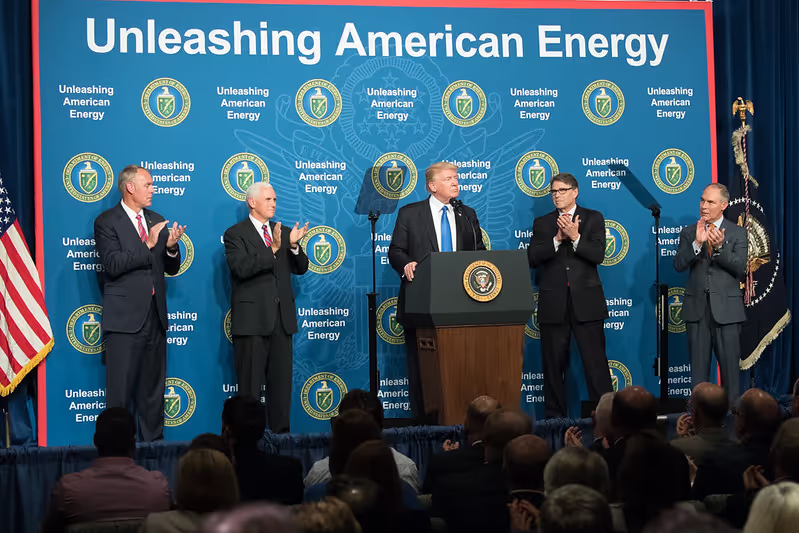
- Samantha Gross and Louison Sall at Brookings argue that Donald Trump advocates for a shift in U.S. energy policy, focusing on fossil fuels, reducing regulations, and opposing renewable energy initiatives to lower energy costs and achieve "energy dominance."
- The article asserts that Trump's ability to implement his energy agenda depends on Congress and the courts, with recent Supreme Court decisions potentially aiding his deregulatory efforts in a second term.
Overview:
This article was written by Samantha Gross and Louison Sall at Brookings.
- A second Trump administration would emphasize fossil fuel dominance and deregulation while rolling back renewable energy initiatives.
- Success in achieving these goals would depend largely on congressional support and judicial interpretations of regulatory laws.
Key Quotes:
- “Trump claims that aggressive drilling policies could reduce energy costs by 50%.”
- "A second Trump administration would likely succeed in changing key regulations, which the executive branch can accomplish on its own."
What They Discuss:
- Trump aims to increase domestic fossil fuel production, refilling the strategic petroleum reserve, and removing delays on federal drilling permits and leases.
- Despite Trump's criticism of Biden’s renewable energy policies, renewable energies like wind and solar have been proven to be cost-effective in many cases.
- Trump's statements on U.S. energy resource sizes are often exaggerated; the U.S. ranks between ninth and 11th for oil reserves and fourth or fifth for natural gas reserves.
- Biden-era climate and energy laws such as the Infrastructure Investment and Jobs Act (IIJA) and the Inflation Reduction Act (IRA) would be difficult to repeal without significant congressional support.
- Supreme Court decisions like West Virginia v. EPA and the end of Chevron deference could aid a Trump administration in rolling back regulations.
What They Recommend:
- The authors recommend looking critically at the feasibility of Trump's energy policy goals, especially his claims about reducing energy costs through increased drilling.
- They suggest understanding the role of existing laws like the IIJA and IRA that may limit the extent to which future administrations can undo current policies.
- They highlight the importance of acknowledging market realities, such as the global pricing of oil, which might undermine the purported benefits of aggressive drilling policies.
Key Takeaways:
- Achieving Trump's extensive energy policy changes requires more than executive orders; congressional support and judicial interpretations are crucial.
- A rightward shift in federal courts and more experienced administration staff could make regulatory rollbacks more likely under a potential second Trump administration.
- Renewable energy initiatives face strong opposition from Trump, but existing investments and policies under Biden may provide resilience against complete rollbacks.
- Supreme Court rulings on administrative law could lead to significant changes in how regulations are interpreted and enforced.
This is a brief overview of the article by Samantha Gross and Louison Sall at Brookings. For complete insights, we recommend reading the full article.
Trump has big plans for climate and energy policy, but can he implement them?
- Samantha Gross and Louison Sall at Brookings argue that Donald Trump advocates for a shift in U.S. energy policy, focusing on fossil fuels, reducing regulations, and opposing renewable energy initiatives to lower energy costs and achieve "energy dominance."
- The article asserts that Trump's ability to implement his energy agenda depends on Congress and the courts, with recent Supreme Court decisions potentially aiding his deregulatory efforts in a second term.
2024 U.S. Elections
- Ryan C. Berg and Christopher Hernandez-Roy at Center for Strategic and International Studies analyze that Venezuela's recent elections showcased a blatant electoral theft by President Maduro, who manipulated election conditions, barred opposition candidates, and used repression to secure a disputed victory over Edmundo González.
- The article asserts that the Maduro regime’s fraudulent actions, including blocking international observations and harassing opposition supporters, risk severe international isolation and a possible constitutional crisis if vote tabulations are not transparently released, undermining any claims to democratic legitimacy.
Overview:
This article was written by Ryan C. Berg and Christopher Hernandez-Roy at Center for Strategic and International Studies.
- It outlines the events leading up to, during, and following the contested Venezuelan election, marking a severe electoral fraud by President Nicolás Maduro.
- The opposition's preparations and international response are critical to understanding the larger implications on regional stability and democratic integrity.
Key Quotes:
- Opposition leader María Corina Machado stated, "There are only two outcomes: a landslide victory or an obscene fraud."
- President Nicolás Maduro had asserted his determination to win "by hook or by crook," foreshadowing the electoral manipulations.
What They Discuss:
- The Venezuelan regime failed to meet any conditions for free and fair elections, as agreed in the Barbados agreement.
- The opposition's candidate Edmundo González Urrutia was shown to lead by a significant margin, according to multiple polls, contradicting the CNE's official results.
- The regime conducted widespread repression, detaining opposition members and obstructing their campaigns.
- The National Electoral Council limited voter participation, especially among the diaspora of 5 million eligible citizens.
- International actors, including Colombia and Brazil, have withheld recognition of the election results, emphasizing the necessity for transparency.
What They Recommend:
- The opposition needs to maintain large and impactful protests to draw international attention and support.
- Leveraging findings from credible organizations like the Carter Center and the OAS is crucial to discrediting the fraudulent election.
- Civil society organizations should continue to document and share evidence of electoral abuses.
- Acquiring and publicizing unaltered vote tabulation sheets is essential to proving electoral fraud.
Key Takeaways:
- The Venezuelan election was marred by severe irregularities and fraud, undermining democratic principles.
- The Maduro regime has engaged in significant repression to maintain power, posing risks to stability.
- International recognition of the election results is divided, with key countries yet to endorse Maduro's victory.
- The opposition's strategy focuses on continuing protests, leveraging international support, and substantiating their claims of fraud through evidence.
This is a brief overview of the article by Ryan C. Berg and Christopher Hernandez-Roy at Center for Strategic and International Studies. For complete insights, we recommend reading the full article.
Can Maduro Pull off the Mother of All Electoral Frauds?
- Ryan C. Berg and Christopher Hernandez-Roy at Center for Strategic and International Studies analyze that Venezuela's recent elections showcased a blatant electoral theft by President Maduro, who manipulated election conditions, barred opposition candidates, and used repression to secure a disputed victory over Edmundo González.
- The article asserts that the Maduro regime’s fraudulent actions, including blocking international observations and harassing opposition supporters, risk severe international isolation and a possible constitutional crisis if vote tabulations are not transparently released, undermining any claims to democratic legitimacy.
International Affairs
- Experts at the Carnegie Endowment for International Peace argue that China's Third Plenum communiqué remains vague on demand-side measures, even though boosting consumption is widely seen as crucial for sustainable growth.
- The analysis suggests that despite consensus on the need for stronger consumer demand, Beijing faces challenges in shifting from an investment-driven economy due to long-standing transfers that benefit manufacturing, infrastructure, and local governments at the expense of households.
Overview:
This article was written by Michael Pettis at Carnegie Endowment for International Peace.
- The Chinese Communist Party's recent Third Plenum communiqué focused more on supply-side measures than demand-side initiatives, despite widespread consensus that boosting consumption is essential for sustainable growth.
- Structural, supply-side changes are vital to enhancing consumption’s role in China’s economy, but these are complex and have far-reaching consequences.
Key Quotes:
- "Beijing has been unable to shift the economy away from its overreliance on investment—and, more recently, on its trade surplus—to maintain high growth rates."
- "Thanks to these direct and implicit transfers, in other words, China’s extremely competitive manufacturing—and the world’s best transportation and logistical infrastructure—should not be thought of as separate from the country’s extraordinarily low domestic consumption."
What They Discuss:
- Consumption accounts for approximately 75% of GDP globally, but only about 53-54% in China, with investment constituting 42-43% of GDP.
- Despite general agreement among economists, China remains heavily reliant on investment rather than consumption for economic growth.
- Structural transfers in China—such as repressed interest rates and a rigorous credit system—have subsidized businesses and investment at the expense of households.
- China’s hukou system and other policies have kept wages and household income growth subdued, further limiting consumption.
- Inefficient investment, particularly in infrastructure, has led to rising local government debt without corresponding economic benefits.
What They Recommend:
- Implementing fiscal stimulus directed at the demand side would offer a temporary boost to household consumption but is not a sustainable long-term solution due to debt concerns.
- Gradually reversing structural transfers to allow household income to grow faster than GDP presents a more sustainable, albeit challenging, approach.
- Reforming inefficient investment practices and ensuring more resources go towards households would support sustainable consumption growth.
Key Takeaways:
- Boosting consumption in China is a complex challenge deeply intertwined with the country’s overall economic structure.
- Temporary fiscal measures alone are insufficient; long-term structural changes are necessary to sustainably enhance the role of consumption.
- Any significant shift in policy could potentially impact China’s manufacturing competitiveness and lead to short-term economic contractions.
- Structural reforms pose a challenge as they involve redistributing resources from businesses and local governments to households.
This is a brief overview of the article by Michael Pettis at Carnegie Endowment for International Peace. For complete insights, we recommend reading the full article.
Why Is It So Hard for China to Boost Domestic Demand?
- Experts at the Carnegie Endowment for International Peace argue that China's Third Plenum communiqué remains vague on demand-side measures, even though boosting consumption is widely seen as crucial for sustainable growth.
- The analysis suggests that despite consensus on the need for stronger consumer demand, Beijing faces challenges in shifting from an investment-driven economy due to long-standing transfers that benefit manufacturing, infrastructure, and local governments at the expense of households.
U.S.-China Relations

- Comfort Oshagbemi and David Wessel at Brookings examine why the U.S. spends substantially more on transportation infrastructure compared to other countries, highlighting limited state DOT capacity and over-reliance on consultants as key cost-drivers.
- The authors argue that limited competition and insufficient bidder outreach in the market for government construction contracts contribute to higher infrastructure costs in the U.S., and increasing bidder outreach and improving project planning can significantly reduce these costs.
Overview:
This article was written by Comfort Oshagbemi and David Wessel at Brookings.
- The high cost of infrastructure in the U.S. is partly due to the limited capacity of state departments of transportation (DOTs) and the over-reliance on consultants.
- Limited competition in the market for government construction contracts also drives up costs.
Key Quotes:
- “A one standard deviation increase in state capacity (measured by state DOT employment per capita) is correlated with 16% lower costs.”
- “An additional bidder on a project was associated with 8.3% lower costs, approximately $460,000 for the average project.”
What They Discuss:
- U.S. infrastructure costs three times as much on a per-mile basis compared to other upper- and middle-income countries.
- State DOTs report severe understaffing and an over-reliance on consultants, leading to higher costs; a one standard deviation increase in consultant use is associated with 20% higher costs per lane-mile.
- A lack of competition in the bidding process for government construction contracts further increases costs; enhancing bidder outreach can reduce costs by 17.6%.
- The performance of individual engineers significantly impacts project costs; replacing a high-cost engineer with a median-cost engineer can reduce costs by 5.3% per mile.
- Better planning and providing more bid details are associated with lower costs, while frequent change orders due to poor planning lead to higher expenditures.
What They Recommend:
- Increase the staffing capacity of state DOTs to reduce reliance on costly consultants.
- Enhance outreach efforts to potential bidders to increase competition and lower costs.
- Focus on better planning and providing detailed project information to minimize costly change orders.
- Invest in training and capacity-building for state engineers to ensure more consistent and efficient project management.
Key Takeaways:
- High U.S. infrastructure costs can be mitigated by strengthening state DOT capacities and encouraging competitive bidding.
- Proper planning and detailed bidding information can significantly reduce project costs.
- Addressing staffing and competitive challenges can lead to substantial cost savings on infrastructure projects.
This is a brief overview of the article by Comfort Oshagbemi and David Wessel at Brookings. For complete insights, we recommend reading the full article.
Why does building and maintaining highways in the US cost so much?
- Comfort Oshagbemi and David Wessel at Brookings examine why the U.S. spends substantially more on transportation infrastructure compared to other countries, highlighting limited state DOT capacity and over-reliance on consultants as key cost-drivers.
- The authors argue that limited competition and insufficient bidder outreach in the market for government construction contracts contribute to higher infrastructure costs in the U.S., and increasing bidder outreach and improving project planning can significantly reduce these costs.