

.avif)


.avif)
.avif)
.avif)
.avif)
.avif)











.avif)




Search Insights

- EJ Antoni at Heritage Foundation argues that the influx of millions of illegal aliens into the United States over the last 3½ years has significantly increased housing demand, leading to skyrocketing home prices as basic economics dictate that increased demand raises prices.
- The article asserts that while many blame the housing crisis on government overspending and interest rate manipulation, few recognize the role of open-border policies in escalating home prices, highlighting that curbing illegal immigration is necessary for housing market stabilization.
Overview:
This article was written by EJ Antoni at Heritage Foundation and highlights the following key insights:
- The surge in illegal immigration over the past 3½ years has significantly increased housing demand in the United States.
- To stabilize the housing market, the entry of illegal aliens must be curtailed.
Key Quotes:
- "Anyone who thinks you can explode the demand for housing by 80% to 100% and not cause prices to go through the roof is delusional."
- "If Americans want their housing market to stabilize, the flood of illegal aliens across the southern border must cease."
What They Discuss:
- The current housing affordability crisis is partially attributed to government overspending and manipulation of interest rates.
- The influx of millions of illegal aliens has exacerbated housing demand, particularly in states that provide additional housing assistance to illegal aliens.
- Neel Kashkari, president of the Federal Reserve Bank of Minneapolis, acknowledges that increased housing demand raises prices—aligning with basic economic principles.
- The article disputes claims that illegal aliens have driven down housing prices by working in residential construction, noting a lack of empirical evidence to support this notion.
- The influx of illegal aliens under the Biden administration has elevated housing demand, comparable to doubling the populations of entire states like Georgia or North Carolina.
What They Recommend:
- Halt the influx of illegal immigrants to mitigate increased housing demand.
- Enforce existing laws to remove those who have entered the country illegally.
- Prioritize American citizens in the formulation and implementation of housing policies.
Key Takeaways:
- The significant increase in housing demand due to illegal immigration has contributed to rising housing prices.
- For housing market stabilization, it is crucial to control and reduce illegal immigration.
- The radical left's open-border policies are seen as a significant factor in inflating housing costs, alongside government fiscal policies.
- Addressing the issue requires both halting the influx and removing those already in the country illegally to restore market balance and uphold the rule of law.
This is a brief overview of the article by EJ Antoni at Heritage Foundation. For complete insights, we recommend reading the full article.
Why an Open Border Means More Expensive Housing
- EJ Antoni at Heritage Foundation argues that the influx of millions of illegal aliens into the United States over the last 3½ years has significantly increased housing demand, leading to skyrocketing home prices as basic economics dictate that increased demand raises prices.
- The article asserts that while many blame the housing crisis on government overspending and interest rate manipulation, few recognize the role of open-border policies in escalating home prices, highlighting that curbing illegal immigration is necessary for housing market stabilization.
Immigration
- William A. Galston at Brookings assesses the impact of first presidential debates since 1976, noting their significant but delayed effect on voter preferences, often detracting from the incumbent or their party.
- Recent debates show a 2.8 percentage point average voter shift, critical in tightly contested elections. Following the Biden-Trump debate, Biden's standing dropped 2 points, heightening the challenge of securing necessary electoral votes.
Overview:
This article was written by William A. Galston at Brookings.
- The first presidential debate of 2024 has resulted in a noticeable shift in voter preferences, increasing former President Trump's lead by 2 percentage points.
- President Biden faces compounded challenges from previous issues that have negatively impacted his public standing, which were intensified by his debate performance.
Key Quotes:
- “Since 1976, the first debate of a presidential year has shifted voters’ preferences by an average of 2.4 percentage points during the two weeks following the debate, almost always against the incumbent president (or the incumbent’s party when the president is not running for reelection).”
- “In the past three presidential elections, the first debate has moved voters’ preferences by an average of 2.8 percentage points. And because we are closely as well as deeply divided, with elections decided by small margins, changes of this size can be decisive.”
What They Discuss:
- The 2 percentage point shift toward Trump is significant and has altered the dynamics between the candidates. Trump's lead grew from 1.5 points before the debate to 3.5 points afterward.
- Due to larger margins in Blue states, Democrats require a substantial lead in the popular vote to win the Electoral College. Biden's 4.5-point margin in 2020 was barely enough to secure victory.
- Post-debate, Biden's situation demands an improvement of at least 5 points in the popular vote to ensure an Electoral College win.
- The debate exacerbated existing problems for Biden, including doubts about his age and leadership capabilities, high prices, and immigration issues.
- Biden's inability to effectively defend his record has heightened concerns and has not stemmed the calls within his party for him to withdraw from the race.
What They Recommend:
- The article does not directly provide policy recommendations but highlights the necessity for Biden to address his weaknesses and public doubts.
- It implies an urgency for a strategic turnaround to regain voter confidence and secure his position in the race.
Key Takeaways:
- The first debate has significantly impacted voter preferences, favoring Trump by enhancing his lead.
- President Biden needs a considerable boost in the popular vote to win the Electoral College, compounded by existing public doubts and criticisms.
- The debate has only intensified the challenges facing Biden, putting additional pressure on his campaign to find effective solutions swiftly.
This is a brief overview of the article by William A. Galston at Brookings. For complete insights, we recommend reading the full article.
Biden’s debate performance threatens his ability to win
- William A. Galston at Brookings assesses the impact of first presidential debates since 1976, noting their significant but delayed effect on voter preferences, often detracting from the incumbent or their party.
- Recent debates show a 2.8 percentage point average voter shift, critical in tightly contested elections. Following the Biden-Trump debate, Biden's standing dropped 2 points, heightening the challenge of securing necessary electoral votes.
2024 U.S. Elections
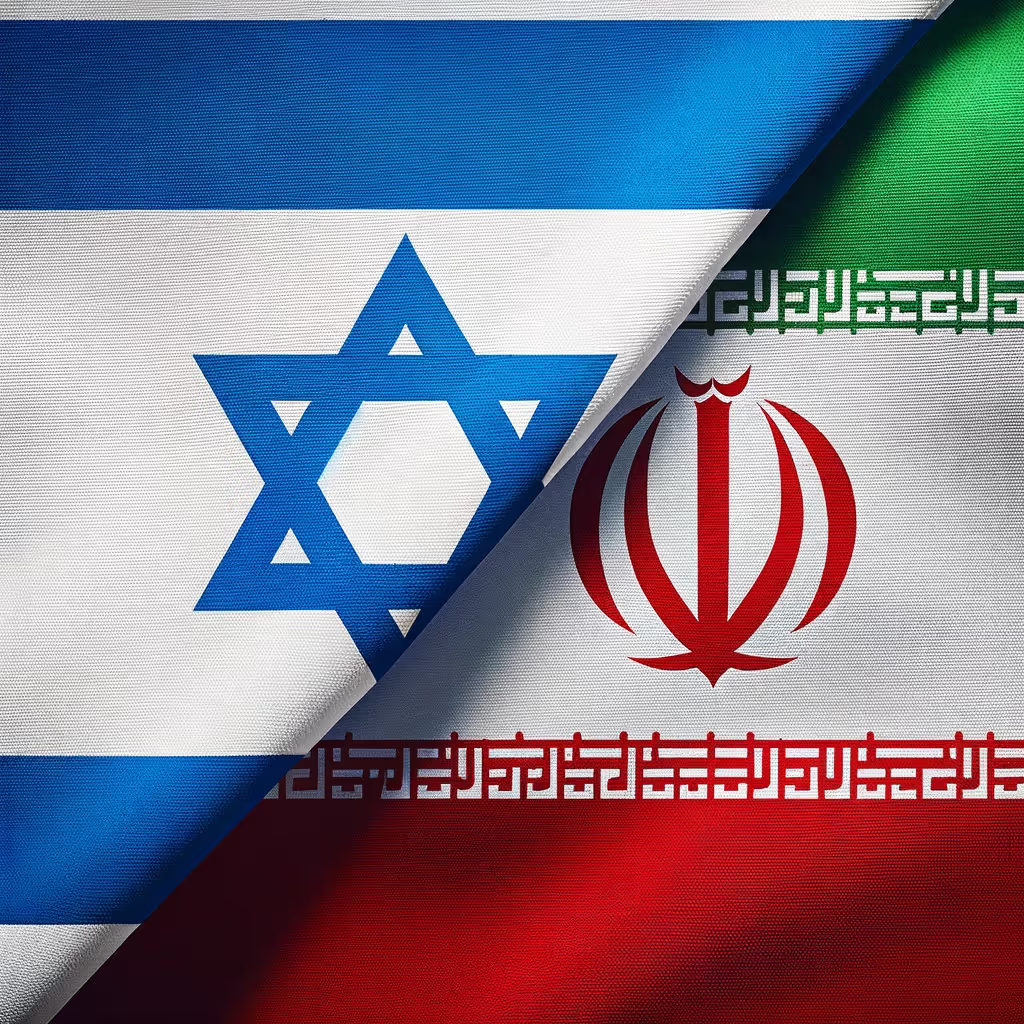
- Israel conducted a precision strike on an Iranian air defense system, signaling its capability and restraint to avoid broader conflict.
- The attack was a response to an unprecedented direct missile and drone attack by Iran on Israeli soil, marking a significant escalation in their long-standing tensions.
Overview:
This article was written by Alexander Palmer, Daniel Byman, Seth G. Jones, and Joseph S. Bermudez Jr., analyzing a recent military engagement between Israel and Iran.
- Israel conducted a precision strike on an Iranian air defense system, signaling its capability and restraint to avoid broader conflict.
- The attack was a response to an unprecedented direct missile and drone attack by Iran on Israeli soil, marking a significant escalation in their long-standing tensions.
Key Quotes:
- "Israel walked a tightrope between escalating the conflict further and inaction, while also signaling to Tehran that it could conduct precision strikes against strategic locations."
- "The strike minimized this fear by targeting only the shortest-range radar in Iran’s air defense complex, designed not to locate threats but to guide interceptor missiles to their target."
What They Discuss:
- The Israeli strike on April 19 targeted an S-300 air defense system part in Isfahan, which is strategically important due to its proximity to Iran’s Natanz nuclear enrichment facility.
- The strike was calibrated to deter further escalation by destroying only a single engagement radar, which was quickly replaced by Iran.
- Iran's initial attack on April 13 involved over 300 missiles and drones, the first direct assault from Iranian soil against Israel.
- The incident reflects ongoing tension and the potential for escalation, influenced by internal political pressures in both Israel and Iran.
- Both nations showed restraint to avoid a full-scale war, although future provocations could disrupt this delicate balance.
What They Recommend:
- Continued vigilance and preparedness for rapid escalation in response to geopolitical developments in the region.
- Engagement in diplomatic efforts to mitigate the risks of further military confrontations.
Key Takeaways:
- The incident underscores the fragile nature of regional stability and the potential for minor incidents to escalate into significant conflicts.
- Israel’s strategy of measured military responses aims to maintain a balance between deterrence and outright war.
- The political dynamics within both Israel and Iran play crucial roles in shaping their military engagements.
Disclaimer:
This is a brief overview of the work by Alexander Palmer, Daniel Byman, Seth G. Jones, and Joseph S. Bermudez Jr. from the Center for Strategic and International Studies (CSIS). For complete insights, we recommend reading the full article.
Assessing Israel’s Strike on Iran
- Israel conducted a precision strike on an Iranian air defense system, signaling its capability and restraint to avoid broader conflict.
- The attack was a response to an unprecedented direct missile and drone attack by Iran on Israeli soil, marking a significant escalation in their long-standing tensions.
War in Israel-Gaza

- Brookings Foreign Policy Fellow Valerie Wirtschafter examines the growing influence of Russian state-affiliated accounts on TikTok and compares it with their presence on other social media platforms like Telegram and X (formerly Twitter).
- Russian state-affiliated accounts are leveraging TikTok's reach to disseminate state-backed narratives.
- Despite lower overall activity compared to other platforms, the engagement per post on TikTok is significantly higher.
Overview:
This article examines the growing influence of Russian state-affiliated accounts on TikTok and compares it with their presence on other social media platforms like Telegram and X (formerly Twitter).
- Russian state-affiliated accounts are leveraging TikTok's reach to disseminate state-backed narratives.
- Despite lower overall activity compared to other platforms, the engagement per post on TikTok is significantly higher.
Key Quotes:
- "Russian state-affiliated accounts have accelerated their use of TikTok since the start of 2024."
- "Posts pertaining to U.S. politics make up a small percentage of overall content shared by Russian state-affiliated accounts, but they represent a slightly higher percentage of total posts on TikTok than on X or Telegram."
What They Discuss:
- In 2024, 46 Russian state-affiliated accounts have increased their posting frequency on TikTok, with some averaging over 10 posts a day.
- TikTok posts from these accounts garner about 100,000 engagements each, far outpacing the engagement seen on other platforms like Telegram and X.
- Content tied to U.S. politics comprises a higher percentage of posts on TikTok compared to other platforms, with notable engagement in Spanish-language posts.
- Russian state-affiliated accounts focus on divisive issues in U.S. politics, such as debates over President Biden’s policies and reflections on U.S.-Russia relations.
- Despite challenges, TikTok's labeling of these accounts as “state-controlled media” varies, affecting public perception and platform response.
What They Recommend:
- The author suggests ongoing vigilance and proactive measures to counteract the spread of Kremlin-backed narratives on social media platforms.
- Further research is recommended to understand the trajectory and impact of Russian state messaging on TikTok, particularly in the context of upcoming elections.
Key Takeaways:
- Russian state-affiliated accounts are exploiting TikTok's extensive reach to target young, diverse audiences, especially through high-engagement, divisive content.
- The effectiveness of Russian influence operations on TikTok highlights the importance of monitoring and addressing state-backed propaganda on social media.
- Despite the high engagement rates, the overall share of political content from these accounts on TikTok remains relatively small, yet notably impactful.
Tracing the rise of Russian state media on TikTok
- Brookings Foreign Policy Fellow Valerie Wirtschafter examines the growing influence of Russian state-affiliated accounts on TikTok and compares it with their presence on other social media platforms like Telegram and X (formerly Twitter).
- Russian state-affiliated accounts are leveraging TikTok's reach to disseminate state-backed narratives.
- Despite lower overall activity compared to other platforms, the engagement per post on TikTok is significantly higher.
Ukraine-Russia War

- Brookings expert William A. Galston reviews four recent polls of U.S. voters on the economy, comparing Biden and Trump on their economic records.
- Sixty-five percent of voters rate the economy as good during Trump’s presidency, compared to 38% under Biden.
Overview:
This commentary from Brookings expert William A. Galston reviews four recent polls from U.S. voters on the Biden and Trump economies. Voters remain pessimistic about the economy, despite recent improvements to the U.S. economy. Inflation and high prices are top concerns among voters' assessment of the U.S. economy.
Key Quotes:
- "President Biden continues to get low marks for his handling of inflation. Overall, only 35% of voters approve of his handling of this issue. Among Hispanics, just 34% approve; for young adults, 28%; among lower-income voters, 29%."
- "These recent polls are a snapshot, not a forecast. Much can change between now and Election Day, as it has in the past. In 2012, for example, President Obama faced negative economic ratings and low consumer confidence early on. But as the year went on, voters’ sentiments improved, and Obama went on to defeat Mitt Romney in the fall."
This is a brief overview of William Galston's insights on American voters and the 2024 U.S. election. For complete insights, we recommend reading the full article.
How voters feel about the economy: 4 takeaways from the latest polls
- Brookings expert William A. Galston reviews four recent polls of U.S. voters on the economy, comparing Biden and Trump on their economic records.
- Sixty-five percent of voters rate the economy as good during Trump’s presidency, compared to 38% under Biden.
2024 U.S. Elections

- President Biden's public statements on the drone attack that killed 3 U.S. soldiers in Jordan shows the U.S. is keen to avoid war with Iran while focusing on Hezbollah's activities.
- The drone attack represents a significant escalation, marking the first US military casualty by enemy air power since 1953 and prompting a strategic withdrawal of Hezbollah from aggressive engagements with US forces in Iraq and Syria.
Overview:
This commentary by Atlantic Council expert Kirsten Fontenrose examines the strategic dynamics between the United States, Kata'ib Hezbollah, and Iran, highlighting the recent developments that have led to a recalibration of KH's actions in the Middle East. It delves into the implications of a drone attack that killed three US soldiers in Jordan, the subsequent cessation of KH's attacks on US forces, and the broader context of US-Iran relations.
Key Points:
- President Joe Biden's public statements have clarified the US stance on avoiding war with Iran while expressing a determined posture towards KH's activities.
- The drone attack represents a significant escalation, marking the first US military casualty by enemy air power since 1953 and prompting a strategic withdrawal of KH from aggressive engagements with US forces in Iraq and Syria.
- Iran's perception of US retaliation capabilities and its continued support for proxy forces like KH challenge the restoration of deterrence by the United States.
Policy Options for the US Response:
- Conduct Strikes Inside Iran Against IRGC Bases and Weapons Stockpiles: Targeting the Islamic Revolutionary Guard Corps (IRGC) could impact Iran's proxy capabilities but might not halt the types of attacks that have targeted US forces.
- Strikes Against Facilities Producing Proprietary Components for Proxies: Attacking production sites could slow proxy attacks but would not eliminate the stockpiled munitions already available to groups like KH.
- Conduct Strikes Against IRGC and Proxy Capabilities in Neighboring States: While this approach has been utilized, it has not deterred Iran or its proxies from continuing their operations against US personnel and interests.
Strategic Considerations:
- The US must manage the potential reputational risks associated with retaliation, ensuring that any military action is perceived as non-escalatory and justified.
- Securing regional support, particularly from Jordan, is crucial for legitimizing US actions and maintaining stability in the Middle East.
- The US should clearly communicate its objectives and manage expectations regarding the effectiveness of military strikes in altering Iran's regional behavior.
Conclusion:
The US faces a complex challenge in responding to the recent escalation by KH and Iran. While military options are available, their effectiveness in achieving long-term strategic objectives may be limited. A multifaceted approach that includes diplomatic engagement, regional cooperation, and targeted military action, while managing the narrative around US responses, is essential for addressing the immediate threats and contributing to stability in the Middle East. The situation underscores the importance of a nuanced understanding of the regional dynamics and the need for a calibrated US strategy that addresses the root causes of proxy aggression without escalating tensions further.
The hard truth about Biden’s coming retaliation for the killing of US troops
- President Biden's public statements on the drone attack that killed 3 U.S. soldiers in Jordan shows the U.S. is keen to avoid war with Iran while focusing on Hezbollah's activities.
- The drone attack represents a significant escalation, marking the first US military casualty by enemy air power since 1953 and prompting a strategic withdrawal of Hezbollah from aggressive engagements with US forces in Iraq and Syria.
War in Israel-Gaza

- The Biden administration has taken a proactive approach to immigration with 535 immigration actions, surpassing the Trump administration in the number of executive actions.
- The administration's immigration actions have led to legal immigration returning to and surpassing pre-pandemic levels, with refugee admissions on pace to reach the highs of the 1990s.
Overview:
This research report by the Migration Policy Institute delves into the Biden administration's immigration policy over its first three years, highlighting the administration's proactive stance with 535 immigration actions, surpassing the efforts of the previous administration.
- The Biden administration has made significant strides in legal immigration, refugee admissions, and humanitarian protections, contributing to economic bolstering and reduced enforcement fears among noncitizens.
- Despite these efforts, the administration faces criticism for its handling of the border crisis, with record migrant encounters and political challenges, including impeachment proceedings against the Homeland Security secretary.
Key Quotes:
- "By taking 535 immigration actions over its first three years, the Biden administration has already outpaced the 472 immigration-related executive actions undertaken in all four years of President Donald Trump’s term."
- "The U.S. southern border has witnessed a record of at least 6.3 million migrant encounters at and between ports of entry since Biden took office in January 2021, resulting in more than 2.4 million migrants allowed into the country."
What They Discuss:
- The administration's immigration actions have led to legal immigration returning to and surpassing pre-pandemic levels, with refugee admissions on pace to reach the highs of the 1990s.
- A new border process aims to discourage irregular arrivals, while temporary humanitarian protections have been extended to hundreds of thousands.
- Enforcement priorities have shifted to focus on narrower categories of unauthorized immigrants, amidst a backdrop of a border crisis with record migrant encounters.
- Negotiations for a $110 billion package are underway, aiming for tightened border controls and asylum eligibility in exchange for aid to various countries.
- The administration has introduced carrot-and-stick measures at the border, faced challenges with Title 42 expulsions, and implemented new guidelines for interior enforcement affecting immigrants' daily lives.
What They Recommend:
The article does not explicitly list recommendations but suggests a need for comprehensive immigration reform, improved border management strategies, and continued efforts to provide humanitarian protections while addressing the challenges of irregular migration.
Key Takeaways:
- The Biden administration has taken a proactive approach to immigration, surpassing the previous administration in the number of executive actions.
- Despite successes in legal immigration and humanitarian protections, the administration faces significant challenges with the border crisis and political opposition.
- The administration's efforts to negotiate with Congress for improved border controls and asylum processes reflect a complex landscape of immigration policy and politics.
This is a brief overview of the Migration Policy Institute's work on the Biden administration's immigration record. For complete insights, we recommend reading the full article.
Biden at the Three-Year Mark: The Most Active Immigration Presidency Yet Is Mired in Border Crisis Narrative
- The Biden administration has taken a proactive approach to immigration with 535 immigration actions, surpassing the Trump administration in the number of executive actions.
- The administration's immigration actions have led to legal immigration returning to and surpassing pre-pandemic levels, with refugee admissions on pace to reach the highs of the 1990s.
Immigration

- Recent developments, particularly Russia's involvement in Ukraine and its reliance on Iran, have strained its relations with Israel, marking a departure from the previously improving ties under Putin's leadership.
- Russia's strategic positioning in the Middle East, balancing relationships with Israel, Iran, and Saudi Arabia, aiming to be a central player capable of engaging with all sides.
Overview:
This policy brief summarizes insights from Brookings expert Fiona Hill on Russia's approach to the Israeli-Palestinian conflict and its relationship with Hamas before October 7, as well as the implications of recent geopolitical shifts.
Key Quotes:
- "During the Soviet period and the Cold War, there was a great deal of hostility toward Israel, which was tied to deeply rooted domestic antisemitism as well as the Kremlin’s suspicion of Soviet Jews having divided loyalties."
- "By the time Vladimir Putin comes along in 2000, over 1 million Israelis have some kind of heritage from the former Soviet Union... Putin starts to see this population as an opportunity for Russia."
What They Discuss:
- Russia's historical hostility towards Israel during the Soviet era, transitioning to a more engaged approach with the creation of Israel and the subsequent migration of Soviet Jews.
- The shift in Russia's stance under Putin, leveraging the significant Russian-speaking population in Israel to foster closer ties, seeing it as a strategic opportunity for economic and political engagement.
- Putin's personal connections and favorable disposition towards Jews, influenced by his early life experiences, contributing to a nuanced relationship with Israel and its Jewish community.
- Russia's strategic positioning in the Middle East, balancing relationships with Israel, Iran, and Saudi Arabia, aiming to be a central player capable of engaging with all sides.
- The impact of Russia's military involvement in Syria on its relations with Israel, including the establishment of a deconfliction channel between the two countries.
- The deterioration of Russia-Israel relations following Russia's actions in Ukraine and its growing dependence on Iran, culminating in a significant shift in stance on October 7, with Putin making antisemitic remarks and distancing from Netanyahu.
What They Recommend:
- Acknowledging the complexity of Russia's evolving relationship with Israel and the broader Middle East, policymakers should monitor Russia's engagements and alignments, especially its closer ties with Iran and the implications for regional stability.
- Diplomatic efforts should consider Russia's historical and current motivations in the region, including its desire to assert itself as a major player and security guarantor, to effectively navigate and respond to its actions.
Key Takeaways:
- Russia's approach to the Israeli-Palestinian conflict and its relationship with Hamas have undergone significant changes, influenced by historical legacies, Putin's personal experiences, and strategic geopolitical calculations.
- Recent developments, particularly Russia's involvement in Ukraine and its reliance on Iran, have strained its relations with Israel, marking a departure from the previously improving ties under Putin's leadership.
- The evolving dynamics underscore the need for nuanced understanding and strategic responses to Russia's actions in the Middle East, considering its potential to impact regional security and diplomatic relations.
This is a brief overview of Fiona Hill's insights on Russia's stance towards the Israeli-Palestinian conflict and its broader geopolitical implications. For complete insights, we recommend reading the full article.
What is Russia’s role in the Israel-Gaza crisis?
- Recent developments, particularly Russia's involvement in Ukraine and its reliance on Iran, have strained its relations with Israel, marking a departure from the previously improving ties under Putin's leadership.
- Russia's strategic positioning in the Middle East, balancing relationships with Israel, Iran, and Saudi Arabia, aiming to be a central player capable of engaging with all sides.
Ukraine-Russia War

- The Biden administration's appeasement of authoritarian regimes in South America have not stopped the outflow of refugees and migrants trying to enter the U.S.
- Lifting previous oil & gas sanctions on the Maduro regime in exchange for free elections have not worked, with Venezuelans now the fastest-growing immigrant group in the U.S.
Overview:
Melissa Ford Maldonado, Policy Director, Secure and Sovereign Frontier at the Texas Public Policy Foundation wrote in her February 1, 2024 commentary piece that President Biden's appeasement of authoritarian regimes in South America is fueling the U.S. migrant crisis. She specifically points to the Biden administration's lifting of oil and gas sanctions on Venezuelan regime of Nicolás Maduro in exchange for holding free and fair elections. She argues that they have not held up their end of the bargain, and that over 7.3 million Venezuelans have fled the country and are now the fastest growing immigrant group in the U.S. seeking refuge.
Key Quotes:
- "Not only does President Biden refuse to acknowledge this trend, but he’s shown how quick he is to bow to authoritarian leaders on matters big and small to avoid getting on their bad side on an election year."
- "Collaborating with cruel and regimes not only empowers oppressive dictatorships but also jeopardizes stability, security, and prosperity in these nations, impacting U.S. border security. The consequence of entrenching criminal regimes is a surge in illegal immigration, increased drug, arms, and human trafficking, increased humanitarian abuses, and, tragically, unnecessary loss of life at the U.S.-Mexico border."
How President Biden is appeasing bad actors
- The Biden administration's appeasement of authoritarian regimes in South America have not stopped the outflow of refugees and migrants trying to enter the U.S.
- Lifting previous oil & gas sanctions on the Maduro regime in exchange for free elections have not worked, with Venezuelans now the fastest-growing immigrant group in the U.S.
Immigration

- The potential return of Donald Trump as President is influencing foreign governments' policy decisions, with some delaying actions in hope of better negotiations and others preparing for less favorable outcomes.
- The uncertainty surrounding US foreign policy under a potential Trump administration is causing both allies and adversaries to adjust their strategies far ahead of the US elections.
Overview:
This article was written by Frederick Kempe, President and CEO of the Atlantic Council, discussing the geopolitical implications of former US President Donald Trump's influence on international relations as he gains momentum in the political arena.
- Foreign governments are increasingly considering the 'Trump put'—delaying decisions in anticipation of potentially more favorable negotiations with the US if Trump returns to power, establishing a baseline for their negotiations.
- Conversely, some nations are seeking a 'Trump hedge' by preparing for the adverse effects his potential return could have on their strategic options, particularly concerning security and trade policies.
Key Quotes:
- “Some foreign governments are increasingly factoring into their relationship with the United States what may come to be known as the ‘Trump put’—delaying choices in the expectation they will be able to negotiate better deals with Washington a year from now.”
- “This year promises to be a year of danger as countries around the world watch US politics with a combination of disbelief, fascination, horror, and hope.”
What They Discuss:
- Russian President Vladimir Putin is speculated to be delaying significant decisions regarding the Ukraine war, betting on Trump's election promise to end the conflict swiftly, which could potentially favor Russia.
- European NATO members and Ukraine are exploring ways to bolster their defense capabilities in anticipation of Trump's questioning of NATO's purpose and mission, which could undermine alliance security guarantees.
- The article highlights global concerns over Trump's trade policies, including his promise to impose a ten percent tariff on all imports, affecting international trade dynamics.
- The uncertainty surrounding US foreign policy under a potential Trump administration is causing both allies and adversaries to adjust their strategies far ahead of the US elections.
- A national leader in Davos expressed concerns over the decreasing predictability of US foreign policy, which complicates other countries' policy-making processes.
What They Recommend:
The article implies the need for countries to adapt their strategies in anticipation of potential shifts in US foreign policy under Trump's influence, though specific recommendations are not provided.
Key Takeaways:
- The potential return of Donald Trump to the US presidency is influencing foreign governments' policy decisions, with some delaying actions in hope of better negotiations (the 'Trump put') and others preparing for less favorable outcomes (the 'Trump hedge').
- The geopolitical landscape is marked by increased uncertainty and strategic adjustments by both US allies and adversaries in response to Trump's political resurgence.
- The evolving dynamics underscore the importance of adaptability and strategic foresight in international relations amid the unpredictability of US foreign policy.
This is a brief overview of Frederick Kempe's work from the Atlantic Council. For complete insights, we recommend reading the full article.
How the prospect of a second Trump presidency is already shaping geopolitics
- The potential return of Donald Trump as President is influencing foreign governments' policy decisions, with some delaying actions in hope of better negotiations and others preparing for less favorable outcomes.
- The uncertainty surrounding US foreign policy under a potential Trump administration is causing both allies and adversaries to adjust their strategies far ahead of the US elections.