

.avif)


.avif)
.avif)
.avif)
.avif)
.avif)















.avif)





TOPIC
U.S.-China Relations
12
articles


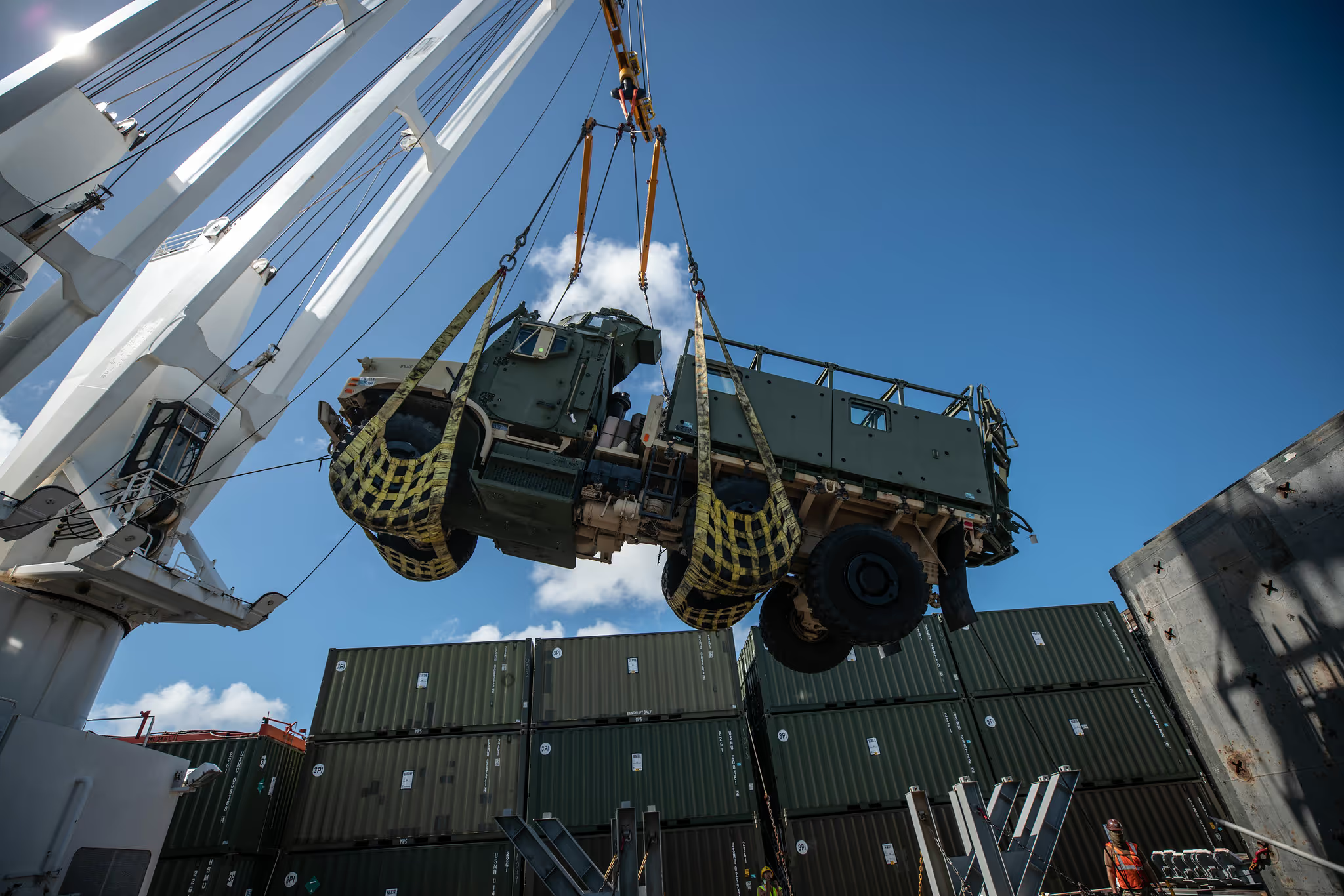
New export restrictions imposed by China on rare earth elements have significant implications for U.S. sourcing of these critical materials, particularly for defense technologies. The restrictions require licenses for exports, potentially disrupting supply chains and impacting U.S. firms, especially in the defense sector, per commentary from Center for Strategic and International Studies.
New export restrictions imposed by China on rare earth elements have significant implications for U.S. sourcing of these critical materials, particularly for defense technologies. The restrictions require licenses for exports, potentially disrupting supply chains and impacting U.S. firms, especially in the defense sector, per commentary from Center for Strategic and International Studies.
China has imposed new export restrictions on seven rare earth elements (REEs) essential for industries like defense and energy. This move could halt exports as a licensing system is established, leading to significant supply disruptions for U.S. firms, particularly in defense.
China accounts for 99 percent of global heavy REE processing, creating a near-monopoly that the U.S. struggles to counter. While the Department of Defense aims to develop a complete REE supply chain by 2027, current U.S. production capabilities remain underdeveloped, leaving it vulnerable. The need for international partnerships is critical to secure alternative sources and reduce reliance on China.
This is a brief overview of an article from Center for Strategic and International Studies. For complete insights, we recommend reading the full an article.

New export restrictions imposed by China on rare earth elements have significant implications for U.S. sourcing of these critical materials, particularly for defense technologies. The restrictions require licenses for exports, potentially disrupting supply chains and impacting U.S. firms, especially in the defense sector, per commentary from Center for Strategic and International Studies.

The U.S. must navigate the complexities of a potential Taiwan conflict concerning China while preventing nuclear escalation. The evolving nature of China's nuclear capabilities demands a more nuanced approach from the U.S. military, especially regarding its operational strategies, per commentary from RAND Corporation.
The U.S. must navigate the complexities of a potential Taiwan conflict concerning China while preventing nuclear escalation. The evolving nature of China's nuclear capabilities demands a more nuanced approach from the U.S. military, especially regarding its operational strategies, per commentary from RAND Corporation.
The issue:
The potential for a U.S.-China conflict over Taiwan poses significant escalatory risks, particularly due to China's secure second-strike nuclear capability. This situation complicates U.S. military strategy, as any conventional strike could provoke unpredictable Chinese nuclear responses.
What they recommend:
The report suggests that the Department of Defense (DoD) should prepare for Chinese nuclear signaling and effectively communicate strategic intentions with China. Additionally, the DoD must plan for the implications of emerging technologies on U.S.-China escalation dynamics and engage allies on their perspectives regarding Chinese thresholds for escalation.
Go deeper:
Understanding that numerous factors influence Chinese nuclear first-use decisions, such as political stability and technological advancements, is crucial. The report identifies six specific U.S. military actions that could significantly increase the likelihood of nuclear escalation from China. Preparing for these scenarios is essential for effective crisis management and deterrence.
This is a brief overview of a report from RAND Corporation. For complete insights, we recommend reading the full report.
The U.S. must navigate the complexities of a potential Taiwan conflict concerning China while preventing nuclear escalation. The evolving nature of China's nuclear capabilities demands a more nuanced approach from the U.S. military, especially regarding its operational strategies, per commentary from RAND Corporation.
The potential for a Chinese invasion of Taiwan poses a significant challenge to U.S. national security. A successful invasion would not only oppress the Taiwanese people but also expand China's influence across East Asia, threatening regional stability, per commentary from RAND Corporation.
The potential for a Chinese invasion of Taiwan poses a significant challenge to U.S. national security. A successful invasion would not only oppress the Taiwanese people but also expand China's influence across East Asia, threatening regional stability, per commentary from RAND Corporation.
The issue:
Taiwan faces the imminent threat of a Chinese invasion, which is complicated by outdated U.S. policies that prevent direct military support and hinder operational readiness. The U.S. struggles with logistical disadvantages, as Chinese forces are primarily based in East Asia, allowing for rapid action that U.S. forces may be unable to counter in time.
What they recommend:
Experts suggest that Taiwan should adopt a "porcupine" defense strategy, enhancing its asymmetrical capabilities to complicate a potential invasion. This includes fortifying beaches with obstacles and expanding the use of naval mines, which can create significant challenges for invading forces.
Go deeper:
Taiwan could create artificial reefs and deploy anti-vehicle obstacles to make invasion beaches less accessible, while also considering the strategic use of naval mines to disrupt Chinese naval operations. Additionally, a scorched-earth policy could be implemented to impede the restoration of key infrastructure that the PLA might capture. Collaboration with the U.S. in enhancing these defensive strategies is crucial, as they provide low-cost measures to boost Taiwan's defense capabilities.
This is a brief overview of a commentary from RAND Corporation. For complete insights, we recommend reading the full commentary.
The potential for a Chinese invasion of Taiwan poses a significant challenge to U.S. national security. A successful invasion would not only oppress the Taiwanese people but also expand China's influence across East Asia, threatening regional stability, per commentary from RAND Corporation.
The U.S.-China relationship currently faces significant rivalry that impacts collaboration, yet history shows that even rivals can work together on shared challenges. Understanding and advancing methods for cooperation among nonstate actors will be critical for addressing major global issues, per commentary from Center for Strategic and International Studies.
The U.S.-China relationship currently faces significant rivalry that impacts collaboration, yet history shows that even rivals can work together on shared challenges. Understanding and advancing methods for cooperation among nonstate actors will be critical for addressing major global issues, per commentary from Center for Strategic and International Studies.
The issue:
Intensifying tensions between the United States and China threaten collaboration on essential global challenges. Current data shows public perception of China is increasingly negative, with 81% of Americans expressing an unfavorable view, the highest since 1989.
What they recommend:
No recommendations provided in the commentary.
Go deeper:
Insights from historical case studies reveal that coordinated efforts between rivals have succeeded when driven by mutual self-interest rather than goodwill. For example, U.S. and Soviet cooperation in smallpox eradication during the Cold War highlighted the political benefits of shared health goals. Such frameworks can inform contemporary U.S.-China engagement on issues like climate-smart agriculture.
This is a brief overview of an issue brief from Center for Strategic and International Studies. For complete insights, we recommend reading the full an issue brief.
The U.S.-China relationship currently faces significant rivalry that impacts collaboration, yet history shows that even rivals can work together on shared challenges. Understanding and advancing methods for cooperation among nonstate actors will be critical for addressing major global issues, per commentary from Center for Strategic and International Studies.
Overview:
This article was written by Bryan Burack at the Heritage Foundation.
Key Quotes:
What They Discuss:
What They Recommend:
Key Takeaways:
This is a brief overview of the article by Bryan Burack at Heritage Foundation. For complete insights, we recommend reading the full article.

Overview:
This article was written by Michael Pettis at Carnegie Endowment for International Peace.
Key Quotes:
What They Discuss:
What They Recommend:
Key Takeaways:
This is a brief overview of the article by Michael Pettis at Carnegie Endowment for International Peace. For complete insights, we recommend reading the full article.