Thinktanker Summary
- Goldman Sachs Global Institute estimates AI could contribute 1.5% to annual productivity growth over a ten-year period, lifting global GDP by nearly $7 trillion.
- U.S. and China are top AI competitors, but geopolitical swing states like India, Japan, Israel, UAE, and South Korea can form "innovation blocs" and cooperate with each other.
Overview:
- This article was written by Jared Cohen, George Lee, Lucas Greenbaum, Frank Long, and Wilson Shirley, published by Goldman Sachs Global Institute.
- It explores the transformative impact of generative AI on global markets, geopolitics, and the balance of power among nations.
- The authors discuss the urgent need for strategic planning during the "inter-AI years" to shape the future of AI-enabled technology.
Key Quotes:
- "The emergence of generative AI marks a transformational moment that will influence the course of markets and alter the balance of power among nations."
- "Decisions made today will determine what is possible in the future. A generative world order will emerge.
What They Discuss:
- The article highlights the potential of generative AI to contribute 1.5% to annual productivity growth over ten years, lifting global GDP by nearly $7 trillion.
- It emphasizes the role of AI in economic growth, technological revolution, and geopolitical dynamics.
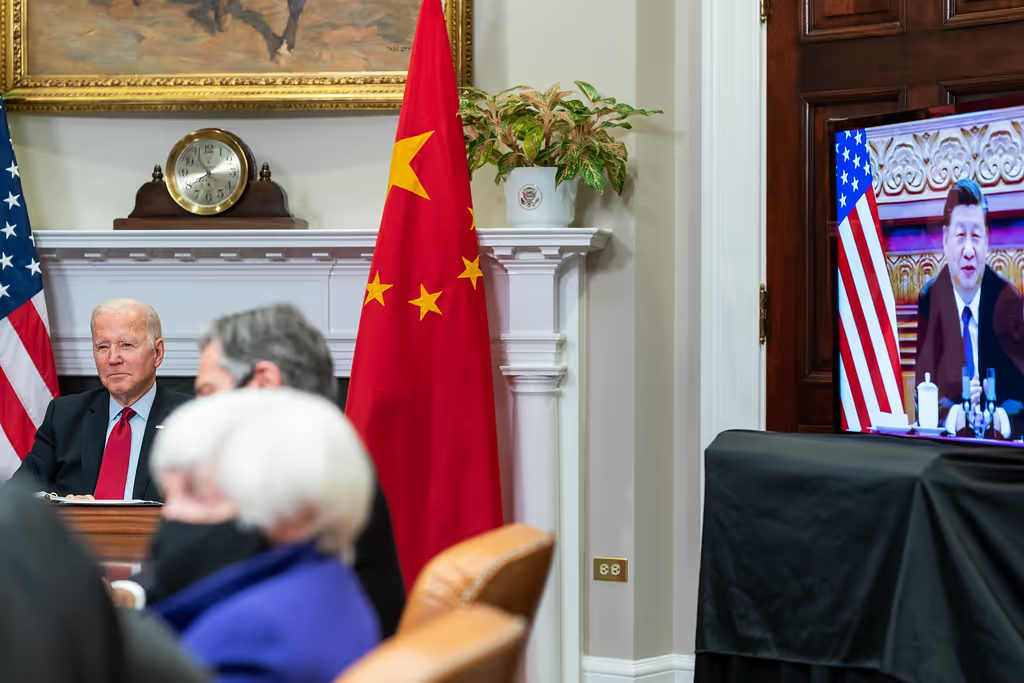
- The authors examine the US and China's position as AI superpowers and their complex relationship as competitors and collaborators in AI research.
- The significant role of large language models (LLMs) in AI innovation and competition is analyzed, along with the concerns and strategies of open and closed societies regarding AI.
- The impact of US-led export controls on semiconductors on China's technological development is discussed, highlighting the geopolitical implications.
What They Recommend:
- The authors recommend a strategic approach to AI development, balancing the need for innovation with the management of risks and geopolitical considerations.
- They suggest fostering international cooperation and partnerships in AI research and development to address global challenges and opportunities.
Key Takeaways:
- Generative AI is reshaping global economic and geopolitical landscapes, with significant implications for national strategies and international relations.
- The US and China are key players in the AI domain, with their actions influencing the global AI landscape.
- Strategic planning and international collaboration are essential for harnessing the potential of AI while managing its risks and challenges.
This is a brief overview of Lucas Greenbaum, Frank Long, and Wilson Shirley's work from Goldman Sachs. For complete insights, we recommend reading the full article.
THINK TANK PROFILE
Washington DC
Founded 1916
An influential Washington-based think tank focusing on global security, defense, and economic policy.
Liberal
Leans Right