

.avif)


.avif)
.avif)
.avif)
.avif)
.avif)















.avif)





Search Insights

- Carnegie Endowment expert Nikita Smagin writes that the Gaza conflict has reinforced Russia's belief in the correctness of its foreign policy approach, particularly in relation to the Western-centric international system.
- Russia views the conflict as an opportunity to further its geopolitical interests, especially amidst the ongoing war in Ukraine.
Overview:
This article was written by Nikita Smagin, offering a comprehensive analysis of Russia's foreign policy in light of the Gaza War.
- The Gaza conflict has reinforced Russia's belief in the correctness of its foreign policy approach, particularly in relation to the Western-centric international system.
- Russia views the conflict as an opportunity to further its geopolitical interests, especially amidst the ongoing war in Ukraine.
Key Quotes:
- "The conflict in the Middle East is the perfect crisis for Russia, which is reaping a whole host of political benefits."
- "Moscow’s bet on the disintegration of a Western-oriented international order appears to be paying off."
What They Discuss:
- The article discusses how the Gaza War has led to a resurgence of internal Western disagreements, particularly in Europe's stance towards Israel.
- It highlights societal divisions and discontent among U.S. officials regarding America's pro-Israel stance.
- The piece notes the impact of the Gaza conflict on shifting international focus away from the Ukraine war.
- Smagin addresses the perceived hypocrisy in the West's approach to conflicts in Ukraine and Gaza, affecting its credibility in the Global South.
- The article examines Russia's cautious stance in the Middle East, balancing its interests with Iran and its position on Israel.
What They Recommend:
- The author suggests that Russia will likely remain a passive actor in the Israel-Hamas conflict, avoiding direct involvement.
- Russia will likely maintain a balance in its Middle East policy, considering public opinion and its international relationships.
Key Takeaways:
- The Gaza War has solidified Russia's belief in its foreign policy direction, emphasizing state interests over moral or ideological considerations.
- Russia's approach to the conflict illustrates its strategic use of international crises to advance its geopolitical agenda.
- The conflict has exposed and possibly widened rifts within Western alliances, offering Russia potential strategic advantages.
This is a brief overview of Nikita Smagin's work from the Carnegie Endowment for International Peace. For complete insights, we recommend reading the full article.

The Gaza War Has Convinced Russia It Was Right All Along
- Carnegie Endowment expert Nikita Smagin writes that the Gaza conflict has reinforced Russia's belief in the correctness of its foreign policy approach, particularly in relation to the Western-centric international system.
- Russia views the conflict as an opportunity to further its geopolitical interests, especially amidst the ongoing war in Ukraine.
Ukraine-Russia War

Cato Institute expert Robert A. Levy writes that U.S. SupremeCourt Chief Justice Roberts will be "concerned about political repercussions" if Trump is disqualified from running.
Levy also argues that liberal justices will likely lean toward allowing voting citizens to decide if Trump should be President.
Overview:
- This article was written by Robert A. Levy, discussing the complex issue of Donald Trump's potential disqualification from running for president in 2024.
- The author critically examines the legal and constitutional implications surrounding the disqualification debate, focusing on the interpretation of the Fourteenth Amendment and its application.
Key Quotes:
- "No person shall … hold any office … who, having previously [served] … as an officer of the United States, shall have engaged in insurrection."
- "The US Constitution is not a legal code; it’s a set of broad principles that implement a framework for governance."
What They Discuss:
- Levy analyzes Colorado's attempt to disqualify Trump from the 2024 ballot and the subsequent legal challenges leading to the U.S. Supreme Court's involvement.
- The article addresses critical legal questions, including who has standing to file suit and whether states can define "engaging in insurrection."
- It scrutinizes whether the term "Officer of the United States" in the Fourteenth Amendment applies to elected officials like Trump.
- The distinction between disqualification from holding office and running for office is explored, with reference to various state court rulings.
- The article considers the constitutional framework for governance and the potential political repercussions of disqualifying Trump without a criminal conviction.
What They Recommend:
- Levy suggests a careful interpretation of the Fourteenth Amendment, emphasizing its historical context and legal precedents.
- The author recommends that the Supreme Court provide clarity on the application of Section 3 of the Fourteenth Amendment.
Key Takeaways:
- The debate over Trump's disqualification centers on constitutional interpretation, especially the Fourteenth Amendment.
- The U.S. Supreme Court's decision will have significant implications for electoral law and the definition of insurrection in a political context.
- The issue raises broader questions about the balance between legal standards and political decision-making in the American democratic process.
This is a brief overview of Robert A. Levy's work from the Cato Institute. For complete insights, we recommend reading the full article.

Trump’s Disqualification: A Primer
Cato Institute expert Robert A. Levy writes that U.S. SupremeCourt Chief Justice Roberts will be "concerned about political repercussions" if Trump is disqualified from running.
Levy also argues that liberal justices will likely lean toward allowing voting citizens to decide if Trump should be President.
2024 U.S. Elections
.avif)
- Both Republicans and Democrats agree on tax cuts, though they propose different types and have varied economic implications.
- Democrats passed a nearly trillion-dollar corporate tax cut through the Inflation Reduction Act and support large increases in child and earned income tax credits.
Overview:
- This article was written by Adam N. Michel, published on the Cato at Liberty Blog at the Cato Institute.
- It discusses the bipartisan nature of tax cut support in American politics, highlighting the complexity of fiscal policy beyond partisan lines.
- The piece also addresses the impending fiscal deadlines and the need for realistic budget planning.
Key Quotes:
- "Both Republicans and Democrats want to keep taxes from rising on the vast majority of Americans, and most legislators also want to protect higher-income Americans from punishingly higher taxes."
- "Policymakers’ instincts are correct; it is best to keep taxes low on Americans at every income level. However, keeping taxes low will require spending cuts."
What They Discuss:
- The continuation of the 2017 tax cuts, supported by President Biden, which would cost between $1.7 trillion and $2.5 trillion.
- The bipartisan agreement on tax cuts, with both parties proposing different types of cuts, yet generally aiming to reduce federal revenues.
- Democrat-supported tax cut initiatives, like the child tax credit and earned income tax credit, estimated to cost around $1.7 trillion over ten years.
- The fiscal challenges of extending the 2017 tax cuts without specific new taxes or spending cuts to offset the cost.
- The projected rise in budget deficits to approximately $2.8 trillion a year by 2033, even with automatic tax increases post-2025.
What They Recommend:
- The author suggests that maintaining low taxes for Americans at all income levels will necessitate significant spending cuts.
- A call for realistic offsets and financial planning in order to reconcile the desire for tax cuts with the current spending levels and budget deficits.
Key Takeaways:
- There is a general bipartisan consensus on the desirability of tax cuts, though differences exist in the types of cuts each party supports.
- The extension of the 2017 tax cuts is a significant fiscal challenge, requiring careful balancing of tax policies and spending reforms.
- The need for a realistic approach to fiscal policy that addresses the growing budget deficit while accommodating the bipartisan desire for tax cuts.
This is a brief overview of Adam N. Michel's article from the Cato Institute. For complete insights, we recommend reading the full article.
It’s Not Just Republicans, Democrats Want Trillion‐Dollar Tax Cuts Too
- Both Republicans and Democrats agree on tax cuts, though they propose different types and have varied economic implications.
- Democrats passed a nearly trillion-dollar corporate tax cut through the Inflation Reduction Act and support large increases in child and earned income tax credits.
U.S. Economy
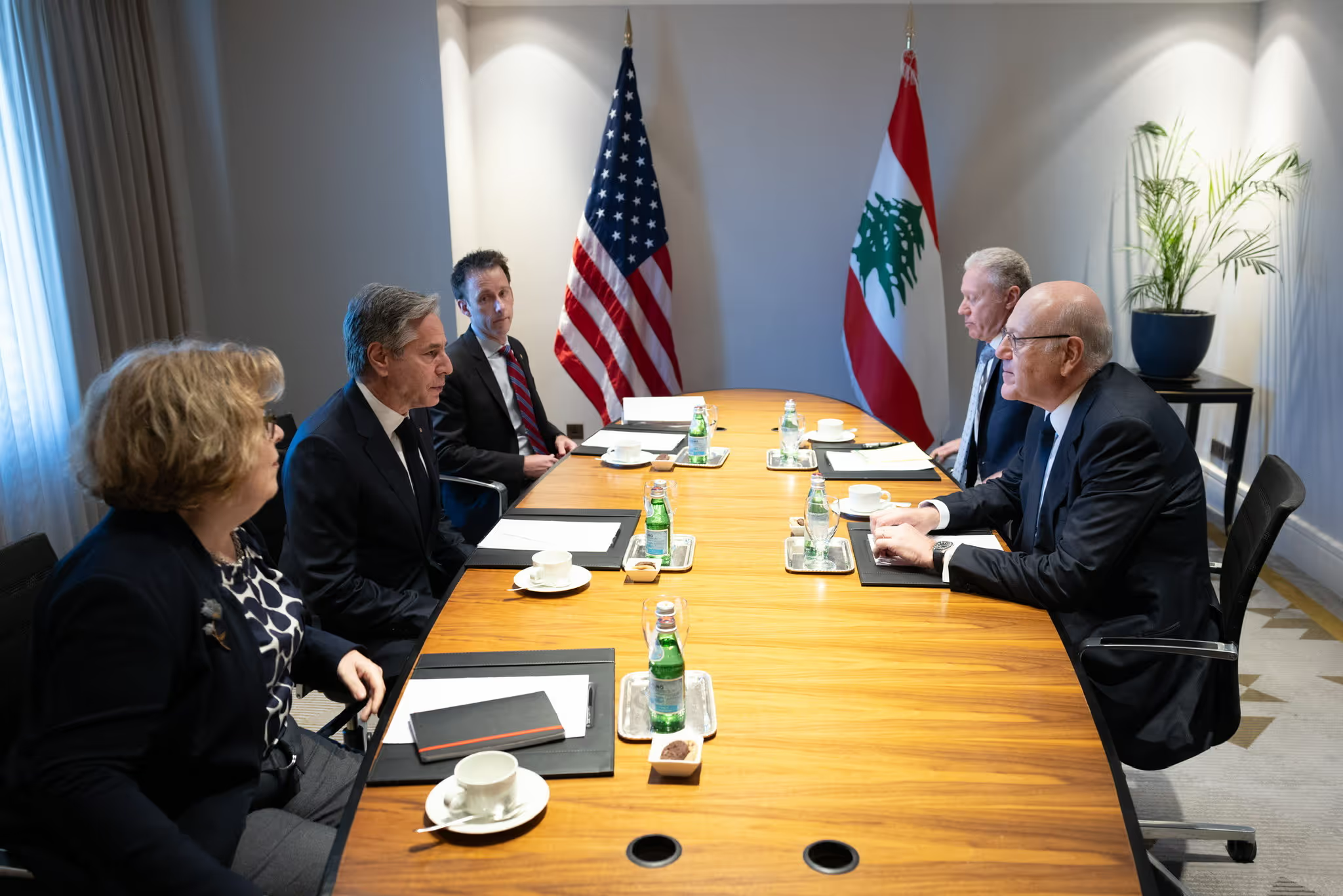
- Hezbollah is a politically-powerful force within Lebanon, and now serves as Iran's equal partner and "most successful and lethal export".
- While Hezbollah and Hamas are on opposite sides of the Shia-Sunni divide, both groups find common ground under Iranian support and being anti-Israeli, anti-American, and anti-Western.
Overview:
This article was written by expert Jeffrey Feltman and research assistant Kevin Huggard, published by the Brookings Institution.
- It provides an in-depth analysis of Hezbollah's multifaceted role in Lebanon and its complex relationships with Iran, Hamas, and the broader geopolitical landscape.
- The piece also examines the potential risks and consequences of escalating tensions between Hezbollah and Israel.
Key Quotes:
- "Hezbollah is the most powerful political force inside Lebanon, operating under an arrogant double standard: rejecting public oversight while insisting on the right to veto any government decision it opposes."
- "Hezbollah’s massive arsenal has little to do with Lebanon and serves primarily as Iran’s deterrence against Israel."
What They Discuss:
- The authors describe Hezbollah as a dominant force in Lebanese politics, heavily influenced by Iran and deeply involved in regional conflicts.
- Hezbollah's extensive arsenal and military capabilities are highlighted as major factors in regional power dynamics.
- The complex relationship between Hezbollah and Hamas is explored, emphasizing their united stance against Israel under Iran's influence.
- Past conflicts between Israel and Hezbollah are analyzed to understand current and potential future military engagements.
- The role of the Biden administration and international dynamics in managing the conflict and preventing escalation is discussed.
What They Recommend:
- The authors suggest cautious diplomatic and strategic approaches to manage the delicate balance of power and prevent a full-scale war.
- They emphasize the need for international engagement to address the underlying causes of the conflict and support stability in the region.
Key Takeaways:
- Hezbollah is a significant player in Lebanon’s political landscape, heavily backed by Iran and involved in regional conflicts.
- The potential for escalation in the Israel-Hezbollah conflict is high, with severe implications for regional stability.
- International efforts, including those of the U.S., are critical in managing the situation and preventing a larger conflict.
This is a brief overview of Jeffrey Feltman and Kevin Huggard's work from the Brookings Institution. For complete insights, we recommend reading the full article.
On Hezbollah, Lebanon, and the risk of escalation
- Hezbollah is a politically-powerful force within Lebanon, and now serves as Iran's equal partner and "most successful and lethal export".
- While Hezbollah and Hamas are on opposite sides of the Shia-Sunni divide, both groups find common ground under Iranian support and being anti-Israeli, anti-American, and anti-Western.
War in Israel-Gaza

- National strategy plan proposes "biotech moonshots", global biotech standards, and securing biotech platforms against rival nations, especially China.
- The plan stresses treating genomic data as a strategic resource and highlights the potential of biotechnology to revolutionize sectors like health and agriculture.
Overview:
Authors: Special Competitive Studies Project (SCSP)
Publishing Date: April 23, 2023
Publishing Organization: Special Competitive Studies Project|
Executive Summary:
The Special Competitive Studies Project (SCSP) has released a comprehensive National Action Plan to establish U.S. leadership in biotechnology. This plan outlines strategic initiatives to harness biotechnology's transformative potential for national security, economy, society, and healthcare.
Background:
Biotechnology, a multi-trillion dollar sector, is pivotal in transforming industries like agriculture, health, industrials, materials, and energy. The U.S. currently leads in genetic engineering and molecular biology, but faces competition from countries like China. This plan is part of a broader effort by SCSP to enhance America's competitiveness in emerging technologies.
Issue Description:
The U.S. is at a critical juncture in securing its biotech future. Key challenges include maintaining global leadership, competing with nations like China, integrating biotech across various sectors, and managing the transition from lab breakthroughs to commercialization.
Policy Options:
- Investing in Biotech Moonshots: Focusing on projects like the Annotated Non-Human Genome Project and National Medshield.
- Strengthening Biotech Infrastructure: Enhancing domestic biomanufacturing capabilities and aligning the biotech standards ecosystem.
- Empowering Innovation Ecosystem: Establishing University Centers of Excellence and expanding biomanufacturing institutes.
- Building Global Bionet: Creating an early warning system for bio-related incidents.
- Developing Talent: Growing a skilled biotech workforce and attracting global talent.
Policy Recommendations:
- R&D Investment: Significant investment in biotech research and development.
- Public-Private Collaboration: Strengthening partnerships between government, academia, and industry.
- Regulatory Framework: Updating regulations to foster innovation and competitiveness.
- Global Leadership: Leading global efforts in setting biotech standards and ethics.
- Security Protocols: Implementing stringent security measures to safeguard biotech advancements.
Conclusion:
The National Action Plan for U.S. Leadership in Biotechnology is a strategic blueprint for securing America's biotech future. It emphasizes the need for substantial investment, innovative policy-making, and global collaboration. Success in these endeavors will ensure U.S. leadership in biotechnology, benefiting national security, economic growth, and global health.
This policy brief is a high-level summary and does not encompass all the details of the comprehensive plan. For a full understanding, it is recommended to review the entire National Action Plan document.
National Action Plan for U.S. Leadership in Biotechnology
- National strategy plan proposes "biotech moonshots", global biotech standards, and securing biotech platforms against rival nations, especially China.
- The plan stresses treating genomic data as a strategic resource and highlights the potential of biotechnology to revolutionize sectors like health and agriculture.
Emerging Technology

- Goldman Sachs Global Institute estimates AI could contribute 1.5% to annual productivity growth over a ten-year period, lifting global GDP by nearly $7 trillion.
- U.S. and China are top AI competitors, but geopolitical swing states like India, Japan, Israel, UAE, and South Korea can form "innovation blocs" and cooperate with each other.
Overview:
- This article was written by Jared Cohen, George Lee, Lucas Greenbaum, Frank Long, and Wilson Shirley, published by Goldman Sachs Global Institute.
- It explores the transformative impact of generative AI on global markets, geopolitics, and the balance of power among nations.
- The authors discuss the urgent need for strategic planning during the "inter-AI years" to shape the future of AI-enabled technology.
Key Quotes:
- "The emergence of generative AI marks a transformational moment that will influence the course of markets and alter the balance of power among nations."
- "Decisions made today will determine what is possible in the future. A generative world order will emerge.
What They Discuss:
- The article highlights the potential of generative AI to contribute 1.5% to annual productivity growth over ten years, lifting global GDP by nearly $7 trillion.
- It emphasizes the role of AI in economic growth, technological revolution, and geopolitical dynamics.
- The authors examine the US and China's position as AI superpowers and their complex relationship as competitors and collaborators in AI research.
- The significant role of large language models (LLMs) in AI innovation and competition is analyzed, along with the concerns and strategies of open and closed societies regarding AI.
- The impact of US-led export controls on semiconductors on China's technological development is discussed, highlighting the geopolitical implications.
What They Recommend:
- The authors recommend a strategic approach to AI development, balancing the need for innovation with the management of risks and geopolitical considerations.
- They suggest fostering international cooperation and partnerships in AI research and development to address global challenges and opportunities.
Key Takeaways:
- Generative AI is reshaping global economic and geopolitical landscapes, with significant implications for national strategies and international relations.
- The US and China are key players in the AI domain, with their actions influencing the global AI landscape.
- Strategic planning and international collaboration are essential for harnessing the potential of AI while managing its risks and challenges.
This is a brief overview of Lucas Greenbaum, Frank Long, and Wilson Shirley's work from Goldman Sachs. For complete insights, we recommend reading the full article.
The generative world order: AI, geopolitics, and power
- Goldman Sachs Global Institute estimates AI could contribute 1.5% to annual productivity growth over a ten-year period, lifting global GDP by nearly $7 trillion.
- U.S. and China are top AI competitors, but geopolitical swing states like India, Japan, Israel, UAE, and South Korea can form "innovation blocs" and cooperate with each other.
Artificial Intelligence

- This report highlights the intersection of growing U.S.-China geopolitical rivalry and the rapid development of military AI and how the U.S. can manage strategic risks.
- It discusses China's integration of AI into its military and civilian sectors, proposes ways for the U.S. to limit China's military AI progress.
Overview:
- This article was written by Jacob Stokes and Alexander Sullivan, with assistance from Noah Greene, from the Center for a New American Security (CNAS).
- It focuses on the escalating geopolitical rivalry between the United States and China, particularly in the context of military artificial intelligence (AI).
- The paper explores the potential strategic risks and management strategies in the sphere of military AI amid increasing tensions.
Key Quotes:
- "Many of the most practical uses for military AI in the near term will be for purposes that are relatively mundane but could help the PLA use resources more efficiently."
- "The net effect, however, of multiple states compressing their decision-making timelines due to AI-augmented processes could be a global security environment that is faster-paced and more prone to miscalculation."
What They Discuss:
- The rapid development of AI technologies for military applications and its potential impact on the U.S.-China geopolitical rivalry.
- China’s strategic investment in AI as a crucial element for its future military modernization and global technological leadership.
- The potential for military AI to inadvertently increase strategic risks and undermine stability in U.S.-China relations.
- Specific pathways through which military AI applications might affect the security dynamics between the U.S. and China, including in decision-making and information domains.
- The challenges and obstacles China might face in integrating AI into the People’s Liberation Army, and the potential for strategic surprises for the U.S.
What They Recommend:
- Developing and implementing best practices and norms for responsible military AI use.
- Engaging with allies and negotiating risk reduction measures with China related to military AI.
- Making military AI a fundamental aspect of diplomatic discussions with China, especially in the context of nuclear weapons and strategic stability.
- Prioritizing intelligence gathering and analysis on China’s military AI capabilities for better assessment and policy-making.
Key Takeaways:
- Military AI development is a critical factor in the intensifying strategic competition between the U.S. and China.
- Proper management and international cooperation are essential to mitigate the strategic risks posed by military AI.
- Balancing innovation in military AI with responsible usage and risk reduction strategies is crucial for global security and stability.
This is a brief overview of Jacob Stokes and Alexander Sullivan's work from the Center for a New American Security (CNAS). For complete insights, we recommend reading the full article.
U.S.-China Competition and Military AI: How Washington Can Manage Strategic Risks amid Rivalry with Beijing
- This report highlights the intersection of growing U.S.-China geopolitical rivalry and the rapid development of military AI and how the U.S. can manage strategic risks.
- It discusses China's integration of AI into its military and civilian sectors, proposes ways for the U.S. to limit China's military AI progress.
U.S.-China Relations
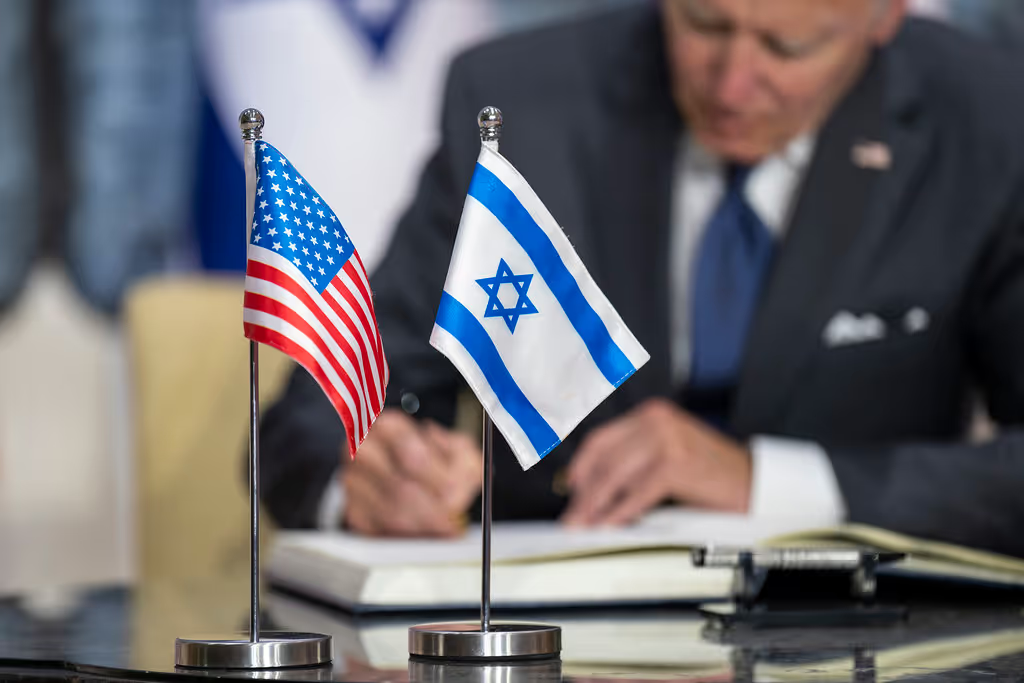
- The U.S. and Europe's pro-Israel stance in the war in Gaza, coupled with their response to Ukraine, is leading to global criticism and a potential shift in international relations, isolating them from non-Western countries.
- This situation offers autocratic nations like China, Iran, and Russia an opportunity to increase their influence, exploiting perceptions of Western moral inconsistency and opportunism.
Policy Brief Summary
Overview:
- This article was written by Kristina Kausch, published by the German Marshall Fund of the United States.
- It delves into the shifting global perceptions regarding the moral stance of Western countries in international conflicts, particularly focusing on the Israel-Hamas war and the Russian invasion of Ukraine.
- The piece highlights the growing global outrage against perceived Western double standards and the potential long-term impact on international relations.
Key Quotes:
- "The United States’ and Europe’s perceived moral waywardness on Ukraine and Gaza is provoking global outrage and risking lasting damage to their relations with non-Western allies."
- "The West’s relative isolation on the Gaza question heralds a potentially significant loss of global soft power from which China, Iran, and Russia can gain."
What They Discuss:
- The author examines the response of the international community to the West's handling of the Israel-Hamas conflict and the Russian invasion of Ukraine.
- Over 13,000 civilian casualties in the Gaza Strip following Israel's response to Hamas' attacks are highlighted.
- The article discusses the UN General Assembly's vote favoring a truce and adherence to international humanitarian law, with Western opposition or abstention.
- It explores the broader implications of these events on transatlantic relations and global perceptions of Western moral principles.
- The piece reflects on the strategic moves of autocracies like China, Iran, and Russia in exploiting these situations to gain soft power.
What They Recommend:
- Kausch recommends that Western powers develop a more insightful understanding and nuanced policies towards today's dynamic and complex global alliances.
- Emphasis is placed on the need for the West to address its perceived double standards to maintain global influence and credibility.
Key Takeaways:
- Western countries face growing criticism for their perceived moral inconsistencies in international affairs.
- This criticism risks causing long-lasting damage to their relationships with non-Western allies and diminishing their global soft power.
- The situation presents an opportunity for autocratic nations to increase their influence in the developing world.
This is a brief overview of Kristina Kausch's work from the German Marshall Fund of the United States. For complete insights, we recommend reading the full article.
Whose Ground Zero? Competing Perspectives of the Israel-Hamas War
- The U.S. and Europe's pro-Israel stance in the war in Gaza, coupled with their response to Ukraine, is leading to global criticism and a potential shift in international relations, isolating them from non-Western countries.
- This situation offers autocratic nations like China, Iran, and Russia an opportunity to increase their influence, exploiting perceptions of Western moral inconsistency and opportunism.